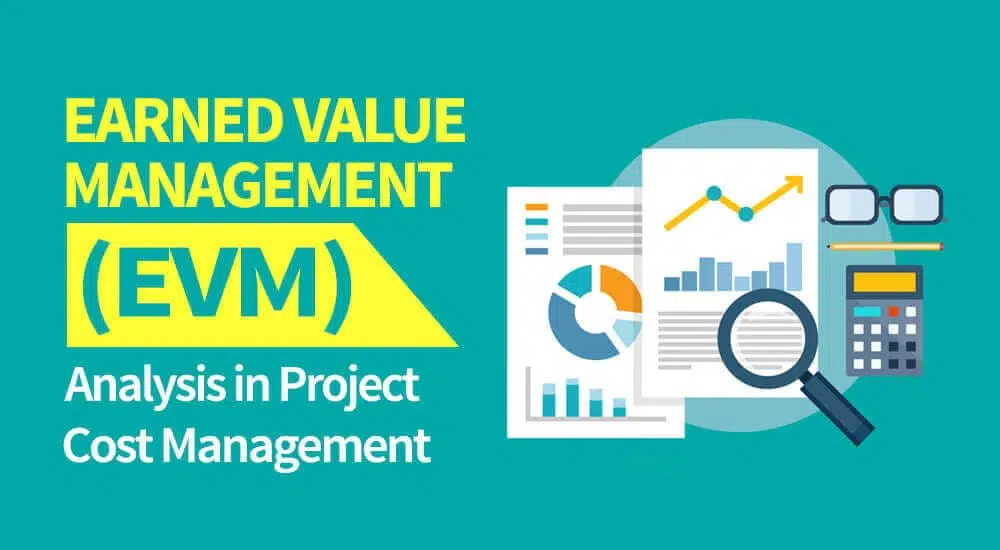
Earned Value Management (EVM) is a key concept in project management.
Cost overrun and schedule delays are common among projects, and these deviations affect the project objectives. If you are managing projects, you must be aware of how the situation can be stressful. If these deviations are not controlled, the project could be terminated.
You need a control mechanism to help you avoid this situation, and one such mechanism is Earned Value Management (EVM).
What is Earned Value Management (EVM) in Project Management?
Earned Value Management was developed in the 1960s when the US Air Force started using it in their programs. Since 2005, it has become a standard part of federal project risk management. Now, EVM is a requirement for US government contracts.
Definition: According to the PMBOK Guide, EVM integrates the scope baseline with the cost and schedule baselines to form the performance measurement baseline.
Put simply, EVM is a performance measurement technique that integrates cost, schedule, and scope to provide project status, progress, and forecasting reports.
EVM uses Earned Value Analysis (EVA), a mathematical technique to determine project status, compute progress, and forecast results.
Fundamentals of Earned Value Management Analysis (EVMs)
Earned Value Management Analysis (EVMs) helps you find project status and measure project progress. To understand the fundamentals of Earned Value Analysis, please refer to the 32 guidelines defined under the EIA-748 standard.
These guidelines are broadly categorized under five principles, which are outlined below.
#1. Organization and Project Scope
The first section has five guidelines emphasizing work organization. You must define the Work Breakdown Structure to a level where you can connect it with the product deliverable; this will be the “what” part.
At the same time, you must have an Organization Breakdown Structure (OBS) that will define “who” will take care of the WBS element. This intersection point of WBS and OBS defines a control account.
#2. Planning, Scheduling, and Budgeting
The next section has ten guidelines for planning, scheduling, and budgeting.
You should develop a resource-loaded schedule so you can determine your budget. This time phase and resource-loaded schedule is known as schedule baseline and is part of performance measurement baselines.
#3. Accounting Considerations
This section has six guidelines for capturing costs incurred (actual costs). You should record your actual cost in accordance with the planned work.
You should record the actual cost along with the earned value. Doing so at different times will affect the accuracy of readings.
#4. Analysis & Management Report
This section has six guidelines defining how to carry out analysis and reporting.
This is where you collect all project data and find variance and performance. If required, calculate a new budget (EAC) and do the forecasting. All Earned Value Management calculations are performed on a control account level.
#5. Revision and Data Maintenance
This is the last section and has five baseline control guidelines.
This guideline details managing change requests and updating the performance measurement baseline.
Elements of Earned Value Management
EVM has three essential elements:
- Planned Value (PV)
- Earned Value (EV)
- Actual Cost (AC)
You can call them primary data points as well.
Planned Value: Planned Value is the scheduled cost of work planned in a given time. It is also called the Budgeted Cost of Work Scheduled (BCWS). The total Planned Value of the project is the Budget at Completion (BAC).
Earned Value: Earned Value is the value earned from the completed work at a given time. Simply put, you can say that the Earned Value will show you the value of the completed work if the project was terminated today, which is also called the Budgeted Cost of Work Performed (BCWP).
Actual Cost: The Actual Cost is the money spent to date. It is also called the Actual Cost of Work Performed (ACWP). This is the easiest element of EVM to identify since it just takes one look at the question.
Visit: Earned Value, Planned Value, and Actual Cost
Secondary Elements of Earned Value Management
You can calculate the following variances and performance indexes with the help of these four elements:
- Schedule Variance
- Cost Variance
- Schedule Performance Index
- Cost Performance Index
You have two variances in EVM: Schedule Variance and Cost Variance. These help you track project performance in dollars.
Schedule Variance
Schedule Variance is the difference between Earned Value and Planned Value. It tells you if you are ahead or behind schedule in terms of dollars.
Schedule Variance = Earned Value – Planned Value
SV = EV – PV
You are behind schedule if the Schedule Variance is negative, ahead of schedule if the Schedule Variance is positive, and on schedule, if it is zero.
Cost Variance
Cost Variance is the difference between Earned Value and Actual Cost. It tells you whether you are under or over budget.
Cost Variance = Earned Value – Actual Cost
CV = EV – AC
You are over budget if the Cost Variance is negative, under budget if it is positive, and zero means you are right on target.
Visit: Schedule Variance and Cost Variance
Like variances, indexes help you compare planned with actual progress, helping you understand how efficient your progress is. You have two indexes in EVM:
Schedule Performance Index (SPI) and Cost Performance Index (CPI).
Schedule Performance Index
This is the ratio of Earned Value and Planned Value.
Schedule Performance Index = (Earned Value) / (Planned Value)
SPI = EV / PV
If the Schedule Performance Index is greater than one, you have completed more work than planned or are ahead of schedule. If the Schedule Performance Index is less than one, you have completed less work than planned and are behind schedule. Lastly, if the Schedule Performance Index equals one, you have completed the work exactly as planned and are on schedule.
Cost Performance Index
This is the ratio between the Earned Value and Actual Cost.
Cost Performance Index = (Earned Value) / (Actual Cost)
CPI = EV / AC
You are earning less than what you are spending or are over budget if the CPI is less than one. If it is greater than one, you are earning more than you are spending and are under budget. If the CPI is one, the spent cost is equal to the cost earned, and you are on budget.
Visit: Schedule Performance Index and Cost Performance Index
Variance and performance indices are examples of derived data points.
Earned Value Management in Forecasting
EVM helps you to forecast the following:
- Estimate at Completion
- Estimate to Complete
- Variance at Completion
- To Complete Performance Index
These tools serve as early warning signs for potential overruns.
Estimate at Completion
Estimate at Completion is the project’s total expected budget. This is the price tag of the project at the end.
You can calculate the Estimate at Completion in four different scenarios.
Please refer to my blog post on Estimate at Completion for further details.
Estimate to Complete
Estimate to Complete lets you calculate the expected cost of completing the rest of the work.
You can calculate the Estimate to Complete in three different scenarios.
Please refer to my blog post on Estimate to Complete for more details.
Variance at Completion
Variance at Completion tells you how much you will be under or over budget when the project is complete. It is the difference between the Budget at Completion and the Estimate at Completion.
Variance at Completion = Budget at Completion – Estimate at Completion
VAC = BAC – EAC
You have spent more than planned if the Variance at Completion is negative. If the difference is positive, you have completed the project within the planned budget.
To Complete Performance Index
The To Complete Performance Index (TCPI) estimates the cost performance required by the project to meet the budgeted goal. Please note that the Cost Performance Index is the past performance, while the To Complete Performance Index is the future cost performance.
You can calculate the TCPI by dividing the remaining work by the remaining funds.
TCPI = (Remaining Work) / (Remaining Funds)
There are two cases in which you can calculate the TCPI:
Case I: under budget
TCPI = (BAC – EV) / (BAC – AC)
Case II: over budget
TCPI = (BAC – EV) / (EAC – AC)
So, you can see how EVM helps you analyze the project’s performance and forecasting.
Visit: To Complete Performance Index
Benefits of Earned Value Management
EVM offers immense benefits to project managers, sponsors, clients, and organizations.
Here are a few benefits of EVM:
- Helps in better planning.
- Integrates schedule and cost performance.
- Provides greater control of project constraints.
- Allows for improved planning processes and correlates time-phased budgets to the project tasks.
- Shows the project’s status and progress.
- Provides early notifications about deviations from the baseline.
- Measures the project’s cost and schedule performance.
- Tracks your project’s performance.
- Gives clients a better understanding of the project’s progress.
- Improves communication and project visibility, which helps prevent scope creep.
- It helps you keep an eye on deviations from any performance measurement baselines.
- Finds potential risk areas.
- Increases clients’ confidence in your project’s success.
- It provides better project visibility and increases accountability.
Earned Value Management Vs Traditional Project Management
Project managers used to have two parameters: planned expenditures and actual expenditures in the past.
These two variables help the project manager compare planned spending with actual spending. However, this is not enough information to get the whole picture as the information is incomplete. It was not possible to understand the relationship between the completed work and the money spent.
Getting the cost performance of the project was not possible.
This is where EVM comes in. It helps project managers overcome the shortcomings of traditional project management methods.
Earned Value Management has several advantages over traditional project management, which focuses on planned and actual expenditures. EVM focuses on actual accomplishments and gives you an insight into the project.
EVM helps analyze the cost performance, schedule performance, cost variance, and schedule variance.
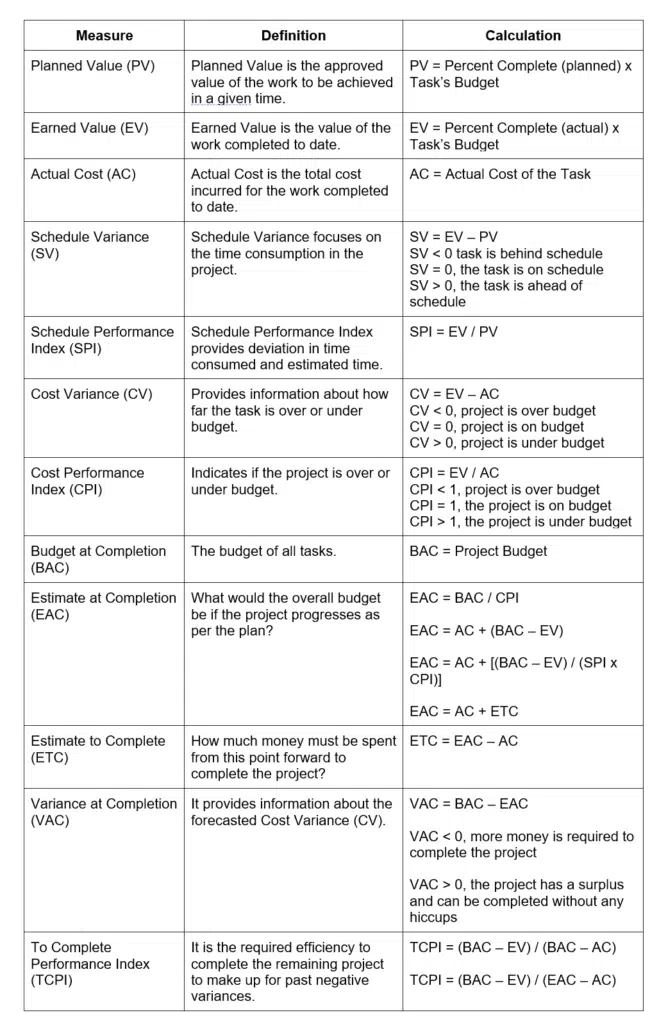
Earned Value Management (EVM) Table
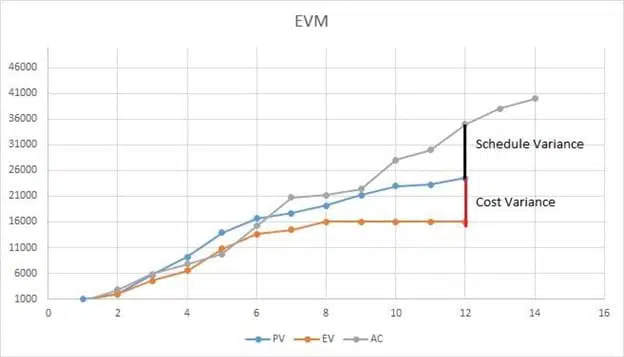
Earned Value Management (EVM) Chart
Summary
Earned Value Management (EVM) helps analyze the project’s performance and predict the forecast. It provides you with quantitative data for decision-making. It is an excellent communication tool for project stakeholders because it helps them understand the project’s insights.
Many PMP aspirants find EVM concepts difficult because of their mathematical calculations. However, once you understand the concept, solving questions will be easy.
I have written eleven blog posts on EVM and project forecasting, explaining EVM concepts with concrete examples. This blog post is the first in a series of seven on Earned Value Management.
The following are links to the other blog posts:
- Earned Value Management (you are here)
- Elements of Earned Value Management
- Budget at Completion in Project Management
- Cost Variance in Project Management
- Schedule Variance in Project Management
- Cost Performance Index in Project Management
- Schedule Performance Index in Project Management
- Schedule Variance and Cost Variance
- Schedule Performance Index and Cost Performance Index
- Estimate at Completion
- Estimate to Complete
- To Complete Performance Index
These blog posts are in a particular sequence, and I request you follow this order. Bookmark this blog post and use it as a reference for Earned Value Management (EVM) concepts.

I am Mohammad Fahad Usmani, B.E. PMP, PMI-RMP. I have been blogging on project management topics since 2011. To date, thousands of professionals have passed the PMP exam using my resources.