

I have discussed earned value management in detail in my previous blog post and also provided a short brief of its three elements: Planned Value (PV), Actual Cost (AC), and Earned Value (EV).
We are going to look at these elements in detail. From this point onward, you’re going to see mathematical calculations. Therefore, I request you go through every step thoroughly.
If you miss any step or don’t understand the concept, further calculations will be very difficult for you, and you may have problems understanding more advanced cost management concepts. Therefore, understand the concepts well before proceeding further.
The calculations for finding Planned Value, Earned Value, and Actual Cost are simple, and once you understand them, the rest will be simple.
Although I will explain them thoroughly, I suggest you obtain a good PMP exam reference book for further reading and practice questions.
Planned Value (PV)
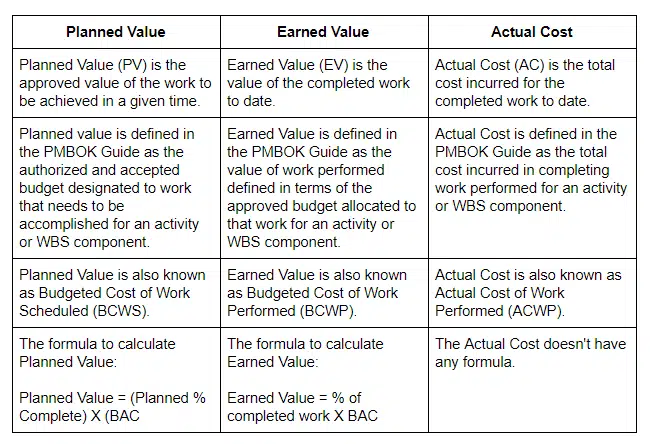
This is the first element of earned value management. Planned Value is the approved value of the work to be completed in a given time. It is the value that you should have earned as per the schedule.
As per the PMBOK Guide, “Planned Value (PV) is the authorized budget assigned to work to be accomplished for an activity or WBS component.”
You calculate Planned Value before actually doing the work, which also serves as a baseline. The total Planned Value for the project is known as Budget at Completion (BAC).
Planned Value is also referred to as Budgeted Cost of Work Scheduled (BCWS).
The Formula for Planned Value (PV)
The formula to calculate Planned Value is simple. Take the planned percentage of the completed work and multiply it by the project budget, and you will get the Planned Value.
Planned Value = (Planned % Complete) X (BAC)
Example of Planned Value (PV)
You have a project to be completed in 12 months. The budget of the project is 100,000 USD. Six months have passed, and the schedule says that 50% of the work should be completed. What is the project’s Planned Value (PV)?
Given in this question.
Project duration: 12 months
Project cost (BAC): 100,000 USD
Time elapsed: 6 months
Percent complete: 50% (as per the schedule)
Planned Value is the value of the work that should have been completed so far (as per the schedule).
In this case, we should have completed 50% of the total work.
Planned Value = 50% of the value of the total work
= 50% of BAC
= 50% of 100,000
= (50/100) X 100,000
= 50,000 USD
Therefore, the project’s Planned Value (PV) is 50,000 USD.
Application of Planned Value (PV)
Planned Value is used to calculate Schedule Variance and Schedule Performance Index.
Actual Cost (AC)
This is the second element of earned value management. Actual Cost is the total cost incurred for the actual work completed to date. Simply put, it is the amount of money you have spent to date.
As per the PMBOK Guide, “Actual Cost (AC) is the total cost actually incurred in accomplishing work performed for an activity or WBS component.”
Actual Cost is also known as Actual Cost of Work Performed (ACWP).
The Formula for Actual Cost (AC)
Finding Actual Cost is the simplest of all.
There is no special formula to calculate the Actual Cost. It is an amount that has been spent, and you can find it easily in the question.
Example of Actual Cost (AC)
You have a project to be completed in 12 months. The budget of the project is 100,000 USD. Six months have passed, and 60,000 USD has been spent, but on closer review, you find that only 40% of the work has been completed so far.
What is the project’s Actual Cost (AC)?
The Actual Cost is the amount of money that you have spent so far.
In the question, you have spent 60,000 USD on the project so far.
Hence,
The project’s Actual Cost is 60,000 USD.
Application of Actual Cost (AC)
Actual Cost is used to calculate Cost Variance and Cost Performance Index.
Earned Value (EV)
This is the third and last element of earned value management. Earned Value is the value of the work actually completed to date. If the project is terminated today, Earned Value will show you the value that the project has produced.
As per the PMBOK Guide, “Earned Value (EV) is the value of work performed expressed in terms of the approved budget assigned to that work for an activity or WBS component.”
Although all three elements have their significance, Earned Value is more useful because it shows you how much value you have earned from the money you have spent to date.
Earned Value is also known as the Budgeted Cost of Work Performed (BCWP).
There is a difference between Planned Value and Earned Value. Planned Value shows you how much value you have planned to earn in a given time, while Earned Value shows you how much value you have actually earned on the project.
The Formula for Earned Value (EV)
The formula to calculate Earned Value is also simple. Take the actual percentage of the completed work and multiply it by the project budget, and you will get the Earned Value.
Earned Value = % of completed work X BAC (Budget at Completion).
Example of Earned Value (EV)
You have a project to be completed in 12 months. The budget of the project is 100,000 USD. Six months have passed, and 60,000 USD has been spent. On closer review, you find that only 40% of the work has been completed so far.
What is the project’s Earned Value (EV)?
In the above question, you can clearly see that only 40% of the work is actually completed, and the definition of Earned Value states that it is the value of the project that has been earned.
Earned Value = 40% of the value of total work
= 40% of BAC
= 40% of 100,000
= 0.4 X 100,000
= 40,000 USD
Therefore, the project’s Earned Value (EV) is 40,000 USD.
Application of Earned Value (EV)
Earned Value is used to calculate Schedule Variance, Cost Variance, Schedule Performance Index, Cost Performance Index, Estimate at Completion, and To Complete Performance Index.
In your PMP exam, you will be given a scenario and asked to identify these three elements. Please note that these elements are also known by different names, such as Planned Value referred to as Budgeted Cost of Work Scheduled (BCWS), Actual Cost as Actual Cost of Work Performed (ACWP), and Earned Value as Budgeted Cost of Work Performed (BCWP).
It is unlikely that you will see these terms in your PMP exam, so concentrate on the terms mentioned in the PMBOK Guide rather than these outdated names.
Planned Value, Earned Value, and Actual Cost Comparision Table
Planned Value, Earned Value, and Actual Cost Chart
Summary
Earned Value, Planned Value, and Actual Cost are basic elements of earned value management. They can be used to generate a basic overview of your project status. Earned Value is the value of the work actually completed to date, Planned Value is the value that you should have earned as per the schedule, and Actual Cost is the amount spent on the project to date. Once you have this information, you can find the current status and compare it with the planned progress.
You can now move on to the next blog post on schedule variance and cost variance, which explains if you are ahead of schedule or behind schedule and whether you are under budget or over budget.

I am Mohammad Fahad Usmani, B.E. PMP, PMI-RMP. I have been blogging on project management topics since 2011. To date, thousands of professionals have passed the PMP exam using my resources.





I want to say thank you for your extraordinary notes. Please help me understand the difference between Rules of Credit and Performance measurement. And how can I establish rules of credit for a project.
Will
Apart from the calculations, I am wondering if there are the factors that can cause a discrepancy between actual costs (AC) and planned value (PV).
A general comment about the CV and CPI definitions. Both of them relate EV and AC performance variables. But the Earned Value (EV) has nothing to do with the execution cost (AC). Then, why when you define the BAC at the beginning of a project you don´t have a Cost Estimate variable similar to the PV, in order to compare the Actual Cost with the Planned Cost?
Thanks in advance
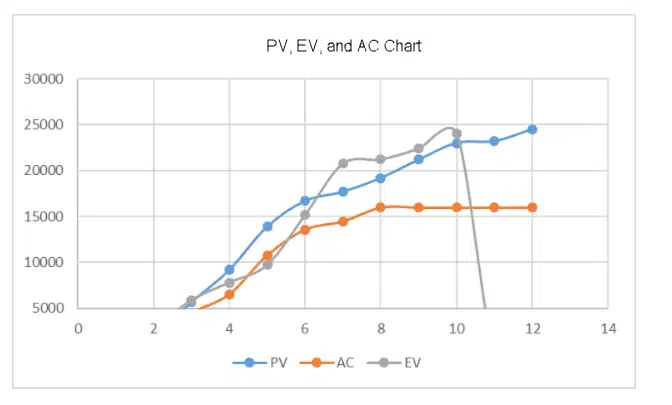
I have one question, in the graphic, EV, PV, and AC chart, you have that the EV curve falls down to zero after period #10, which is probably a mistake because you can´t lose the earned value you have gotten before that period. Suppose you don’t add value between periods 10 and 12, then the curve should keep the value reached before, which should be shown as a horizontal line at the value reached at period #10.
hie, i think think the graph is correct, here we are not looking at cumulative earned value, but value earned for each month.
Simple explanation of the Earned Value Management.
Great work
– Project’s total budget is 1,5m€
– 50 milestones, which have a same amount of financial resources and same length in time
– Development time for entire project is 4 years
The situation is following after the first year
– You have spent the money in this stage 315 000€
– You have performed 9 milestones
Calculate the key figures using EVM technique.
2 / 2
To calculate the key figures using the Earned Value Management (EVM) technique, we need to determine the Planned Value (PV), Earned Value (EV), and Actual Cost (AC) for the project.
Given information:
Total budget (B) = 1,500,000€
Number of milestones (N) = 50
Development time for the entire project = 4 years
After the first year:
Money spent (AC) = 315,000€
Number of milestones completed (n) = 9
Calculations:
Planned Value (PV): This represents the planned cost of the work scheduled to be completed.
PV = (n / N) * B
PV = (9 / 50) * 1,500,000€
PV = 270,000€
Earned Value (EV): This represents the value of the work actually performed.
EV = (n / N) * B
EV = (9 / 50) * 1,500,000€
EV = 270,000€
Actual Cost (AC): This represents the actual cost incurred for the work completed.
AC = 315,000€ (given)
Now that we have the PV, EV, and AC, we can calculate the key EVM figures:
Cost Variance (CV): This measures the difference between the earned value and the actual cost.
CV = EV – AC
CV = 270,000€ – 315,000€
CV = -45,000€
Schedule Variance (SV): This measures the difference between the earned value and the planned value.
SV = EV – PV
SV = 270,000€ – 270,000€
SV = 0€
Cost Performance Index (CPI): This indicates the cost efficiency of the project.
CPI = EV / AC
CPI = 270,000€ / 315,000€
CPI ? 0.857
Schedule Performance Index (SPI): This indicates the schedule efficiency of the project.
SPI = EV / PV
SPI = 270,000€ / 270,000€
SPI = 1
These are the key figures calculated using the EVM technique based on the given information after the first year of the project.
Was this response better or worse?
– Project’s total BAC 1.5m€
– 50 milestones, which have a same amount of financial resources and same length in time
– Development time for entire project is 4 years
The situation is following after the first year
– You have spent the money in this stage 315 000€
– You have performed 9 milestones
Calculate the key figures using EVM technique.
Free Research Preview. ChatGPT may produce inaccurate information about people, places, or facts. ChatGPT May 24 Version
Abigeal assigned a building project to your team, and you are asked to play the role of the project
manager. The project is proposed to be completed in 8months after allocation, considering the internal
and external factors. The estimated budget for the building project is 8Million but as at the 6th month,
Abigeal realized that your team has executed only 40% of the proposed project and 4Million expended
already.
As a project manager, please undertake a project financial budget breakdown to ascertain if the project
will be achievable within budget and time frame considering the following;
1. PV
2. EV
3. AC
4. CV
5. SV
6. CPI and
7. SPI
this question is confusing, i need help pls
Hi Fahad Usmani,
I’d appreciate if you can calculate for me please:
A concrete slab project has a budget of $25,000 and after 40% of the concrete pour, remaining price increased to $85,000 due to price escalation. What is cost Variance and schedule variance.
Thanks,
Ramesh
Your project is 50% of the way through its planned duration. It has spent 40% of the amount that was budgeted for the total project, and has completed 50% of the total work
I’m not too sure which value I am able to use to calculate this cost. Can anyone help me?
Thanks Charles for your visit and leaving comment.
Hi, I can’t find examples for where the project has already over-run the planned end date.
* Planned duration: 100 days
* Current duration: 200 days
* BAC = 100,000
Does this mean my PV$ = $200,000 and PV% = 200% ???????
This seems strange because the actual budget was only 100k, so surely I can’t “plan” to spend more than that much? But then again, this value gives me an SPI that calculates a useful completion date.
In a report, should I show PV$ as $100k or $200k?
Paul,
Your PV will never be greater than your BAC, so at day 100 your PV becomes $100k and stays there. Unfortunately, once PV=BAC, SPI becomes less useful (as it approaches 1 with increased EV). Using Current Duration / EV% would give a meaningful forecast Finish Duration.
The BAC of a small project is $100,000. So far $40,000 has been spent to deliver work worth $30,000. What will be the cost estimate to finish the project, assuming future work will be done at the budgeted rate?
Cost estimate to finish=BAC-AC
$100,000-$40,000= $60,000
Hi Fahad,
Could you tell me about the project cost mean. Are the project cost including staff salary, operation, insurance etc? and how to measure EV and PV of that item? Thanks.
Yes, they are included and EV and PV are measured against cost baseline and actual baseline. You do not measure PV or EV for salary, operation, or insurance, etc.
Hi Fahad please assist how do you go about calculating cash flow if given EV, AC, and CV?
How much has been spent – outflow
Whatever you have earned – inflow
Hi fahad,pls can a project manager assume d progress of a project as 90% because it was done in 90 hours out of the planned 100hrs.
Thanks
Progress in terms of schedule or cost?
One question
project duration is 12 month.
but project have delay after 12 month, how i can calculate PV?
Thanks
In this case you will have to update the schedule and then you will be able to see the PV.
Hi!! What is the difference between Variance Formulas EV-xx (AC or PV)
and what is the relation between Index Formulas EV/xx (AC or PV)
THANKS
It is already explained in below given blog post:
https://pmstudycircle.com/2012/05/schedule-variance-sv-cost-variance-cv-in-project-cost-management/
https://pmstudycircle.com/2012/05/schedule-performance-index-spi-and-cost-performance-index-cpi/
In order to find Future Value which formula is correct to calculate from PMP point of view
1. FV=PV(1+r)n where n is the power of (1+r) and PV is Present value, r is rate of interest & n is time period i.e number of years
2. FV=PV(1+r/100)n where n is the power of (1+r/100)
3. FV=CF [1-1/(1+r)n]/r + CF[1/(1+r)n] where n is the power of (1+r) , CF is the cash flow
The second formula is correct.
Need your help in understanding the planned value (PV) with the example :
a. Project started in Oct 2014;
b. Project will be completed in 28 months from Oct 2014;
c. Below was the month on month Budget value, Earned Value and Actual cost;
Particulars Oct 2014 Nov 2014 Dec 2014 Jan 2015 Feb 2015 Mar 2015 April 2015 Total
Budget (BAC) 3450 3000 3200 3000 3500 3400 3500 26550
Earned Value (EV) 3450 2800 3000 2800 3200 3200 3400 21850
Actual Cost (AC) 3450 0 3000 2500 3000 2000 1000 14950
With your above practical example in this article, it seems that PV = EV for the period already passed.
Please advice.
Thanks & Regards,
Hemang Shah
BAC = 23050(upto Apr’15) + 26550 = 49600
Duration complete is 7 months out of 28 months = 25%
PV = 25% of BAC
i.e., PV = (25/100) * 49600
therefore, PV = 12400
EV = 21850
AC = 14950
is this correct..???
hi all, i’m new to this post and i found the conversation and calcualtion was very detail and simple. im doing my pmp prep and i want someone to help me out on the below actual project scenario to find out PV and EV.,
project duration – 4months authority approval + 8 months construction = 12months total
project total cost = 13,500,000 (BAC)
at the end of 75th day, i’ve obtained 5 authority approvals out of 7 and ongoing.
i paid so far = 12,000 (AC)
advance payment = 20 % of BAC, not paid.
i got confused while calcualting the PV and EV, as i’ve only so much details as per the current project situation.
help me out in find out the PV, EV
Bala
With the given data, I believe it is difficult to get the value of PV and EV.
Can you please tell me how we can work out in this question ??
An activity on the critical path of a project was scheduled to be completed within 16 weeks, with a budget of £8000. During a performance review, which took place 8 weeks after the activity was initiated, it was found that 60% of the work had already been completed and that the actual cost was £6000.
(a) Calculate the Earned Value (EV) of the activity.
(b) Calculate the Cost Performance Index (CPI) and the Schedule
Performance Index (SPI) for the activity.
(c) Based on the performance so far, provide an estimate for the expected budget at completion.
(d) The management argues that the expected budget at completion could stay at £8000. Discuss the assumptions behind this argument.
Budget at Completion (BAC) is £8,000
Earned Value (EV) = 60% of 8,000 = £4,800
Actual Cost (AC) = £6,000
Planned Value (PV) = 50% of £8,000 = £4,000 (Since 50% of time has passed, so let us assume that 50% of work should be completed).
I hope now you can calculate the rest of things…
How do I calculate the PV, EV and AC for an activity tha finished 2 weeks behind schedule with a cost of $100,000. It was to have a cost of $110,000.
Your AC is $100,000 because this is what you have spent.
And EV is $110,000, because this is what you should have spent.And $110,000 is the PV, because this is what you have planned to spend. (corrected)
Wasn’t the $110,000 should be the PV instead??
Ohh…
Yes, you’re right.
$110,000 is the Planned Value.
I have corrected my comment.
Dear Sir,
Could you please explain the ways to get the ‘planned percent complete’ and ‘percent of work completed’.
Thanks and Regards,
Manish
Usually these information are given in the question itself. Otherwise you can get it with either variance formulas or the performance index formulas.
I still don’t understand the difference between PV and EV. Isn’t EV the same as AC – i.e. the actual amount of work that has been done? The definition of EV is very vague in the PMBOK as well as everywhere on the internet.
Difference between these terms is very clear.
Earned Value is the value of the completed work. Let us say that by this time you have completed 10% of the project and total worth of the project is 100,000 USD. In this case the Earned Value will be 10,000 USD.
However, you notice that, to complete this much of work you have spend 15,000 USD. This is your Actual Cost.
Again when you see your schedule, which says that by time you should have completed 13% of the work. This means that your Planned Value is 13,000 USD.
Hope it helps.
how can i get actual cost if i only have Assume that A project has planned value of $628,000 and earned value of $590,000 and that you have calculated a CV of negative $50,000. also what is ssume a typical variance
Assume an atypical variance.
CV = EV – AC
-50,000 = 590,000 – AC
AC = 640,000
Thank you for your very good explanation.
Question: When we are talking about percentage of completion are we talking with regards to output, expenditure or time?
For example, if my project is to make 100 cars in one year, but i buy all my materials upfront and this accounts for half my expenditure, then when is the project 50% complete? Is it:
1) After ive made 50 cars
2) After half a year
3) After the first month when ive spent 50% of my planned budget
Thank you.
We are talking about the Values. For example, Earned Value, Actual Cost and Planned Value.
Producing cars is an example of operation.
Anyway I understand what you want to ask…
You will always measure your performance against approved plan. If your plan says that you should have done these things to date, and you do not able to do so, you’re in bad shape.
Thank you for your reply, im just trying to establish that where you have put ‘Percent complete – 50% (as per the schedule)’ how i can tell im 50% of the way through my project.
Yes i agree if your plan is saying you should have completed more by a certain date then your behind schedule but that dosen’t tell you your percentage completion, just that your not where you planned to be.
I’m sure it differs between projects but my question is whats the generic way of dividing up your project into 20%, 30%, 50%, before the project has begun…is it time related?
Again thank you
Yes it is time related with cost factor melted in…
How do you call the difference between Actual Cost (AC) and Planned Value (PV)?
The answer is not Cost Variance
For cost variance, you can refer this blog post:
https://pmstudycircle.com/2012/05/schedule-variance-sv-cost-variance-cv-in-project-cost-management/
Need to answer this questions
1. What is the actual cost to date? Is the project over or under budget?
2. What is the SV for the project? Is the project ahead of or behind schedule?
3. Calculate CPI and SPI.
4. Assume a typical variance and calculate ETC and EAC.
5. Assume an atypical variance and calculate ETC and EAC.
Assume that A project has earned value of planned value of $628,000 and earned value of $590,000 and that you have calculated a CV of ($50,000).
This is a very simple question, just apply the formula and get the answer.
I suggest you read this blog post and the links given inside it.
https://pmstudycircle.com/2012/05/fast-forward-earned-value-management-evm-forecasting-tcpi/
And, to calculate the EAC you need the BAC (Budget).
I can’t seem to determine what the BAC is from the information given in this question. Fahad?
Yes, you are right Rantz, BAC is missing from the given question. This is what I told to Andy.
Can you help me to understand how the “0.375” in the answer was calculated.
You are a project manager who is in charge of an important project for your company. The project is 40% complete after 3 months and has cost $350,000. The budget for the project is $950,000 and is scheduled to last 8 months. How is the project performing?
Reason
The project is ahead of schedule and under budget
CPI=EV/AC CPI=(950,00*40%)/350,000 CPI=380,000/350,000 CPI=1.09(under budget); SPI=EV/PV SPI=380,000/(950,00 x 0.375) SPI=380,000/36,250 SPI=1.07 (ahead of schedule
Hello Peggy,
Let us calculate the Planned Value from the given question:
Question says that the total budget is 950,000 USD, and the duration is 8 months.
It means, you have to spend 950,000 USD in 8 months,
Therefore, money to be spend in one month = 950,000*1/8
and, money spend in three months = (950,000*1/8)*3
= 950,000*3/8
=950,000*0.375
=356,250 USD
Hope this helps.
Dear Fahad,
Your Examples on PV, EV & AC and very clear.
I was struggling to know whats the difference between EV & AV, now you made me clear..
thank you very much for the detailed explanation.
Sesha.
This was the first article of series of few posts in cost management. I suggest you read all articles in this series to gain understanding of cost management concepts; e.g. SPI, CPI, EAC, ETC, TCPI, etc.
Fahad
Hello Fahad..
Can we apply the PV and EV concepts on FP projects using Fixed Milestone Billing (FMB) ?
If yes, then could you please let me know how this would need to be calculated?
Earn Value concepts provide you status of project and Fixed Milestone billing is way of making payment.
It is up to you that how you plan to make payment. You may make payment on monthly basis based on status report or based on some other parameters….
Your project has a BAC of $400,000 and is expected to last one year. The project work is scheduled to be completed in equal amounts each month. Currently, the project is in month three, but is only 20% complete. You have spent $35,000 to completed the work. What is the PV for this project?
$8750
Hello Imran, sorry for this late reply. I was thinking that I have already replied.
Anyway, solution is as follow:
As the question says, the project work is scheduled to be completed in equal amounts in each month. Therefore, Planned Value to be spent in any single month is 400,000/12 which is $33,333.00
Now, you’re saying that the project is in third month.
Therefore, the money spend till the end of third month will be three times the money spend in one month; i.e. 3*33,333.000 which will be $100,000 USD.
Hope this helps.
Sir can we:
(100% / 12) x 3 = 25%
PV = 25% of 400,000 => $100,000 USD
Will it be a right apporach to follow in future???
If concept is clear, you can calculate it anyway you like..
one year project
pv=130000
ev= 100000
ac= 150000
bac= 900000
Q1. how long the project doing?
Q2. use the CPI to calculate the EAC?
Q3. use the SPi to estimate how long it will take to finish this project?
could you help me to find answer?
Please review my cost management blog posts. These concepts are already explained in detail.
I m still confused that what is the major difference between earned value and actual cost. What i perceived from you article is that earned value is in terms of the work which was performed/achieved at any spontaneous time and it has no concern with the cost involved in it whereas in actual cost the major parameter is the cost. Do correct me if i am wrong
Let’s say that you have $100 project. At certain point you notice that you have spend $50.
Therefore this $50 is you Actual Cost (AC).
Now, on closer review you notice that only 40% of the project is completed. Therefore, Earn Value (EV) will be the 40% of total work; i.e. $40.
Thanks Fahad Sb… for a moment Saad got me confused as well… BUT saved my undersading going off tarck..
Can we say!!! AC is the amount of MONEY you have spent on a project at any pointif time???? BUT “EV” is the % completed by spending that MONEY???
cause it might be possible that you have spent $80 but the completed work is only 30%
So 80 becomes teh AC and 30% becmes the EV
Right Sir??
You are right, EV is amount of money that you have earned by spending the AC.
in that case, Earned Value is of more significance, which helps you understand your Project’s performance at any point in time. Whereas Actual Cost only gives you the realistic data..
in simpler terms, EV is how much i should have spent for this work, AC is how much i actually spent.
Please correct me if iam wrong..!
Thanks Bro Fahad
Earned Value is how much you got from the completed work to date.
An amount of 25,000$ was given to a small project team to produce an application for the duration of 12months. Rate of performance for the project is 20,000$. The budget at completion (BAC) is 120,000$. Please how do i find the cost variance (CV), earned value (EV) and actual cost (AC)?
Thank you.
Hello Adeola,
This question has some contradictory statements. You’re saying that project team has been given a 25,000$ money to produce an application within 12 months. According to this statement, BAC is 25,000$.
Now again in same question, you are saying that BAC is 120,000$. How is this possible?
Yes it got me confusing. Its actually a question from an assignment given to me.
The original question is “Amount of 25,000$ (PV) was given to a small project team to produce simple android mobile application for the duration of 12 months. Rate of performance for the project is 20,000$(RP). The budget at completion is 120,000$.”
I omitted (PV) from the earlier message. Does it make any sense now?
Sorry Mr. Adeola but it still don’t make sense to me.
The $25,000 is BAC for the project team, because project team has to complete the product from this amount.
Now again you are saying that BAC is $120,000. How is it possible?
Fahad,
I hope you do not mind but I wanted to get in touch with you and could not find a way to directly email you. You wrote a very helpful article on this site regarding the three estimating methods and I would like to know if you know of any resources that show actual examples with each method applied.
I am trying to understand the difference between Parametric estimating and Bottom Up as both seem to provide the same output to me. Please help me to understand if there is any difference.
I appreciate any help you can provide and thank you for reading my message.
For a project, I have Planned Value :1725.02
Actual Cost is: 1709.02
Can we figure out Earned Value from this?
The system yielded 1865.91 which is higer than both numbers. Is this possible?
Thanks
No, you can not figure out the earned value from the given data.
Yes, it is possible to have earned value more than the actual cost and the planned value.
Hope it helps.
Dear Sir,
Why cant we calsulate EV from the given information????
I mean, is NOT really possible OR the question require more information…
BAC’s planned completion is PV
BACs actual completion is EV
Money spent so far from BAC is AC…
So, is there no banlance equation combining ALL four in it…
Something like PV + EV + AC = BAC???
Let us say that you have completed the project. Just think that in this case how much you have spend, how much you have earned, and what is your planned value.
If we go by your formula
BAC = PV + EV + AC
BAC = 3 times of BAC (approximately)
This is so because at the end of your project, planned value will be equal to BAC, and about equal amount has been spent to complete it same amount is earned.
Therefore your formula is not correct.