

Schedule Variance (SV) and Cost Variance (CV) are two essential parameters in Earned Value Management. They help you analyze the project’s progress, i.e., how you are performing in terms of schedule and cost.
Assume you are managing a construction project. The client asks you to update them with the current status and progress of the project.
What do they mean by asking for these metrics?
How will you get this information?
The client is asking for information on the cost incurred to date, work completed, and how the project is performing in terms of cost and schedule.
You will get this information with the help of Earned Value Management. Earned Value Management has three basic elements: Earned Value, Planned Value, and Actual Cost.
Earned Value is the value of the work completed to date. Planned Value is the money you should have spent as per the schedule. Actual Cost is the cost spent on the project to date.
These basic elements help you find Schedule Variance and Cost Variance. Schedule Variance helps you understand if you are behind or ahead of schedule. Cost Variance helps determine if you are under or over budget.
Variance analysis is the key to the success of any project, which is finished on time and within the approved budget. Variance analysis helps monitor your project performance, allowing you to take corrective action as soon as required and letting you know if you are going in the correct direction.
Schedule Variance (SV)
You must keep your project on schedule, and Schedule Variance helps you complete it on time. It enables you to avoid unnecessary cost overruns due to a slip in schedule. Costs increase as you go over the stipulated time.
For example, you have rented some equipment for a specific duration and may pay more if you need this equipment for longer. You may need to rent this equipment from other suppliers on an urgent, short-term contract at a higher price.
Schedule Variance is a vital analytical tool; it lets you know if you are ahead or behind schedule in dollars.
The Formula for Schedule Variance (SV)
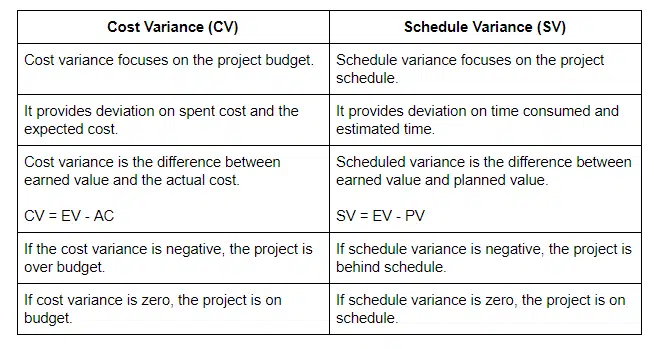
You can calculate Schedule Variance by subtracting Planned Value from Earned Value.
Schedule Variance = Earned Value – Planned Value
SV = EV – PV
From the above formula, we can conclude that:
- You are ahead of schedule if the Schedule Variance is positive.
- You are behind schedule if the Schedule Variance is negative.
- You are on schedule if the Schedule Variance is zero.
When the project is complete, the Schedule Variance becomes zero because all Planned Value has been earned.
Example of Schedule Variance (SV)
You have a project to be completed in 12 months, and the project budget is 100,000 USD. 6 months have passed, and 60,000 USD has been spent, but on a closer review, you find that only 40% of the work has been completed.
Find the project’s Schedule Variance (SV) and determine if you are ahead or behind schedule.
Given in the question:
Actual Cost (AC) = 60,000 USD
Planned Value (PV) = 50% of 100,000
= 50,000 USD
Please note that the Planned Value is not specifically given in the question, but the question says that half of the time has passed. In such a situation, you can assume that the budget was evenly distributed, so the planned value will be 50%.
Earned Value (EV) = 40% of 100,000
= 40,000 USD
Now,
Schedule Variance = Earned Value – Planned Value
= 40,000 – 50,000
= -10,000 USD
The project’s Schedule Variance is -10,000 USD. You are behind schedule since it is negative.
Cost Variance (CV)
Cost Variance is as important as Schedule Variance. You must complete your project within the approved budget. Exceeding the planned budget is bad for you and your stakeholders.
Everything is about money. Clients are cautious about spending because any deviation from the cost baseline can affect their profit. In the worst case, they may have to put more money into the project to complete it. This is detrimental if the contract is fixed price.
Cost Variance deals with the cost baseline of the project. It provides information on whether you are over or under budget in dollar terms. Cost Variance is a measure of the cost performance of a project.
The Formula for Cost Variance (CV)
Cost Variance can be calculated by subtracting the actual cost from the Earned Value.
Cost Variance = Earned Value – Actual Cost
CV = EV – AC
We can conclude the following from the above formula:
- You are under budget if the Cost Variance is positive.
- You are over budget if the Cost Variance is negative.
- You are on the budget if the Cost Variance is zero.
Example of Cost Variance (CV)
You have a project to be completed in 12 months, and the budget of the project is 100,000 USD. 6 months have passed, and 60,000 USD has been spent, but on closer review, you find that only 40% of the work has been completed so far.
Find the project’s Cost Variance (CV) and determine if you are under budget or over budget.
Given in the question:
Actual Cost (AC) = 60,000USD
Earned Value (EV) = 40% of 100,000 USD
= 40,000 USD
Now,
Cost Variance = Earned Value – Actual Cost
CV = EV – AC
= 40,000 – 60,000
= –20,000 USD
Hence, the project’s Cost Variance is –20,000 USD, and you are over budget since it is negative.
Cost Variance and Schedule Variance Comparision Table
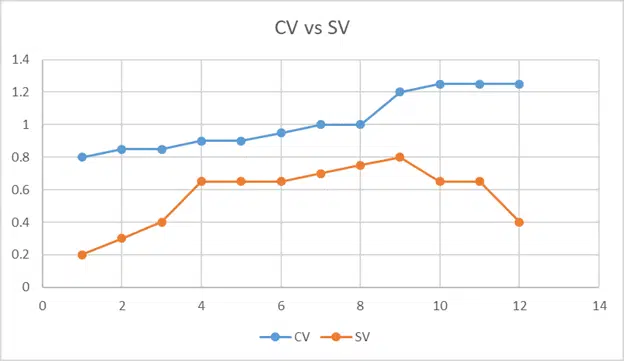
Cost Variance and Schedule Variance Comparision Chart
Summary
Schedule Variance and Cost Variance are great tools for analyzing project health. As a project manager, you should monitor these variances for any deviations. If both variances are positive, your project is progressing well. However, something is wrong if either variance is negative, and you have to take corrective action to bring the project back on track.
How are you using Schedule Variance and Cost Variance in your project? Please share your experience in the comments section.
This concept is important from a PMP exam point of view.
This blog post is the third in eleven series on Earned Value Management and project forecasting. Please read through my previous two posts before reading this post if you’re coming here from a search engine or a referral.
The following are the links for other blog posts:
- Earned Value Management
- Elements of Earned Value Management
- Budget at Completion in Project Management
- Cost Variance in Project Management
- Schedule Variance in Project Management
- Cost Performance Index in Project Management
- Schedule Performance Index in Project Management
- Schedule Variance and Cost Variance (You are here)
- Schedule Performance Index and Cost Performance Index
- Estimate at Completion
- Estimate to Complete
- To Complete Performance Index

I am Mohammad Fahad Usmani, B.E. PMP, PMI-RMP. I have been blogging on project management topics since 2011. To date, thousands of professionals have passed the PMP exam using my resources.





Hi,
Do you know where can I find more questions like this online?
Thanks
Hello Ahmad,
You can try my Earned Value Management eBook.
https://pmstudycircle.com/earned-value-management-for-the-pmp-certification-exam/
Hello Fahad,
Thank you for the PMP blog. This has been very helpful and is easy to understand.
While going through the Project Budget formula under Cost Management and the EVM formulae from the Formula guide I got confused with the Planned Value, BAC, Cost Baseline and Project Budget.
Project Budget = Cost Baseline + Management Reserve
I understand that:
BAC = Total Planned Value (without Management Reserve)
Now Cost Baseline = Project Cost + Contingency Reserve
However, in the guide, I see the following statement:
“The project budget is also known as the Budget at Completion and denoted by BAC.”
So how is Project Budget the same as BAC as BAC does not include Management Reserve?
Should BAC = Cost Baseline?
Appreciate your feedback.
thank you,
Mukund
Budget = BAC = Cost Baseline + Management Reserve
Hi Fahad ,
I think management reserve will not be added to the cost baseline like contingency reserve unless it goes through change control process.
Hello Jajo,
Management reserve is not part of the cost baseline but included in the total budget (BAC)
SV must equal 0 upon completion regardless of the where the budget is.
What you are all missing is you can’t achieve 110%.
If the project has completed all tasks, the project is complete.
Fahad is correct.
Which aspect should we improve normally if a project is OVER BUDGET and BEHIND OF SCHEDULE?
Kindly share some viewpoints on this matter. Thank you.
In this case you will need to find the exact cause of it. If there is problem with project plan or any unidentified risk has occurred caused you delay in schedule and cost.
Based on the issue, you will take corrective action.
Pretty useful. I have never seen previously scary arithmetic concepts made so simple. Indeed simply demystefied
Thanks. I doff my hat.
And come to think of it? Its free and I have paid a lot of money to learn these concepts at the Masters Level?
I’m glad Clem I could be of some help to you.
Hello Fahad,
Many thanks for the good work you are doing.
Please can you take a look at this question i found at one of your recommended links to the pool of pmp questions.
On your current project, EV = $45,000, AC = $50,000, PV = $40,000. What is the schedule variance as a percentage of the work accomplished at this point in time?
Suggested solution
the formula for schedule variance is SV = EV – PV. Therefore the schedule variance as a percentage of the work accomplished is PV/EV or +88.8%
Link to the question.
http://edwel.com/Free-Resources/PMP-Certification-Final-Exam.aspx
It is question number 2
Earned Value is 45,000 USD and Planned Value is 40,000 USD.
So the schedule variance will be 1.125.
No idea why did they take inverse of it and come up with 88%.
I suggest you can contact them and if you get a reply, please update here as well.
Thanks Fahad
Can anyone explain me this scenario.
Planned Star Date = 1 March 2013
Planned End Date = 10 March 2013
Actual Start Date = 5 March 2013
Actual End Date = 15 March 2013
In both condition the time taken in 10 days only, but will this be considered in Schedule Variance as we have delayed the delivery? Kindly provide a concrete solution.
Based on these parameters, Schedule Variance can not be calculated.
Why Not?
I’m having the same dilemma…
In fact once the task is completed, this means all planned value has been earned; i.e. schedule variance will be zero.
I agree with Fahad there is no schedule variance in this case.
-Akhilesh