
Managing change and innovation often requires more than one person or project.
Organizations use three related disciplines to get work done: project management, program management, and portfolio management.
While they sound similar, each operates at a different level and serves a distinct purpose.
Understanding these differences helps leaders align resources, set priorities, and increase business value.
What is Project Management?
A project is a time-limited effort that produces a unique product, service, or result.
Projects have clear objectives and operate under constraints such as budget, schedule, scope, and resources.
Project management is the practice of applying knowledge, skills, tools, and techniques to meet those objectives within the established limits.

Characteristics of a project include:
- A defined start and end date.
- Unique deliverables rather than routine outputs.
- Constraints on time, cost, and scope.
Project management blends art and science.
It involves planning, organizing, and controlling tasks, resources, and stakeholders.
For example, launching a company website often requires designing the interface, writing code, uploading content, testing features, and going live.
A project manager ensures each task happens in sequence, within a set budget and timeframe.
Methodologies and Frameworks
Project teams adopt methods tailored to the nature of their work:
- Waterfall: A sequential approach suited for well-defined requirements.
- Agile: An iterative method ideal when requirements evolve or are uncertain.
- Hybrid: A blend of traditional and agile practices for projects with both fixed and flexible elements.
Choosing the right method depends on clarity of scope, risk tolerance, and stakeholder expectations.
Role of a Project Manager
A project manager guides the team from initiation through closure.
Their responsibilities include defining scope, creating plans, assigning tasks, monitoring progress, controlling costs, and ensuring quality.
The project manager also communicates with stakeholders, resolves issues, and documents lessons learned to improve future projects.
Key activities of a project manager:
- Initiation: Define project objectives, identify stakeholders, and draft the project charter.
- Planning: Develop schedules, budgets, and risk plans using tools such as Gantt charts and critical path analysis.
- Execution: Coordinate the team, manage resources, and track milestones.
- Monitoring and Controlling: Measure performance, manage changes, and keep the project aligned with goals.
- Closing: Deliver final outputs, obtain approvals, release resources, and record insights.
Great project managers combine technical knowledge with leadership and communication skills.
What is Program Management?
A program comprises multiple interrelated projects that share a strategic objective.

Program management involves coordinating these projects to realize benefits that cannot be achieved by managing them separately.
Programs typically span longer timelines and deliver outcomes rather than single outputs.
In essence, program management aligns projects to deliver business outcomes — not just deliverables.
It provides a framework for managing interdependencies, optimizing resources, and ensuring each project contributes to the overarching strategy.
Key Objectives
- Strategic Alignment: Programs ensure that all projects support corporate goals.
- Benefit Realization: Focus on outcomes like increased revenue, improved efficiency, or enhanced customer satisfaction.
- Resource Optimization: Allocate people, budget, and tools across projects to maximize value.
- Risk Management: Identify and mitigate risks that could affect multiple projects.
Programs are often ongoing and adaptive.
They adjust to changing business priorities while maintaining progress toward long-term goals.
Role of a Program Manager
The program manager has a strategic, cross-project role.
They define the program’s vision, coordinate project managers, and ensure that interdependencies are managed effectively.
Their duties include:
- Strategic Alignment: Make sure each project aligns with the organization’s mission.
- Stakeholder Coordination: Foster communication among project teams and senior leaders.
- Resource Optimization: Allocate resources where they have the most impact.
- Performance Monitoring: Track progress, budgets, and risks across all projects.
Program managers look at the bigger picture.
They adjust plans as needed to keep the program aligned with evolving business priorities.
What Is Portfolio Management?
A portfolio is a collection of projects and programs — related or unrelated — that are managed together to achieve strategic goals.
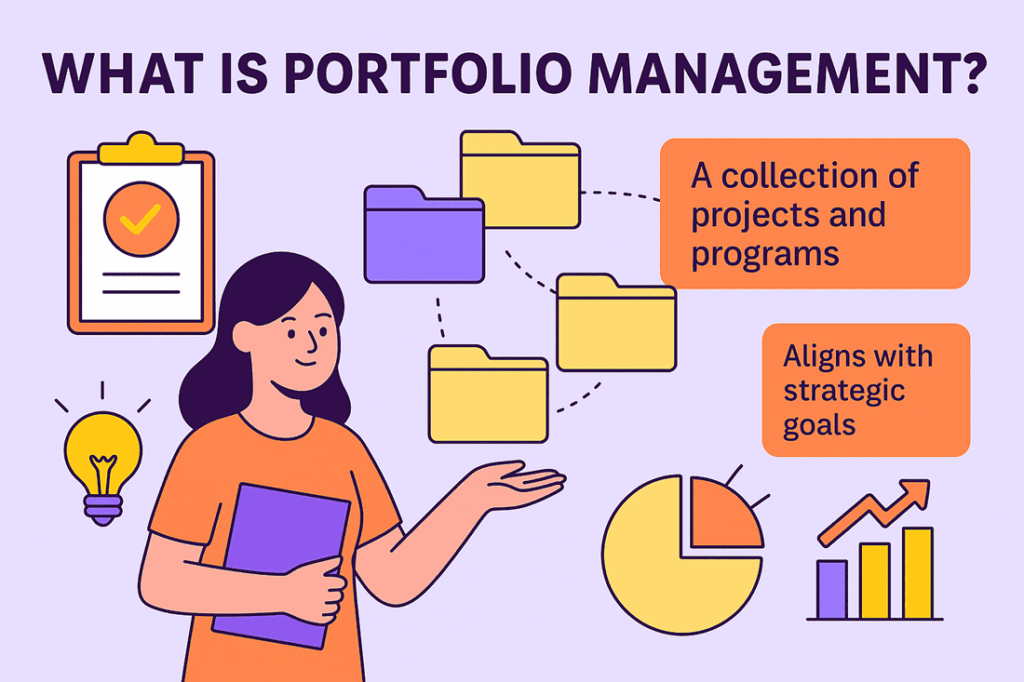
Portfolio management centralizes decision-making about which initiatives to undertake, ensuring resources go to the work that best supports organizational priorities.
Unlike program management, which coordinates related projects, portfolio management balances diverse initiatives.
It involves evaluating risks and returns, prioritizing work, and adjusting the portfolio as business needs evolve.
Portfolio Principles
- Goal Alignment: Select and sequence projects to advance the organization’s strategy.
- Resource Balancing: Maintain a healthy mix of safe and innovative initiatives.
- Continuous Monitoring: Reassess priorities and reallocate resources as conditions change.
Role of a Portfolio Manager
Portfolio managers make high-level decisions about which projects and programs to undertake.
They consider financial returns, risks, and strategic fit.
Their responsibilities include:
- Selection and Prioritization: Decide which initiatives enter the portfolio and in what order.
- Balancing Risk and Reward: Ensure the portfolio contains both stable and innovative work.
- Monitoring and Adjusting: Regularly review progress, add or remove projects, and adjust schedules to maintain alignment with organizational goals.
- Strategic Communication: Explain the “why” behind each initiative and how it contributes to company objectives.
Portfolio managers operate at a strategic level.
They do not oversee individual project execution; instead, they focus on maximizing value across the organization.
Project Vs Program Vs Portfolio: Differences at a Glance
The following table summarizes the core differences across these three disciplines.
It uses concise phrases so you can compare at a glance.
| Dimension | Project Management | Program Management | Portfolio Management |
| Scope | Single initiative producing a unique output | Multiple related projects delivering combined benefits | Mix of related or unrelated projects and programs |
| Focus | Deliver output on time, within budget, meeting stakeholder requirements | Coordinate projects to achieve strategic outcomes and benefits | Align initiatives with organizational strategy, balance risks and returns |
| Timeframe | Finite start and end; short to medium duration | Ongoing or long-term; adapts to evolving goals | Continuous; portfolio composition changes as priorities shift |
| Success Metrics | Completion of deliverables within scope, schedule, and cost limits | Realization of program benefits and achievement of strategic objectives | Maximizing value across all initiatives; achieving strategic goals |
| Manager Role | Plans and executes tasks; manages team and stakeholders | Aligns projects; oversees interdependencies and resources | Selects and prioritizes initiatives; balances portfolio and communicates strategy |
Tip: Think of projects as delivering outputs, programs as delivering outcomes, and portfolios as delivering strategy.
Why These Disciplines Matter: Trends and Statistics
Understanding the distinctions is essential for career planning and strategic decision-making.
Recent data highlights why effective project, program, and portfolio management is in demand:
- Growing Software Market: The project management software market is estimated at $7.24 billion in 2025 and is projected to reach $12.02 billion by 2030, a compound annual growth rate (CAGR) of 10.67%.
- High Adoption: 82% of companies use work and project management software, and 57% of employees report using more tools than the previous year.
- Talent Demand: There are around 40 million project management professionals worldwide, and up to 30 million more will be needed by 2035.
- Project manager employment is expected to grow 6% from 2024 to 2034, faster than the average for all occupations.
- The Bureau of Labor Statistics projects about 78,200 job openings per year over the next decade.
- Certification Benefits: 33% of professionals with a Project Management Professional (PMP) certification report higher median salaries than those without.
- More than 1.58 million professionals hold the PMP credential across 211 countries.
- Portfolio Management Market Boom: The global project portfolio management market size was about USD 5.7 billion in 2024 and is projected to reach USD 12.25 billion by 2030, with a CAGR of 14.2%.
- North America currently holds the largest share, while the Asia Pacific has the fastest growth.
These figures underline the growing importance of structured management disciplines.
Organizations are investing in technology and talent to handle complex initiatives and stay competitive.
Choosing the Right Approach
Selecting the appropriate management level depends on the nature of the work and desired outcomes:
- Use project management when you need to deliver a specific product or service with defined requirements, timeline, and budget.
- Examples include developing a mobile app, launching a marketing campaign, or constructing a house.
- Use program management when several related projects need coordination to realize broader benefits.
- A city’s renewable energy program might include upgrading power grids, installing solar panels, and running public education campaigns.
- Managing these projects together reduces redundancies and ensures they all support the same strategic objective.
- Use portfolio management when you need to balance diverse initiatives with limited resources.
- A multinational corporation may run programs ranging from product development and customer experience to internal process improvement.
- Portfolio management helps leaders decide which initiatives align best with long-term goals and risk appetite.
FAQs
Q1. What is the main difference between project and program management?
A project delivers a unique output within defined constraints.
A program coordinates related projects to achieve benefits that cannot be realized through single projects alone.
Q2. How does a program differ from a portfolio?
Programs group similar projects under a shared objective.
Portfolios include related and unrelated projects and programs and focus on aligning them with strategic priorities.
Q3. Why should organizations invest in portfolio management software?
As project complexity grows, portfolio management tools provide visibility, resource optimization, and strategic alignment.
The global PPM market is projected to more than double from 2024 to 2030.
Q4. Are certifications like the PMP worth it?
Yes. Professionals with a PMP certification report higher median salaries.
Certification also signals expertise and can improve job prospects in a competitive market.
Q5. When should a project be elevated to a program?
Suppose multiple projects share a common goal and depend on each other. In that case, consolidating them into a program improves coordination, resource sharing, and benefit realization.
Summary
Project, program, and portfolio management are not interchangeable.
Projects deliver specific outputs, programs deliver strategic outcomes, and portfolios ensure that every initiative advances the organization’s mission.
With growing demand for skilled managers and powerful tools, understanding these distinctions is more important than ever.
By choosing the right approach, aligning work with strategy, and investing in people and technology, organizations can navigate complexity and achieve lasting success.
Further Reading:
- What is a Project?
- What is Project Management?
- What is a Program in Project Management?
- What is Program Management? Definition & Overview
- What is a Portfolio in Project Management?
- What is Project Portfolio Management?
These are essential topics from a PMP exam point of view, and you will see some questions on these topics on your exam. Make sure you understand these topics well.

I am Mohammad Fahad Usmani, B.E. PMP, PMI-RMP. I have been blogging on project management topics since 2011. To date, thousands of professionals have passed the PMP exam using my resources.




ok
Thank you! Clear explanation that helped me clarify these in my mind. Great visual.
You are welcome, Susan.
Can you summarize in definitive terms project, program and portfolio and their management to the understanding of a layman?
I tried my best to describe these concepts in easy terms. Let me know where you are facing issues?
Does it mean that portfolio management is broader than program management, which is broader than project management?
Yes.
Fahad and all, Who are members of project board and change control board? Are these two boards the same entity? Is project board same as board of directors? Project board is in charge of project governance, right? Meanwhile, board of directors is in charge of organization governance, right? So, does project board report to board of directors?
Hello Jo, it totally depends on organization structure. However generally board of directors are for organization governance and project board report them or any other authority as per the organization policy.
The program manager is a senior project manager, right? He reports to the portfolio manager aka project director who in turn reports to the CEO portfolio manager is at the same level with operations manager and technical manager. Therefore, all three are at least heads of departments or divisions while project manager is only head of a section or unit of projects.
It depends on organization structure and policy. It is not necessary that program manager reports to portfolio managers. They may work in isolation and separately report management.
Who prepared the business case for each project or program? Is it the portfolio manager? Is the portfolio manager equivalent to project director? Does the program manager prepare the benefit management plan? Project sponsor is the same as the project champion, right because s/he is the project originator or proposer?
Business case is usually prepared by business analyst along with the sponsor. Project manager, program manager, portfolio manager can be involved.
How do i get this document through pay pal. I need soft copy like tomorrow
Which document are you talking about?
Hi Fahad Usmani
Can you please mention few more benefits of PPM.
For example, better resource utilization within the organization.
Hi It’s quite helpful. I am preparing for
Pmp
Thanks Atta for your visit and leaving comment.
Which one in your opinion is better suited for a professional business title? Portfolio Management can also be confused with the same in the financial industry…
It should be defined by the company. It should not be confused with two positions in the company, outside, it does not matter.
Are Project Portfolio Management (PPM) and Portfolio Management (PfM) the same things and hence used interchangeably?
I think both are the same.
So much better and clear explanation than the one that I found in 3 books already,
Something about the words you used clarified all the doubts that I had. Thank you for your help!
Thanks HFR for your visit and leaving comment.
Very very clear and concise!. Kind of explanations one would like to find more often in the internet!.
Thanks a Lot!
You are welcome Roberto.
How does the interaction between project management, project portfolio management and strategic programme management lead to better planning and financial performance?
It helps you in better resource utilization – hence better planning and financial performance.
For example, an equipment is idle at another project, you can plan it to use on your project to better utilize and save some money.
Thanks fahad. You have good knowledge of PMP. i understood now. Thanks a lot.
You are welcome Faran.
Hello Usmani, how can I get a hard copy your 400 PMP exam sample questions pls?
You can buy it from here:
https://pmstudycircle.com/pmp-question-bank/
Hard copy is not available.
Fahad
Hello Usmani,
Can one order a hard copy of your 400 PMP exam queantion bank or the A2Z of PMP certification preparation manual? And what is the procedure lease?
Both of these eBooks are available in soft format only, though you can take printout if you need.
I did not understand your question on procedure lease. Can you elaborate it?
Wow! This is so insightful and beneficial too. I’ve just registered to enroll on a PMP course and subsequently exams. This prep is just to refresh my memory on management before stepping into the tutorials. I will keep coming back to your blog to learn more so as to gain added advantage. Thanks. Please keep up the good work.
Thanks Lizzy for your comment.
This is a nice, simple explanation. Thank you. In practice, the definitions can sometimes overlap a little depending on how you choose to break up the effort. Some large projects, with many moving parts, could be considered either a project or a program. Some large programs contain projects that are less interconnected than others, and therefore might be thought of as a portfolio, rather than a program.
The term Program Management Office is also used in a variety of different ways. I’ve seen it used variously to refer to offices overseeing several projects, one or more programs, or a portfolio.
Well said Heather.
Dear Fahad
I’ve just started my MS in PM, I’m very impressed by your simple, precise and clear defining skills.
I just wanna associate with you not till the completion of my MS but as long as possible.Can i read your other relevant stuff on PM, give me one link brother.
I do appreciate your effort.
You can reach m at [email protected]
Yours Plz
Syed Shakaib Shah
Hello Syed,
You can read all of my blog posts here:
https://pmstudycircle.com/study-notes/
I wanna say big thanks ,really it’s useful and now I understood it.
You are welcome Amna.
Dear Fahad Usmani
very crystal clear explanation of Project, Program and Portfolio ,
Appreciate your intent to help those new PMP entrants.
God Bless you for ToK(transfer of knowledge)
You can also throw some light on ITTO!
thank You
Mahesh
Thanks Mahesh for your comment. I have written a blog post on ITTO. You can read it here:
https://pmstudycircle.com/2012/03/input-tool-technique-and-output-itto-for-pmp-certification-exam-memorize-remember-or-understand/
Fahad,
I am confused in Program and Portfolio in below example. The company calls it a “Project,” but I believe its wrong. Please clear me
“A company is starting a mega project of housing community. They will construct a 100 luxury villas, 200 small family houses, and 100 condos, with a small hospital 10 beds, kinder-garden school, recreational parks, and shopping mall in it. They will also open a zoo in the community project.”
Is this a Program or a Portfolio? They call it Project. My understanding is, its a “Construction Program” and the entrepreneur is using a wrong word, “Mega project” for this type of adventure. Please clarify my confusion. Thanks
I believe they should manage it under either program or portfolio.
Thanks Fahad!
Dear Fahad Sb,
Assalam o Aleikum,
I have confusion with this definition of Program which is;
“A program is group of related projects…”
What does mean by related projects, same projects? or related to each other?
For example: Engineering, Procurement & Construction are different projects or sub-projects of EPC project but also related to each other.
So, is this program or portfolio ?
Hello Anjum, I am updating this blog post in two or three days. I hope it will answer your query as well.
Hi Fahad,
I appreciate the pains that you’ve taken to provide the difference here. However, to check whether my knowledge is correct or not, an example would help me, obtain a complete understanding of project, portfolio and an OPM model. Can you please assist?
With warm regards
K.N.Jayanth Krishnamoorthy
Project: Any single project will be managed.
Program: Let’ say you got two projects, one is to construct school building and other is to construct a office building. You will manage these two projects under program management because both are of similar type.
Portfolio: Let’ say you got two projects, one is to construct school building and other is to develop a software program for any organization. This will be managed under portfolio management because both projects are entirely different.
OPM3: Please visit below given links:
https://www.pmi.org/learning/library/grow-up-already-opm3-primer-8108
Hi Fahad,
Your explanation is simple and well understood and will help to perform audit examation of projects, programs with its relationship aligned to expenditure to achieve audit objective, and provide report/recommendations to management.
Where and how can I get examples of past PMP exams before sitting for the exams.
You can not get real PMP exam questions from anywhere. If you get it, it is illegal and please report to the PMI.
However, if you want to practice PMP exam sample questions, the below link will help you such sources:
https://pmstudycircle.com/pmp-questions/
Hi Fahad,
Kudos to you for the great work of knowledge shearing via your blog posts. Very informative publications indeed.
Pls could you send me a one-in-all study material i can use wholly for the pmp exam via my email add?
Appreciate your support.
Hello Etu, all reference books are is in hard format that can not be shared through email, and the rest is copyrighted material, that is also can not be shared.
In your above post you mention the 4th ed. of the PMBOK Guide. The 5th edition is out and that is what will be reference when I sit for the CAPM exam. Is this information still accurate?
Thank you for your posts – they are very helpful in breaking down concepts and making analogies.
Yes, it is still valid.
I guess you are a teacher M. FAHAD , if not you have to be :)
you are doing a good job here.
it’s so helpful.
Thanks Said,
I am just a blogger who passed the PMP exam and helping other to do so…
I am glad that you’re benefiting from my posts…
Wonderful explanation,thanks
You’re welcome Adhar.
Thank you Fahad. I am preparing for PMP Exam these days.
This was really helpful. Keep up the good work.
Hello Khan,
Let me know if you need any help from me.
How can one be a project manager. Am a graduate of physics and astronomy from University of Nigeria Nsukka. Pls i need your help.
Hello Paul,
I assume that you are asking about how to become a PMP.
To become a PMP, graduation is enough. Second condition is to have three years of experience in leading and directing the project. If you have this much of experience then you can go for the training and apply for the exam.
Once you pass this exam, you will be a PMP.