Agile team roles define how work moves from idea to delivery. When roles are clear, teams collaborate better and deliver value faster. Each role has a specific purpose, yet all work toward a shared goal.
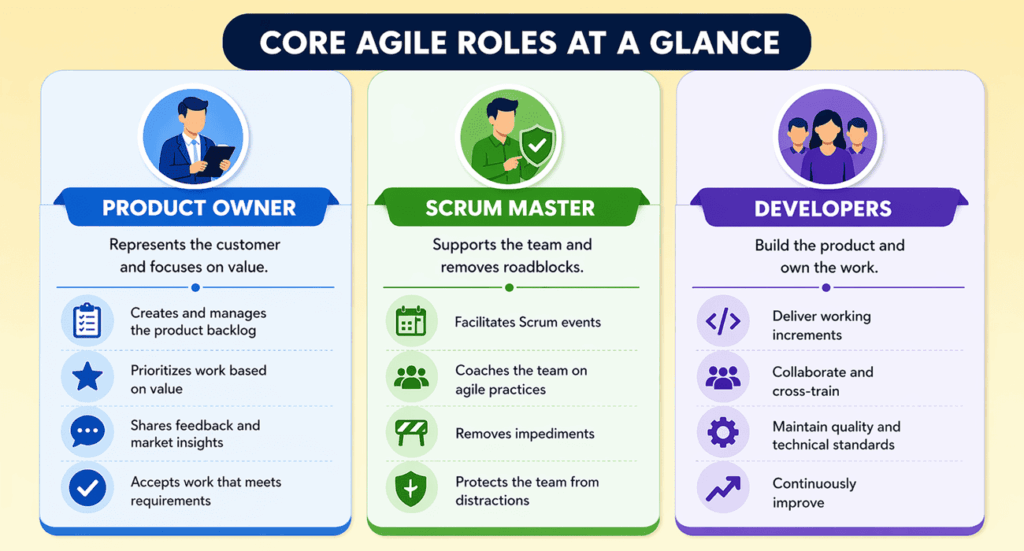
The Product Owner focuses on value and priorities. The Scrum Master supports the process and removes obstacles. Developers build and improve the product in each sprint. In many organizations, an Agile Coach also guides teams through change.
But how do these roles work together in real projects?
This blog post explains each role in simple terms so you can understand responsibilities and build a strong Agile team.
Key Takeaways
- Agile teams rely on clear accountabilities. A Product Owner maximizes value, a Scrum Master guides the process, and Developers build working increments according to the backlog.
- Agile adoption isn’t universal. The 18th State of Agile report from 2025 found that only 13% of organizations have deeply embedded Agile across their business, while 74% use hybrid frameworks.
- Coaching accelerates transformation. An Agile coach supports individuals and teams by teaching principles, removing impediments, and mentoring people at every level.
- Continuous learning matters. Teams improve by reflecting on outcomes, refining the backlog, and adapting to change. Regular inspections and clear definitions of done are essential.
What Makes an Agile Team?
An Agile team is a small, cross-functional group that organizes its own work. Everyone shares responsibility for delivering value during short iterations called sprints.
The team follows Agile principles such as customer collaboration, responding to change, and working software over documentation. While Scrum is the most common Agile framework, many organizations tailor practices and tools to suit their context.
In 2025, the State of Agile report observed that over 74% of organizations blend frameworks or use their own approach. Agile isn’t a one-size-fits-all solution; it’s a mindset supported by clear roles.
Why Roles Matter in Agile
Without defined accountabilities, teams risk misalignment and stalled progress. Roles clarify who makes decisions, who facilitates the process, and who builds product increments. This helps teams focus on delivering value rather than debating responsibilities. When every member understands their role, coordination improves, and impediments surface early.
Product Owner: The Voice of the Customer
The Product Owner (PO) is responsible for maximizing the value delivered by the team. According to the Scrum Guide, the Product Owner manages the Product Backlog by developing and communicating the product goal, creating backlog items, ordering them, and ensuring that the backlog is transparent and understood. Even if the PO delegates tasks, they remain accountable for the backlog’s content and priority.
Responsibilities
- Define and communicate vision. The Product Owner creates a clear product goal and ensures that everyone understands it.
- Manage the backlog. They write user stories, prioritize items, and refine details with stakeholders.
- Maximize value. The PO ensures that the team focuses on the highest-value features first. They balance customer needs, business goals, and technical constraints.
- Engage stakeholders. The PO represents customers and works with marketing, sales, and leadership to align expectations.
Qualities of a Great Product Owner
A strong Product Owner combines business savvy with empathy. They listen to customers, translate feedback into product goals, and make tough trade-off decisions. Communication skills are critical: the PO must explain priorities clearly and mediate between stakeholders and the team. Technical literacy helps them understand constraints, but they don’t need to write code. Above all, they champion value, not just features.
Real-World Example
Imagine a startup building a mobile banking app. The Product Owner talks to users, learns that customers want real-time transaction alerts, and places that feature at the top of the backlog. They work with designers and developers to refine user stories and decide what “done” looks like. By guiding priorities, the PO ensures the team delivers features customers care about first.
Scrum Master: The Team’s Servant Leader
A Scrum Master (SM) ensures that the team follows Agile principles and removes barriers to progress. The Scrum Guide describes the Scrum Master as accountable for establishing Scrum and enabling the team to improve its practices. They coach members in self-management and cross-functionality, help the team focus on creating high-value increments, remove impediments, and ensure all Scrum events are productive.
Responsibilities
- Facilitate Scrum events. The SM organizes sprint planning, daily stand-ups, sprint reviews, and retrospectives. They keep meetings time-boxed and focused.
- Remove impediments. When obstacles arise, from unclear requirements to technology issues, the SM helps the team address them so work can continue.
- Champion continuous improvement. They encourage the team to reflect on what’s working and what’s not. In retrospectives, the SM guides discussions that lead to actionable improvements.
- Serve the organization. Beyond the team, the Scrum Master leads the organization in adopting Agile practices, plans Scrum implementations, and helps stakeholders understand empirical approaches.
Qualities of an Effective Scrum Master
An outstanding Scrum Master leads through influence, not authority. They are patient, observant, and skilled at facilitation. Empathy allows them to understand team dynamics and resolve conflicts. They should be comfortable challenging the status quo and advocating for change when needed. A good SM also understands the technical environment enough to identify barriers but focuses on process, not on telling people how to do their jobs.
Real-World Example
Consider a software team struggling with delayed releases due to frequent scope changes. The Scrum Master works with the Product Owner to improve backlog refinement and ensures that user stories are well-defined before sprint planning. They introduce a definition of done and help the team set realistic sprint goals. By coaching the team to address impediments early, the SM helps improve delivery predictability.
Development Team: Builders of Value
The Development Team (often simply called Developers) consists of the professionals who build the product. Scrum defines Developers as the people committed to delivering a usable increment of work every Sprint. Their skills vary by domain, but they share accountability for planning work, upholding quality, and adjusting plans toward the sprint goal. Within a Scrum Team, there is no hierarchy; every developer has equal status in selecting work and holding each other accountable.
Responsibilities
- Plan the sprint. Developers create and manage the Sprint Backlog, forecasting which backlog items they can deliver.
- Deliver increments. They design, code, test, and integrate features to produce a working product at the end of each sprint.
- Maintain quality. Developers adhere to the Definition of Done, ensuring that every increment meets agreed quality standards.
- Adapt daily. They inspect progress and adjust their plan each day to meet the sprint goal.
Skills and Attributes
Agile Developers are cross-functional. A team might include front-end engineers, back-end engineers, testers, and UX designers. Some are specialists; others have broad skill sets. The blend educes single points of failure and allows the team to pivot quickly. Collaboration and accountability are essential. Developers must feel comfortable giving and receiving feedback, participating in pair programming, and stepping outside their usual roles when needed.
Real-World Example
A team building an eCommerce platform includes developers skilled in JavaScript, Python, and database design. During sprint planning, they collectively decide how many user stories they can complete. If the sprint goal changes due to shifting customer needs, the developers adapt the plan and coordinate tasks to deliver the highest-value features while maintaining quality.
Agile Coach: Guiding Transformation
While not always part of every team, the Agile Coach plays an important role during transformations. According to the International Consortium for Agile (ICAgile), an agile coach supports individuals, teams, and organizations in adopting and improving agile practices. They act as mentors and facilitators, enhancing collaboration and streamlining processes. Their responsibilities depend on whether they coach at the team or enterprise level.
Responsibilities
- Teach and mentor. Agile coaches introduce key principles, train teams on ceremonies and artifacts, and provide hands-on guidance to help people internalize agile values.
- Facilitate change. At the enterprise level, coaches help leaders co-design roadmaps and align organizational structures with Agile principles.
- Promote collaboration. They encourage cross-functional teamwork, guide conflict resolution, and foster a culture of continuous improvement.
- Mentor leaders. Agile coaches advise executives on leading transformations and help them understand their role in enabling agility.
Qualities of a Skilled Agile Coach
Great Agile coaches are seasoned practitioners with deep experience in Agile frameworks. They possess strong communication and facilitation skills, emotional intelligence, and the ability to adapt their approach to different contexts. They remain impartial and avoid imposing solutions, instead helping teams find their own answers. Coaches are lifelong learners who stay current on new practices and emerging tools.
Real-World Example
A large insurer decides to adopt Agile across its IT department. The Agile coach works with teams to implement Scrum, trains product owners on backlog refinement, and helps leaders shift from a command-and-control approach to servant leadership. After several months, teams are delivering increments more frequently, and stakeholders report improved transparency.
Changing Landscape of Agile Adoption
Understanding the broader context of Agile helps teams appreciate why roles evolve. The 18th State of Agile Report (2025) revealed that most organizations are still navigating their transformations: only 13% of respondents said Agile is deeply embedded, while 42% admitted their culture was “better than nothing but could be more effective”. Leadership involvement remains low; only 15% said business leaders actively shape Agile practices. At the same time, hybrid frameworks are now the norm, with 74% of organizations using them. The report also showed that 84% of organizations use or plan to use AI tools, yet only 49% have established guardrails.
These statistics highlight that adopting Agile requires more than training. It demands cultural change, leadership engagement, and a willingness to experiment. Teams need guidance from experienced roles, such as Scrum Masters and Agile coaches, to navigate complexities and adapt frameworks to their environment.
Adapting Roles for Hybrid Frameworks and AI
As hybrid frameworks and AI tools become commonplace, roles must evolve. Product Owners should understand multiple delivery methods and collaborate with teams using Kanban or custom workflows. Scrum Masters need to facilitate alignment across distributed teams and integrate AI tools that automate routine tasks. Developers will work with AI-assisted coding or testing tools, which will require new skills in prompt design and data ethics. Agile coaches can guide organizations through these changes by establishing governance and ensuring that AI supports rather than replaces human judgment.
How Roles Work Together
These roles are interdependent. The Product Owner articulates a clear vision; the Scrum Master ensures that processes enable the team to realize that vision; the Developers turn the vision into working software; and Agile coaches provide guidance when adopting or scaling practices.
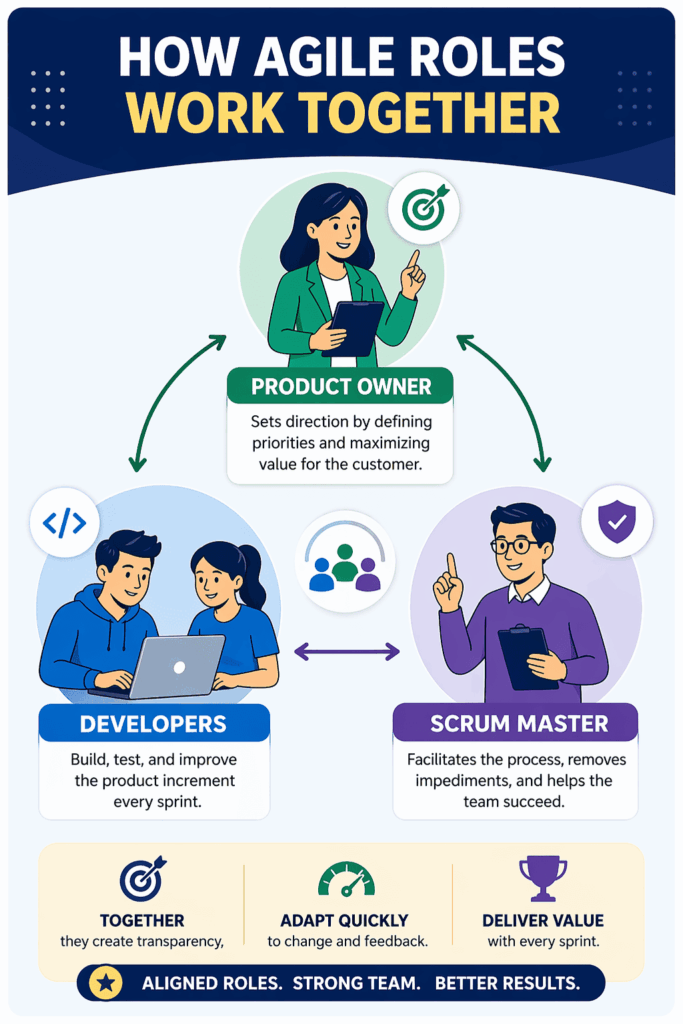
Successful teams communicate openly and respect each other’s accountabilities. When responsibilities blur or conflicts arise, the Scrum Master facilitates resolution while the Product Owner maintains focus on value.
Collaboration Example
During a sprint planning session, the Product Owner proposes adding a new payment method to the backlog. Developers discuss technical implications and estimate effort. The Scrum Master ensures that the conversation stays focused and time-boxed. If the organization is new to Agile, an Agile coach may observe the session and later offer feedback on backlog refinement and team dynamics. This collaboration illustrates how roles complement each other to deliver value quickly and adapt to change.
Tips for Successful Agile Roles
- Start with clear definitions. Before forming a team, ensure that everyone understands the accountabilities of the Product Owner, Scrum Master, Developers, and any Agile coach. Clarify how decisions will be made and who owns the backlog.
- Prioritize continuous learning. Encourage team members to pursue certifications, attend workshops, and share lessons learned. Roles evolve, and staying current helps maintain relevance.
- Engage leadership early. Agile transformations require executive support. Invite leaders to sprint reviews, share metrics that matter to the business, and involve them in backlog prioritization.
- Tailor practices to fit. Use Scrum as a starting point, but adapt ceremonies, artifacts, and roles to suit your organization’s context. Consider hybrid approaches when scaling agility, as many companies now do.
- Leverage coaching. When teams struggle or organizations embark on a transformation, bring in an Agile coach. Coaches accelerate learning, foster collaboration, and help leaders embrace servant leadership.
FAQs
Q1. What is the main job of a Product Owner?
The Product Owner maximizes product value by defining goals, managing the backlog, and prioritizing work so that the team focuses on the most valuable features.
Q2. How does a Scrum Master differ from a project manager?
A Scrum Master does not command the team; instead, they guide the process, remove impediments, and coach the team to follow Agile practices. They promote self-management rather than assigning tasks.
Q3. Do developers have a say in what work they do?
Yes. Developers collaborate with the Product Owner to select backlog items, create a sprint plan, and adjust daily to meet the sprint goal. They hold each other accountable.
Q4. When should an organization bring in an Agile coach?
An Agile coach is useful when teams are new to Agile, when scaling frameworks across departments, or when leadership needs guidance on cultural change and aligning practices.
Q5. Why are so few organizations deeply Agile?
The 2025 State of Agile report suggests that only 13% of organizations fully embed Agile because cultural change and leadership engagement remain challenging. Many use hybrid approaches or struggle to align practices with strategic goals.
Summary
Agile teams succeed when each role works with clarity and purpose. The Product Owner drives value, the Scrum Master supports the process, and the Developers deliver results. An Agile Coach can guide teams during change and growth. When these roles align, teams improve faster and deliver better outcomes. Clear communication and shared goals keep everyone on track. If you apply these roles well, your team can adapt to change, solve problems quickly, and deliver real value in every sprint.

I am Mohammad Fahad Usmani, B.E. PMP, PMI-RMP. I have been blogging on project management topics since 2011. To date, thousands of professionals have passed the PMP exam using my resources.