Are you trying to choose the right Agile framework for your team or organization? Two of the most prominent options are Scrum and the Scaled Agile Framework (SAFe). While Scrum is a lightweight, team-level framework, SAFe is a comprehensive system for coordinating dozens of teams across a large enterprise.
Critics sometimes claim SAFe is just “bloated Scrum,” yet more than 70% of Fortune 100 companies use SAFe as their primary method of scaling Agile. At the same time, 87% of Agile practitioners still rely on Scrum. So, which one fits your situation?
In this blog post, I will break down the key differences between Scrum and SAFe, compare their strengths and limitations, and provide a clear decision framework to help you choose.
Let us first have a quick look at the differences between Scrum and SAFe.
Scrum Vs SAFe: Key Differences
The table below shows the key differences between Scrum and SAFe:
| Category | Scrum | SAFe |
| Team Size & Scope | Small, cross-functional teams of up to ten people manage a single product backlog. | Coordinates multiple teams (50-125 people per Agile Release Train) across portfolios; suitable for large enterprises. |
| Roles & Governance | Roles: Developers, Product Owner, Scrum Master. Governance is minimal; teams self-manage. | Adds Release Train Engineer, Product Manager, System Architect, and portfolio managers for oversight. |
| Planning Cadence | Short Sprints of one month or less; planning happens at the start of each Sprint. | Program Increment planning every 8-12 weeks; teams still run Sprints but align to longer cycles. |
| Autonomy | High autonomy within the team; decisions are made by those doing the work. | Balance of autonomy and top-level alignment; teams adhere to portfolio roadmaps and governance. |
| Visibility & Tooling | Informal visual boards and lightweight reporting are common. | Strong need for portfolio management tools, dependency mapping, and cross?team visibility. |
| Culture Fit | Best for organizations that value team-level flexibility, experimentation, and rapid, direct feedback. | Better for large organizations that require cross-team standardization, regulatory compliance, and integrated, strategic planning. |
What is Scrum?
Scrum is a simple yet powerful framework for building products in complex environments. According to the official Scrum Guide, a Scrum Team is self-managing, cross-functional, and usually has ten or fewer people. The team includes three accountabilities: Developers, a Product Owner, and a Scrum Master who ensures that Scrum practices are followed. Work is delivered in short, fixed-length cycles called Sprints that last one month or less and create increments of value.
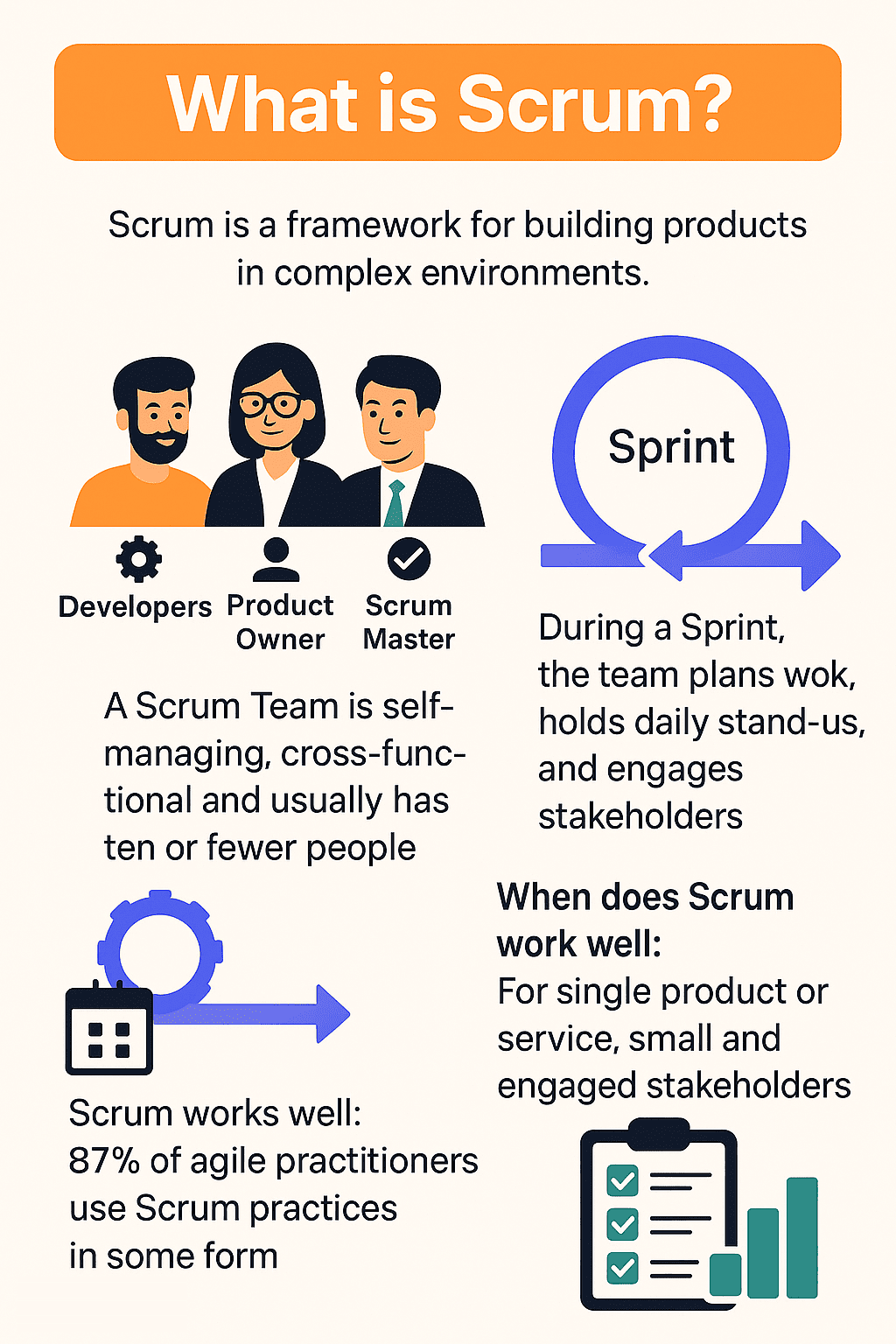
During a Sprint, the team plans the work, meets each day in a short stand-up meeting, reviews the increment with stakeholders, and holds a retrospective to improve. The Product Owner manages a prioritized backlog and makes sure the team builds the most valuable features. This simple cadence allows rapid feedback and continuous improvement. It thrives when you need speed, flexibility, and direct customer collaboration.
When does Scrum work well? Suppose you have a single product or service, a team small enough to coordinate informally, and stakeholders willing to collaborate frequently. In that case, Scrum offers a lightweight structure with few roles and ceremonies. Its popularity underscores its effectiveness—87% of Agile practitioners use Scrum practices in some form. However, Scrum does not prescribe how to coordinate across many teams or manage enterprise-wide portfolios.
What is SAFe?
SAFe (the Scaled Agile Framework) is a comprehensive set of patterns for applying Agile and Lean principles at enterprise scale. It is an organizational and workflow pattern for implementing Agile practices at scale. SAFe promotes alignment, collaboration, and delivery across hundreds of practitioners and is based on Agile, Lean, and systems thinking. SAFe introduces four configurations (Essential, Large Solution, Portfolio, and Full) to suit different levels of complexity.
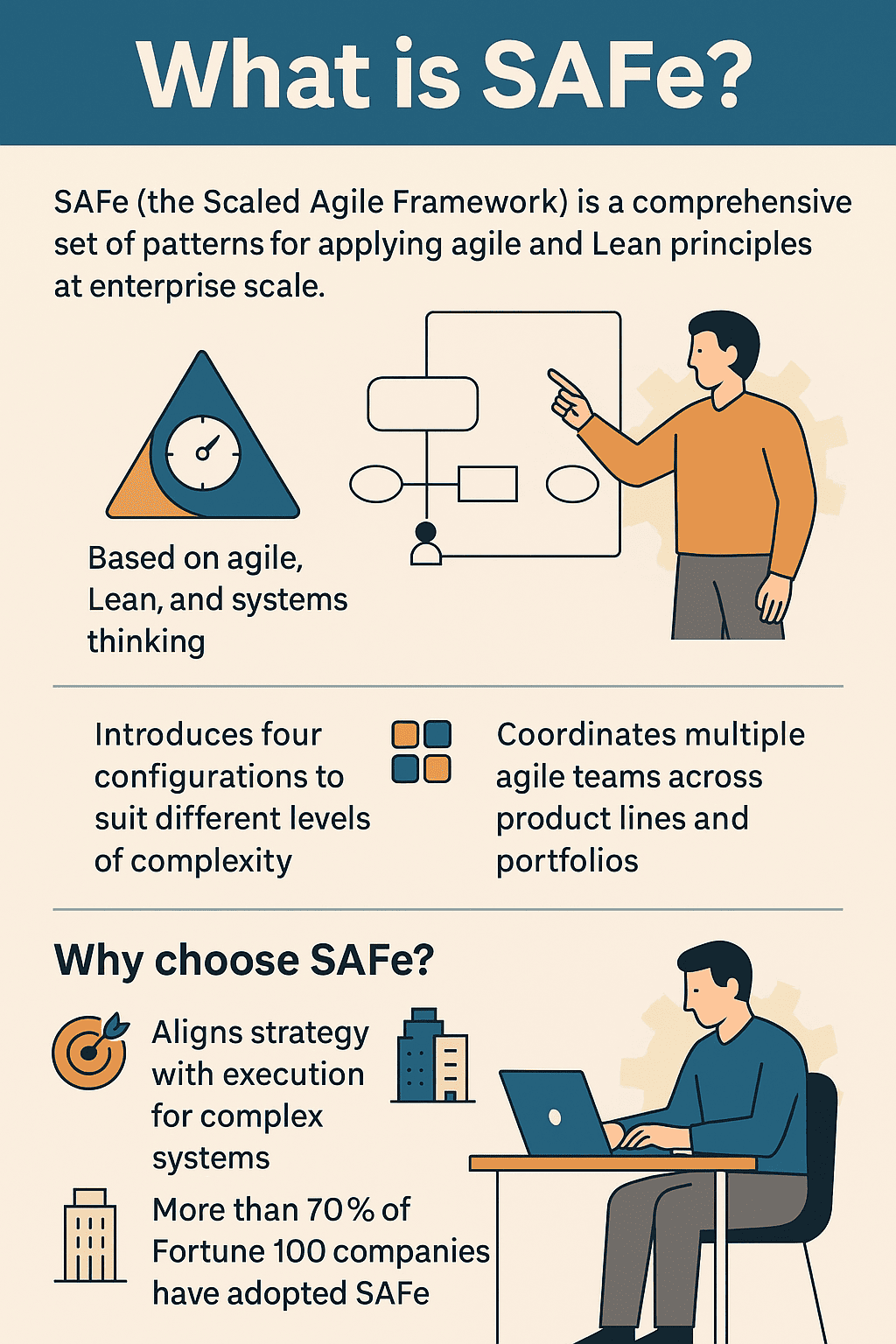
Unlike Scrum’s focus on small teams, SAFe coordinates multiple Agile teams across product lines and portfolios. It adds roles such as Release Train Engineers, Product Managers, and System Architects to manage dependencies and maintain technical governance. Work is planned in Program Increments lasting 8-12 weeks, providing a longer horizon for integrated planning. SAFe also emphasises built-in quality, transparency, and alignment across teams with regular cadence for planning and reflection.
Why choose SAFe? If your organization includes dozens of teams building complex, interconnected systems, SAFe offers a structured approach to align strategy with execution. More than 70% of Fortune 100 companies have adopted SAFe, demonstrating its appeal for large enterprises.
Yet SAFe has critics. Some developers argue it can add bureaucracy if implemented poorly. Success with SAFe requires leadership to treat it as a set of adaptable principles and patterns, not a rigid recipe, to avoid stifling team autonomy.
What Are the Key Differences Between Scrum and SAFe
Now, we will see the difference between these two frameworks in detail:
Organization Structure
Scrum is designed for small, self-organizing teams that work independently or with minimal coordination. The structure is flat, with teams empowered to decide how work is completed. There are no layers of management inside the framework itself, which keeps communication fast and direct.
SAFe, by contrast, is built for large, complex organizations. It introduces multiple layers, including teams, Agile Release Trains (ARTs), and portfolio management. This hierarchical structure helps align strategy, execution, and governance across departments. While Scrum emphasizes autonomy, SAFe emphasizes coordination and alignment at scale.
Timeframe
Scrum works in short, consistent iterations called sprints, typically lasting 1 to 4 weeks. Each Sprint results in a potentially shippable product increment, enabling fast feedback and quick adjustments. Timeframes are predictable but flexible based on team needs.
SAFe operates on longer planning horizons. While teams still use sprints, they are grouped into Program Increments (PIs) that usually span 8 to 12 weeks. This longer timeframe helps align multiple teams, manage dependencies, and coordinate releases. Scrum focuses on rapid, short-term delivery, while SAFe balances short-term execution with long-term strategic planning.
Development Philosophy
Scrum follows a lightweight, adaptive philosophy. It focuses on learning through experimentation, fast feedback, and continuous improvement. Teams are encouraged to inspect results frequently and change direction if needed. The philosophy centers around simplicity, collaboration, and rapid delivery of value.
SAFe adopts a structured, systems-thinking approach. It blends Agile, Lean, and systems engineering principles to improve flow across the entire organization. Instead of optimizing a single team, SAFe looks at the enterprise as a whole, ensuring that development aligns with business strategy. Scrum favors flexibility at the team level, while SAFe prioritizes stability and predictability at scale.
Implementation
Scrum is relatively easy to implement. Organizations can start with a single team by defining roles, setting up a backlog, and beginning short sprints. Minimal training and tooling are required, making Scrum accessible for startups and small teams.
SAFe implementation is more complex and resource-intensive. It often requires formal training, certification, tooling upgrades, and cultural change. Companies usually roll it out in phases, starting with pilot Agile Release Trains before expanding. SAFe implementations also involve executive sponsorship and governance structures. Scrum implementation is quick and lightweight, whereas SAFe requires careful planning and enterprise-level alignment.
Roles
Scrum defines three core roles: Product Owner, Scrum Master, and Developers. Each role has clear responsibilities, and the team is self-managing. The Scrum Master serves as a servant leader, helping remove blockers. At the same time, the Product Owner focuses on value and backlog priorities.
SAFe expands on these roles by adding enterprise-level positions. These include Release Train Engineer, System Architect, Product Manager, and Lean Portfolio Manager. These roles help coordinate work across multiple teams and align it with business objectives. Scrum roles are simple and team-focused, whereas SAFe roles are broader, more specialized, and designed for scale.
Processes
Scrum uses simple, repeatable processes. Work moves through a product backlog, sprint planning, daily stand-ups, sprint reviews, and retrospectives. The focus is on keeping processes minimal while ensuring constant feedback and continuous improvement.
SAFe introduces more formalized processes. It includes Program Increment (PI) planning, synchronized sprint cycles across teams, backlog refinement at multiple levels, and system demos. Processes are designed to coordinate dependencies and reduce risk in large systems. Scrum processes prioritize speed and adaptability, while SAFe processes prioritize consistency, visibility, and controlled delivery.
How to Choose the Right Framework
Deciding between Scrum and SAFe isn’t about passing a personality test. It’s about understanding your context.
You can consider the following questions when choosing the right framework:
- Team Size and Product Scope: Are you working on a single product with a single team, or coordinating multiple products and services? Scrum thrives with a small, autonomous team. SAFe suits large, distributed programs.
- Alignment Vs Autonomy: Do teams struggle to stay aligned across departments, or are they micromanaged? SAFe brings consistent cadence and visibility; Scrum empowers teams to decide how to work.
- Complexity and Dependencies: Do your teams share common components, require integrated releases, or navigate regulatory constraints? SAFe provides roles and ceremonies to manage cross-team dependencies.
- Agile Maturity: Are teams experienced with Agile practices and continuous delivery? SAFe assumes a foundation of Agile knowledge; Scrum is easier to adopt for beginners.
- Stakeholder Engagement: Can your stakeholders collaborate frequently and accept incremental delivery? If yes, Scrum can deliver value quickly. If not, SAFe offers longer planning cycles to coordinate external dependencies.
Ask yourself: Do you need more structure or more flexibility? A candid conversation about these factors will guide you toward a framework that supports your goals instead of hindering them.
Beyond Scrum and SAFe: Other Scaling Frameworks
While Scrum and SAFe are popular choices, they are not the only options for scaling Agile. If your organization finds itself between a single Scrum team and a large SAFe implementation, consider these frameworks:
- LeSS (Large-Scale Scrum): Designed to apply the principles and simplicity of Scrum to many teams working on a single product, with minimal additional roles and structure.
- Nexus: A lightweight framework that extends Scrum for about three to nine teams, focusing on minimizing dependencies and cross-team complexity during a Sprint.
Exploring these alternatives can help you find the most tailored fit for your organization’s specific scale and culture.
Similarities Between SAFe and Scrum
Scrum and SAFe (Scaled Agile Framework) share the same core foundation: both are built on Agile principles and aim to improve how teams deliver value to customers. At their heart, both frameworks promote iterative development, where work is delivered in small, manageable increments rather than large, infrequent releases. This allows teams to gather feedback early and adapt quickly.
Both Scrum and SAFe emphasize transparency. Work is made visible through backlogs, boards, and clear goals, helping teams and stakeholders stay aligned. They also rely heavily on regular inspections and adaptation, using structured ceremonies such as reviews and retrospectives to improve teams, processes, and outcomes continuously.
Another major similarity is their focus on customer value. Both frameworks encourage prioritizing work by business impact, ensuring teams spend time on the most valuable features first. They also promote cross-functional collaboration, where people with different skills work closely together to avoid silos and handoffs.
Leadership and teamwork are central to both approaches. Scrum uses roles such as the Product Owner and Scrum Master, while SAFe scales similar responsibilities across larger groups, but the underlying goal remains the same: enable teams to work effectively and remove obstacles.
Finally, both Scrum and SAFe encourage empirical decision-making, meaning teams make choices based on real data, outcomes, and learning rather than fixed long-term predictions.
FAQs
Q1. Can you combine Scrum and SAFe?
Yes. Many organisations run Scrum in individual teams while adopting SAFe ceremonies, such as the Program Increment planning, to foster cross-team alignment. The frameworks are complementary.
Q2. What is the difference between a Scrum Master and a Release Train Engineer?
A Scrum Master coaches one team and ensures Scrum practices are followed. A Release Train Engineer facilitates planning and delivery across multiple teams in an Agile Release Train.
Q3. Is SAFe only for large enterprises?
SAFe is designed for large organisations but can be adopted in mid-sized companies when multiple teams work on interconnected products or when portfolio governance is needed.
Q4. How long should a Sprint be?
Scrum guidelines recommend a Sprint length of one month or less. Shorter Sprints provide more frequent feedback; longer Sprints may slow learning.
Q5. Do I need special tools to implement SAFe?
While you can use basic boards and spreadsheets, dedicated portfolio management tools make it easier to plan Program Increments, manage dependencies, and provide visibility at scale.
Summary
Scrum and SAFe both offer powerful ways for teams to work more effectively, but they serve fundamentally different organizational needs. Choose Scrum for team-level agility and autonomy. Choose SAFe for enterprise-level alignment and coordination.
Understanding their similarities and strengths helps organizations select the right approach without forcing unnecessary structure or losing agility. The best results come from aligning your framework choice with real team needs, clear strategic goals, and a sustained culture of continuous improvement.
Further Reading:

I am Mohammad Fahad Usmani, B.E. PMP, PMI-RMP. I have been blogging on project management topics since 2011. To date, thousands of professionals have passed the PMP exam using my resources.