When two parties sign a contract, they hope each side will deliver on its promises. But what happens when things go wrong, and it is hard to put a dollar figure on the harm? A liquidated damages clause offers a solution. It specifies in advance the amount one party will pay if the other party breaches the agreement.
Liquidated damages help reduce uncertainty and limit the duration of legal disputes. A liquidated damages clause sets clear expectations from the start and protects both sides. Businesses, employers, and contractors rely on liquidated damages to manage risk when losses are hard to measure.
This blog post explains how liquidated damages work, why courts enforce them, when they turn into penalties, and what recent legal changes mean for employers and contractors today.
Key Takeaways
- A liquidated damages clause sets a specific amount payable if a party breaches a contract, covering losses that are difficult to quantify.
- Courts enforce these clauses when the amount is a reasonable forecast of actual harm and is not punitive.
- Liquidated damages differ from penalty clauses, which are designed to punish and are often unenforceable.
- In 2025, the U.S. Department of Labor barred its Wage and Hour Division from seeking liquidated damages in administrative settlements, citing that the practice extended investigations by 28%.
What Are Liquidated Damages?
Liquidated damages are a pre-agreed sum or formula that one party agrees to pay the other if they breach a contract. They are intended to compensate for real but difficult-to-quantify losses, such as reputational damage or loss of confidential information. Liquidated damages specify the exact amount or formula payable when a breach occurs and must be clearly stated and agreed upon by the parties. They provide certainty and avoid the time and cost of litigating actual damages.
These clauses are common in construction contracts, supply agreements, and real estate transactions. They might cover missed deadlines, late delivery of goods, disclosure of trade secrets, or failure to complete a project. Parties include them when the damages from a breach are difficult to quantify in advance.
Legal Framework and Policy
Contract law principles. Courts enforce liquidated damages clauses when the amount is a reasonable forecast of just compensation for the harm likely to result from a breach. The Federal Acquisition Regulation (FAR) instructs government contracting officers to use liquidated damages only when on-time performance is crucial and actual damages are difficult to estimate. The clause must not be punitive or used as a negative performance incentive. If the amount is grossly disproportional to the anticipated harm, a court may deem it an unenforceable penalty.
How Liquidated Damages Work
Consider a home-purchase contract. The buyer and seller agree that the buyer will pay a $50,000 deposit at closing. The contract states that if the buyer backs out without a valid reason, the seller keeps the deposit as liquidated damages. The deposit represents compensation for the seller’s lost time, missed opportunities, and potential price decline. If the buyer performs, the deposit is applied toward the purchase price.

How courts evaluate the clause:
- Difficulty of measuring harm. Parties must show that actual damages from the breach would be hard to estimate ahead of time. For example, a construction delay may affect a company’s reputation or future revenue, both of which are difficult to quantify.
- Reasonable forecast. The amount must be a reasonable estimate of the anticipated harm, not a penalty. Courts may compare the liquidated amount to evidence of actual damages; if it is vastly higher, they may reject it.
- Proportionality and fairness. Clauses that impose multiple times the contract price or exceed likely losses are often struck down.
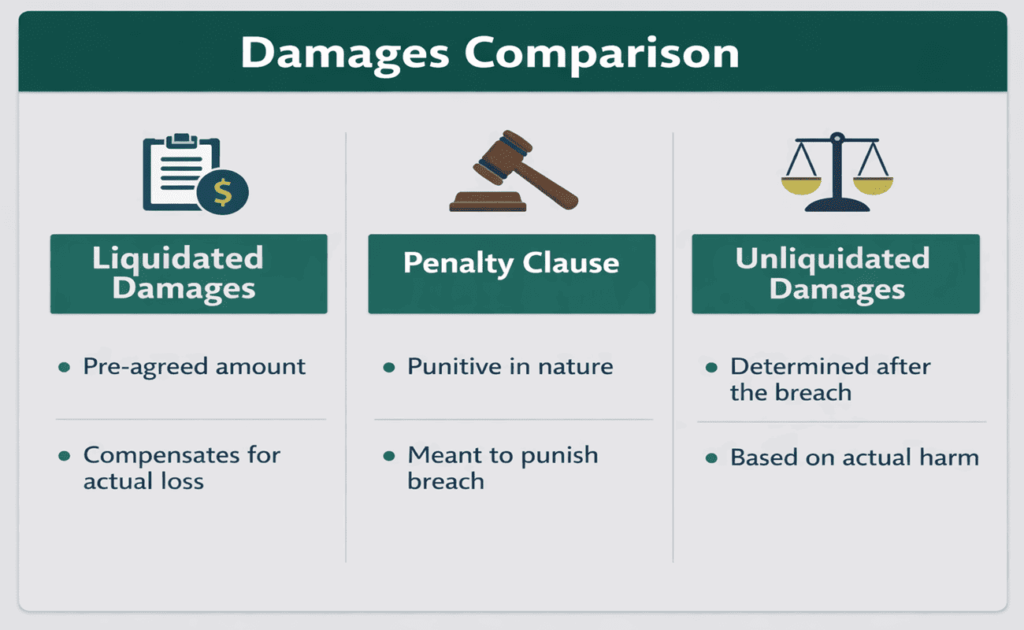
Liquidated Damages Vs Penalty Clauses Vs Unliquidated Damages
Many people confuse liquidated damages with penalties or assume they can always choose whichever remedy suits them. These three concepts differ in important ways.
| Type | Definition | Enforceability |
| Liquidated damages | Pre-agreed amount or formula that compensates for a breach when actual damages are hard to prove. | Enforceable when the amount is a reasonable forecast and not punitive. |
| Penalty clause | Provision intended to punish the breaching party rather than compensate the injured party. | Generally unenforceable because it goes beyond fair compensation. |
| Unliquidated damages | Damages not specified in the contract are determined by a court after the breach. | Must be proved with evidence of actual harm; award depends on the facts of the case. |
Determining a Reasonable Liquidated Damages Amount
- Assess the potential harm. Estimate the cost of delay or breach by considering lost revenue, additional administrative expenses, increased interest costs, and intangible losses such as reputation.
- Use a per-day or per-unit calculation. In many construction contracts, liquidated damages are expressed as a daily rate per day of delay. The FAR recommends using a maximum amount or a maximum period to assess damages when appropriate.
- Document your reasoning. Government guidelines recommend keeping written records of how you calculate the anticipated damage so that you can justify the amount if challenged.
- Avoid punitive figures. Choose a sum that reflects expected losses, not an arbitrary multiplier. Courts may strike down clauses that appear designed to punish.
Enforceability and Special Considerations
Judicial scrutiny. Courts may decline to enforce liquidated damages clauses if they view the amount as a penalty or if the parties could have reasonably calculated actual damages. For example, in some jurisdictions, unliquidated damages may be capped at a percentage of the contract price. Some state laws even specify limits; for instance, certain real estate statutes cap liquidated damages at five percent of the purchase price.
Case example. In Sun Microsystems v.s Microsoft (1997), Sun claimed $35 million in liquidated damages after Microsoft allegedly disclosed Java source code. The case settled for $20 million. This example illustrates that liquidated damages clauses are negotiable and may be reduced if the parties reach a settlement or a court deems the amount excessive.
Policy shifts. As noted above, the U.S. Department of Labor now limits the WHD’s ability to demand liquidated damages outside of court proceedings. Employers facing wage and hour investigations should be aware that the agency can no longer seek these damages administratively and must file a lawsuit to recover them.
International and state differences. Civil law jurisdictions may treat liquidated damages differently. In some European countries, courts routinely adjust liquidated damages to reflect actual harm, while in many U.S. states, the clause stands unless shown to be a penalty. Always consult local counsel when drafting a clause.
Advantages and Disadvantages
Pros:
- Certainty: Liquidated damages provide a known cost for breach, allowing parties to plan for potential losses and avoid expensive litigation.
- Efficiency: They save time and resources by eliminating the need to prove actual damage in court.
- Risk allocation: When used properly, they allocate risk fairly and incentivize timely performance.
Cons:
- Potential unenforceability: Courts may strike down clauses that are punitive or disproportionate to the expected harm.
- Overestimation or underestimation: If the amount is too high, it may deter contractors or create disputes; if it is too low, it may not cover the true cost of a breach.
FAQs
Q1. What is a liquidated damages clause?
A liquidated damages clause is a contract provision that sets a specific amount or formula for damages if one party breaches. It compensates for losses that are hard to quantify.
Q2. Are liquidated damages the same as penalties?
No. Penalty clauses punish the breaching party and are generally unenforceable. Liquidated damages compensate for hard-to-measure losses.
Q3. How do I calculate a reasonable amount?
Estimate the expected harm from a breach, such as lost revenue and administrative costs, and document your reasoning. Use a per-day rate if appropriate.
Q4. Can the amount be challenged in court?
Yes. Courts will enforce the clause only if the amount is a reasonable forecast and not punitive. If actual damages are easy to prove or the figure is excessive, the court may strike it down.
Q5. Do recent laws affect liquidated damages clauses?
In 2025, the U.S. Department of Labor barred its Wage and Hour Division from seeking liquidated damages in administrative settlements. This change applies only to wage-and-hour cases and does not affect private lawsuits or liquidated damages clauses in other contracts.
Summary
Liquidated damages help contracts stay clear when real losses are hard to measure. By setting a fair amount in advance, both parties know the risk of a breach. Courts support these clauses when they reflect honest estimates, not punishment. Used correctly, liquidated damages save time, reduce disputes, and limit legal costs. They also create certainty for businesses and individuals. Before signing any contract, it’s wise to review how the liquidated damages clause works and whether the amount matches the possible damage.

I am Mohammad Fahad Usmani, B.E. PMP, PMI-RMP. I have been blogging on project management topics since 2011. To date, thousands of professionals have passed the PMP exam using my resources.