The Project Management Body of Knowledge (PMBOK) Guide is the handbook many project managers turn to for guidance. Over the years, it has evolved from a prescriptive set of process steps into a flexible reference built around principles and outcomes.
With the Eighth Edition now available as a digital download and the new PMP exam launching worldwide on July 9, 2026, understanding the differences between the PMBOK Guide 7th and 8th editions is more important than ever.
In this blog post, you’ll learn what changed, why it matters, and how to prepare for the upcoming exam update.
Let’s get started.
What is the PMBOK Guide?
The PMBOK Guide is both a standard and a handbook. The standard defines what project management is and the environment in which projects operate. The guide explains and expands on the standard through principles, performance domains, and now Focus Areas. It is not meant to be read cover-to-cover. Instead, think of it as a toolbox you can open whenever you face a new planning challenge or need to clarify a concept with your team.
How the PMBOK Guide 7th Edition Changed the Landscape
When the Seventh Edition arrived in 2021, it signaled a major shift. Rather than listing processes and knowledge areas, it introduced 12 principles to guide behavior and 8 performance domains focused on outcomes such as team cohesion, stakeholder engagement, and value delivery.
It removed the long-standing Process Group structure and encouraged tailoring for predictive, agile, or hybrid methods. While many appreciated the flexible mindset, some practitioners struggled without detailed process guidance. They missed the familiar flow of Initiating -> Planning -> Executing -> Monitoring & Controlling -> Closing and asked for clearer, actionable examples.
The Road to the PMBOK Guide 8th Edition: A Data-Driven Development
PMI took the feedback seriously. For the Eighth Edition, it gathered input from thousands of project professionals and more than 48,000 data points. The development team balanced modern principles with practical guidance, resulting in a guide that both inspires and instructs.
Released digitally in November 2025, the Eighth Edition retains the Seventh Edition’s focus on outcomes while simplifying the principles, aligning the performance domains with core responsibilities, and bringing back process-level detail. As a PMI chapter leader once told me, “We need a guide that speaks to the head and the hands.” The PMBOK Guide 8th Edition aims to do just that.
Comparing the PMBOK Guide 7th and 8th Edition
The table below summarizes the most significant changes between the Seventh and Eighth Editions. These changes fall into five categories: principles, processes, lifecycle structure, performance domains, and terminology. Note how the Eighth Edition consolidates and clarifies information while restoring some familiar structure.

Key Differences Explained
- Principles: The PMBOK Guide, 7th edition, introduced twelve broad principles. The PMBOK Guide 8th edition streamlines them to six clear principles (see the next section) to reduce overlap and make them easier to apply across industries.
- Processes: The Seventh Edition removed formal processes. The PMBOK Guide 8th edition reintroduces about 40 processes, including their inputs, tools, techniques, and outputs, giving practitioners practical “how-to” guidance without prescribing a single method.
- Lifecycle Structure: The Seventh Edition abandoned Process Groups altogether. The Eighth Edition brings back the familiar flow as five Focus Areas: Initiating, Planning, Executing, Monitoring & Controlling, and Closing, but treats them as flexible categories rather than strict phases.
- Performance Domains: The eight outcome-based domains of the PMBOK Guide 7th edition evolve into seven domains aligned with core responsibilities: Governance, Scope, Schedule, Finance, Stakeholders, Resources, and Risk. This alignment helps map guidance directly to real-world planning and governance tasks.
- Terminology and Tools: The Eighth Edition uses clearer language and restores the inputs, tools & techniques, and outputs structure that many teams rely on for templates and training.
Why These Changes Matter
By blending principles with processes, the PMBOK Guide, 8th edition, bridges the gap between mindset and mechanics. Newer project managers gain a clear framework to understand how a project flows from start to finish. Experienced professionals regain the detail they need to tailor templates and tools to their context. The Eighth Edition also emphasizes value delivery, sustainability, and emerging technologies such as artificial intelligence (AI) and predictive analytics, ensuringthe guide reflects modern project environments.
The Six Principles of The PMBOK Guide 8th Edition
The PMBOK Guide, 8th edition, consolidates 12 principles into six concise guidelines that apply to any project. Each principle combines several ideas from the previous edition. Together, they provide a holistic mindset for project managers.
- Adopt a Holistic View: Look beyond individual tasks to see how your project fits within the organization and broader system. Systems thinking, adaptability, and complexity management come together here.
- Focus on Value: Success is measured by outcomes, not just deliverables. Always ask whether each activity contributes to value for stakeholders and the organization.
- Embed Quality Into Processes and Deliverables: Quality is designed in from the start, not inspected at the end. Make continuous quality management part of every phase.
- Be an Accountable Leader: Combine stewardship, servant leadership, and accountability. Create clarity, inspire trust, and take responsibility for outcomes.
- Integrate Sustainability Within All Project Areas: Consider environmental, social, and economic impacts. This new emphasis reflects global expectations and regulatory trends.
- Build an Empowered Culture: Encourage collaboration, psychological safety, and autonomy. High-performing teams thrive when they feel safe to innovate and make decisions.
These principles guide decision-making across predictive, agile, and hybrid environments. For example, when planning a construction project, taking a holistic view helps you consider supply-chain risks and community impact, while integrating sustainability ensures materials and waste management support long-term goals.
Focus Areas and Performance Domains
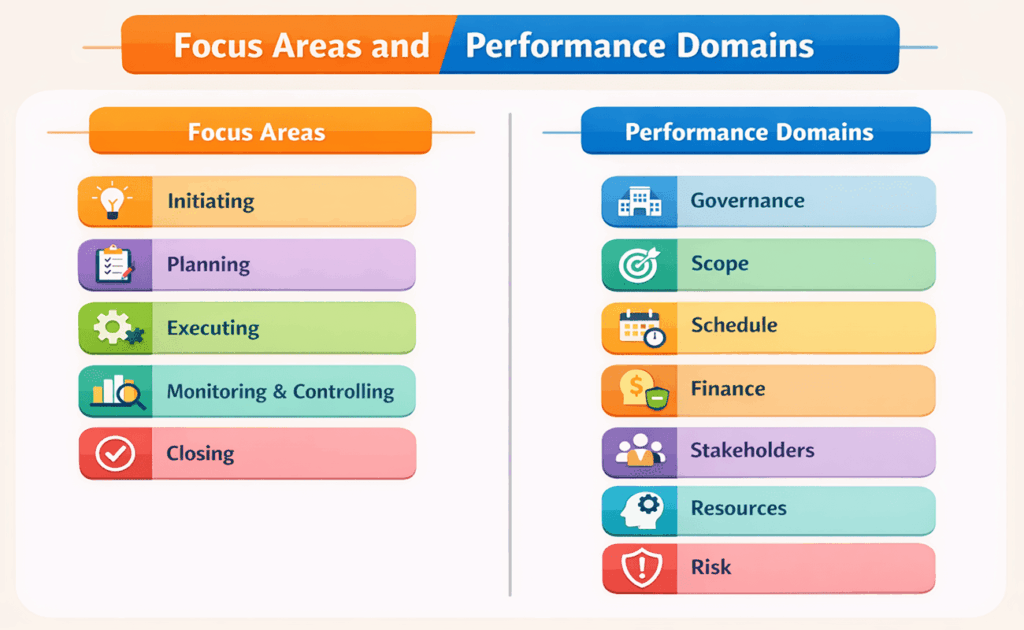
In earlier editions, Process Groups anchored planning and execution. The PMBOK Guide 7th edition removed them, causing confusion for some readers. The PMBOK Guide 8th edition brings back structure through Focus Areas and aligns the Performance Domains with the tasks project managers actually perform.
The Five Focus Areas
- Initiating: Align the project with strategic objectives, define high-level intent, and secure authorization. During the initiation phase, you develop the charter and identify stakeholders.
- Planning: Scope, schedule, cost, risk, quality, procurement, and resources come together in a coherent plan. Planning is iterative; revisit it whenever conditions change.
- Executing: Deliver work, coordinate teams, and manage stakeholder engagement. Leadership and communication are critical here.
- Monitoring & Controlling: Track performance, manage issues, and compare progress against plans. Adjust the plan when necessary to stay aligned with objectives.
- Closing: Hand over deliverables, ensure acceptance, capture lessons learned, and measure long-term benefits.
The Seven Performance Domains
- Governance: Define roles, decision rights, and accountability. Align project decisions with organizational strategy.
- Scope: Ensure project outputs meet agreed requirements and remain aligned with business value.
- Schedule: Create realistic timelines, monitor progress, and adapt to changes.
- Finance: Manage budgets, funding, and cost control. Understand the financial impacts of scope and schedule decisions.
- Stakeholders: Identify and engage people who influence or are impacted by the project. Maintain open communication and adapt to their needs.
- Resources: Plan and manage the people, materials, and tools required to deliver the project.
- Risk: Proactively identify, assess, and respond to threats and opportunities. Risk management is ongoing throughout the project.
By mapping guidance to these domains, the PMBOK Guide 8th edition helps practitioners align their work with organizational governance and value delivery. For example, when managing a software rollout, you can tie scope decisions directly to stakeholder needs, budget constraints, and risk tolerances.
New Topics in The PMBOK Guide 8th Edition: AI, Sustainability, and Value
One of the most notable changes in the Eighth Edition is the expansion of emerging topics. These include artificial intelligence, sustainability, predictive analytics, and modern PMOs. PMI recognized that trends like AI and sustainability are reshaping how projects are executed. As explained in the updated PMP Examination Content Outline, PMI assessed the impact of trends such as AI and sustainability on professional practice and used these inputs to validate what the exam measures. This ensures that future project managers can apply technology and environmental considerations responsibly.
The guide also emphasizes value delivery. Projects aren’t just about completing tasks; they’re about achieving outcomes that justify the investment. Value now includes quality, stakeholder satisfaction, long-term benefits, sustainability, and alignment with organizational objectives. For instance, a renewable-energy project should be evaluated not only on whether it meets budget and schedule but also on how it supports environmental goals and community needs.
Impact on the PMP Exam
The PMBOK Guide, 8th edition, directly influences the PMP certification. The updated exam will be available globally starting July 9, 2026. Candidates who wish to take the current version must sit for the exam before July 8, 2026. New learning resources will be released on April 14, 2026, to align with the next exam version.
While the exam still covers People, Process, and Business Environment domains, it places greater emphasis on sustainability, AI, value delivery, and governance. According to the 2026 Examination Content Outline, PMI integrated trends such as AI and sustainability into its job task analysis to ensure the exam measures the tasks most relevant to modern practice.
What Does This Mean for the PMP Aspirants?
If you’re studying for the current exam, continue your preparation; core principles remain the same. If you plan to test after July 9, begin familiarizing yourself with the new guide and emerging topics. Think about how AI tools can improve risk analysis or scheduling and how sustainability considerations affect project decisions. You might also use PMI resources, such as the Study Hall and practice exams, to deepen your knowledge.
Preparing for the 2026 PMP Exam
- Read the PMBOK Guide 8th Edition: Focus on understanding the six principles, seven domains, and the rationale behind the focus areas. Pay attention to new topics like AI and sustainability.
- Map Concepts to Experience: Reflect on your own projects. How have you built an empowered culture? When did value considerations guide scope decisions? Real stories help cement concepts.
- Use Tailoring Wisely: No single method fits all projects. Tailor processes and tools based on your context. For example, an agile software team may emphasize stakeholder engagement and rapid iteration, while a construction project may require detailed scheduling and finance controls.
- Practice Scenario-Based Questions: The updated exam uses situational questions. Work through scenarios that test your ability to apply principles, domains, and focus areas.
- Engage with Your Community: Join study groups or PMI chapters. Discussing topics like AI’s role in risk management or sustainability in procurement will deepen your understanding.
FAQs
Q1. When was the PMBOK Guide 8th edition released?
PMI released the digital version in November 2025 and plans to publish the physical edition in early 2026.
Q2. How many principles does the PMBOK Guide 8th edition include?
The Eighth Edition contains six principles: holistic view, value focus, embedded quality, accountable leadership, integrated sustainability, and empowered culture.
Q3. What is the last day to take the current PMP exam?
Candidates must sit for the current exam by July 8, 2026. The new exam version rolls out on July 9.
Q4. Does the PMBOK Guide, 8th edition, eliminate agile approaches?
No. The guide integrates predictive, adaptive, and hybrid methods throughout its principles, domains, and focus areas, supporting flexibility in delivery.
Q5. How does AI influence project management according to the PMBOK Guide, 8th edition?
AI assists with forecasting, risk identification, and data-driven decisions. PMI included AI trends in its exam analysis to ensure professionals can apply technology responsibly.
Summary
The PMBOK Guide 8th edition marks a practical evolution from the PMBOK Guide 7th edition by blending principle-driven thinking with clear process guidance. It simplifies the principles, aligns performance domains with real project responsibilities, and reintroduces structured focus areas. The guide also highlights value delivery, sustainability, and emerging technologies like AI. With the updated PMP exam launching in July 2026, understanding these changes will help you adapt your approach, strengthen your leadership skills, and stay competitive in modern project environments.

I am Mohammad Fahad Usmani, B.E. PMP, PMI-RMP. I have been blogging on project management topics since 2011. To date, thousands of professionals have passed the PMP exam using my resources.