Leadership styles shape how teams feel, perform, and innovate. In a world where virtual and hybrid teams are the norm, old command-and-control approaches no longer fit. Most of us have experienced bosses who issue orders rather than guidance, and we know how demoralizing that can be. What if there were a way to lead that put people first and still delivered results?
In this blog post, we will explore traditional and servant leadership and explain why the latter resonates so strongly in today’s workplace.
What is Traditional Leadership?
Traditional leadership is a management style where authority flows from the top down. The leader holds most of the power and makes the main decisions. Team members follow instructions rather than take part in decision-making. This approach focuses on structure, clear roles, and strong control over tasks and performance.
Leaders set goals, assign work, and monitor results closely. Many organizations used this style during the industrial era because it creates order and quick decisions. However, relying too heavily on authority rather than collaboration and open communication with their teams may limit creativity and employee engagement.
Origins of Servant Leadership
The phrase “servant leadership” dates back to 1970, when management thinker Robert K. Greenleaf wrote his essay The Servant as Leader. He argued that great leaders begin with a desire to serve others. Rather than being driven by status or authority, they see leadership as a tool to help people grow.
At a glance, the words “servant” and “leader” may seem at odds. When we view leading as an act of support and service, however, the contradiction disappears. Servant leaders give their teams autonomy, guidance, and resources; they still provide direction, but with humility and care.
Comparing Traditional and Servant Leadership
Traditional leadership grew out of industrial-age hierarchies. In that model, power flows from the top down. Leaders give orders and expect compliance. Employees may feel like cogs in a machine. Success is measured by authority and control. Servant leadership turns that pyramid on its head. Instead of using authority to demand obedience, servant leaders focus on supporting and empowering those around them. They see themselves as stewards who remove obstacles, share information, and encourage growth.
The table below summarises the key differences between these two approaches. A light background and clear icons help convey the contrasts at a glance.
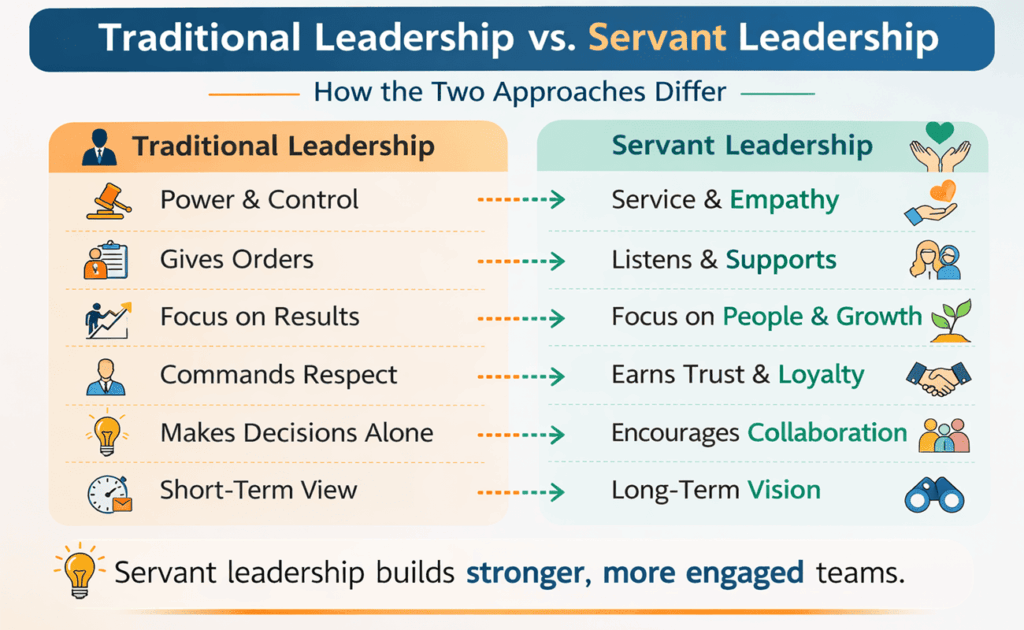
In a traditional model, the boss wields power and expects obedience. In a servant model, the leader listens and collaborates. Traditional leaders guard information; servant leaders share knowledge freely. Traditional leaders measure success by personal achievement; servant leaders measure success by team growth and well-being. Both styles can deliver results, but only one aligns with today’s workforce expectations.
Why Servant Leadership Matters Today
Employees crave hope and trust
Recent research from Gallup’s Global Leadership Report shows that followers want four things from their leaders: hope, trust, compassion, and stability. Hope stands out as the dominant need, desired by 56% of followers worldwide, while trust ranks second at 33%. Compassion and stability make up the remaining 11%.
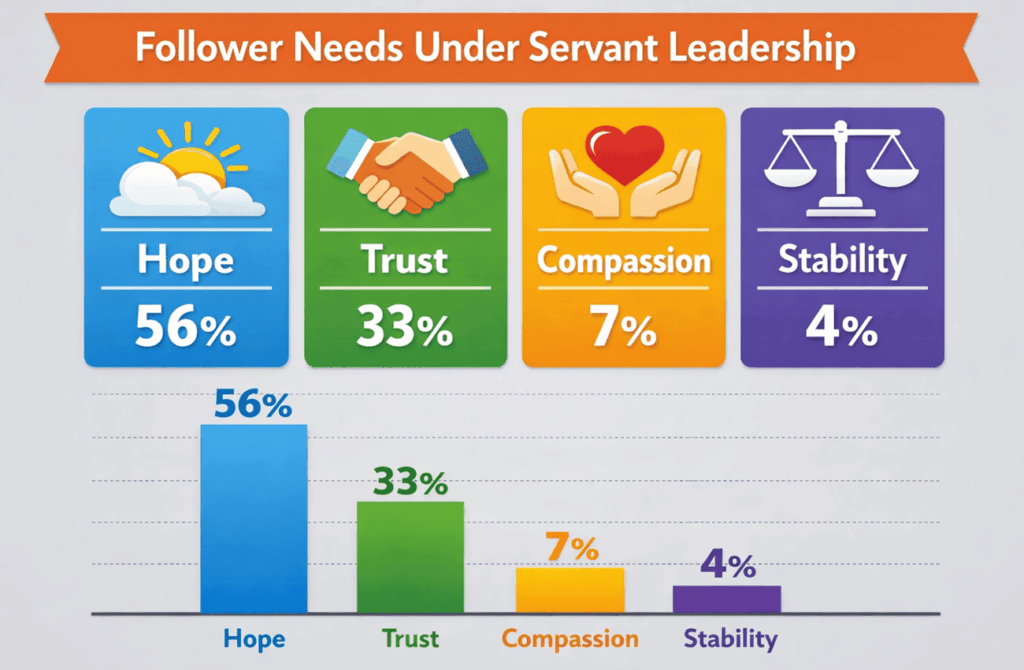
Gallup also found that followers are far more likely to look for hope from top executives than from direct supervisors or colleagues (64% versus 59% and 58%, respectively). These findings suggest that leaders who communicate a positive vision and build trust have a profound impact on morale.
The rise of remote work
Hybrid and remote work amplify the need for servant leadership. Data from the U.S. Bureau of Labor Statistics show that 24.9% of employed adults aged 25 and older teleworked in the first quarter of 2024, up from 21.5% in the first quarter of 2023. Telework rates climb to 43.6% for workers with advanced degrees, indicating that knowledge workers spend much of their time away from a central office. In a distributed environment, leaders cannot rely on physical presence or constant oversight. Servant leadership, built on trust, clear communication, and empowerment, helps remote teams thrive.
Empathy is linked to retention
Empathy isn’t just nice; it has financial stakes. Businessolver’s 2025 State of Workplace Empathy report found that 27% of employees view their organization as unempathetic, and those employees are 1.5 times more likely to change jobs within six months, costing U.S. companies an estimated $180 billion in attrition each year. When leaders practice empathy by listening, acknowledging feelings, and supporting mental well-being, employees feel valued and stay longer. Servant leadership, which prioritizes empathy, connection, and psychological safety, directly addresses this concern.
Benefits of Servant Leadership
Higher engagement and innovation
Servant leadership encourages people to speak up and contribute ideas. When team members know their opinions matter, they are more likely to innovate. Instead of worrying about pleasing a boss, employees focus on solving problems and creating value. Empowered teams often find creative solutions because they are trusted to experiment. Servant leaders celebrate successes but also provide a safe space for failure and learning.
Improved retention and culture
People want to work for leaders who respect them. By listening actively and responding with empathy, servant leaders build loyalty. Employees who feel supported stay longer, reducing turnover and recruiting costs. A culture built on service encourages kindness, collaboration, and mutual respect. It’s no coincidence that companies praised for employee happiness often adopt servant-like practices.
Better performance during change
Change is constant, whether due to technology shifts, economic pressures, or social change. Servant leaders help teams navigate uncertainty by focusing on clear communication and shared purpose. When a leader explains why changes are happening and seeks input, people feel less anxious. This transparency builds resilience. Servant leaders also look out for their team’s well-being, which is crucial when stress levels rise.
FAQs
Q1. What are the core principles of servant leadership?
Servant leadership centers on listening, empathy, awareness, persuasion, clear communication, humility, and stewardship. These principles guide leaders to put their team’s needs first and encourage growth.
Q2. How does servant leadership differ from traditional leadership?
Traditional leadership relies on authority and control, with leaders giving orders. Servant leadership flips the script: leaders serve their teams, share power, and prioritize collaboration. The goal is to help people develop and succeed.
Q3. Can servant leadership work in a fast-paced business?
Yes. While it emphasizes service, servant leadership does not eliminate accountability. By empowering teams and communicating clear priorities, servant leaders can respond quickly to market demands and drive innovation.
Q4. How do I start practicing servant leadership?
Begin by listening more than you speak. Ask your team how you can support them. Share information openly and model humility. Small, consistent actions build trust and set the stage for larger cultural shifts.
Q5. Is servant leadership compatible with remote work?
Absolutely. Remote teams rely on trust, clarity, and empathy, which are key components of servant leadership. By checking in regularly, providing resources, and celebrating accomplishments, servant leaders help distributed employees feel connected and valued.
Summary
Traditional and servant leadership take very different paths to guide teams. Traditional leaders focus on authority, control, and clear direction. Servant leaders focus on support, trust, and their people’s growth. Both styles can achieve results, but modern workplaces often benefit from leaders who empower teams and encourage collaboration. When leaders listen, show empathy, and remove obstacles, employees perform better. Organizations that balance structure with service can build stronger cultures and achieve long-term success.

I am Mohammad Fahad Usmani, B.E. PMP, PMI-RMP. I have been blogging on project management topics since 2011. To date, thousands of professionals have passed the PMP exam using my resources.