Six Sigma belts help professionals improve processes, reduce errors, and deliver better results. Six Sigma belt levels show a step forward in skills, responsibility, and leadership. From White Belt beginners to Master Black Belt experts, the journey builds strong problem-solving abilities.
Many industries, such as manufacturing, healthcare, and finance, use Six Sigma to improve quality and efficiency. If you want to grow your career and make a real impact, understanding these belt levels is important. But which Six Sigma belt level should you choose first?
This blog post explains each level in simple terms so you can decide on the best path for your goals.
Key Takeaways
- Belt hierarchy: White and Yellow Belts build basic awareness. Green Belts lead small projects. Black Belts drive cross-functional change. Master Black Belts set strategy and mentor others.
- Training time: Entry levels take just days, while advanced belts require several weeks of study and practice.
- Salary growth: Data from 2025 shows that moving from Green Belt to Black Belt can raise base pay by 30–40%, and Master Black Belts often earn six-figure salaries. Different industries also pay differently.
- Market demand: The Lean and Six Sigma services market is growing fast; it was valued at $1.6 billion in 2023 and is projected to reach $4.3 billion by 2030, with a 13.6% compound growth rate.
- Digital-age adaptation: Modern tools like AI, IoT, and cloud platforms enhance Six Sigma. In one example, AT&T reduced customer complaints by 60% and improved installation accuracy to 95% by applying DMAIC to its broadband services.
Understanding Six Sigma Belt Levels
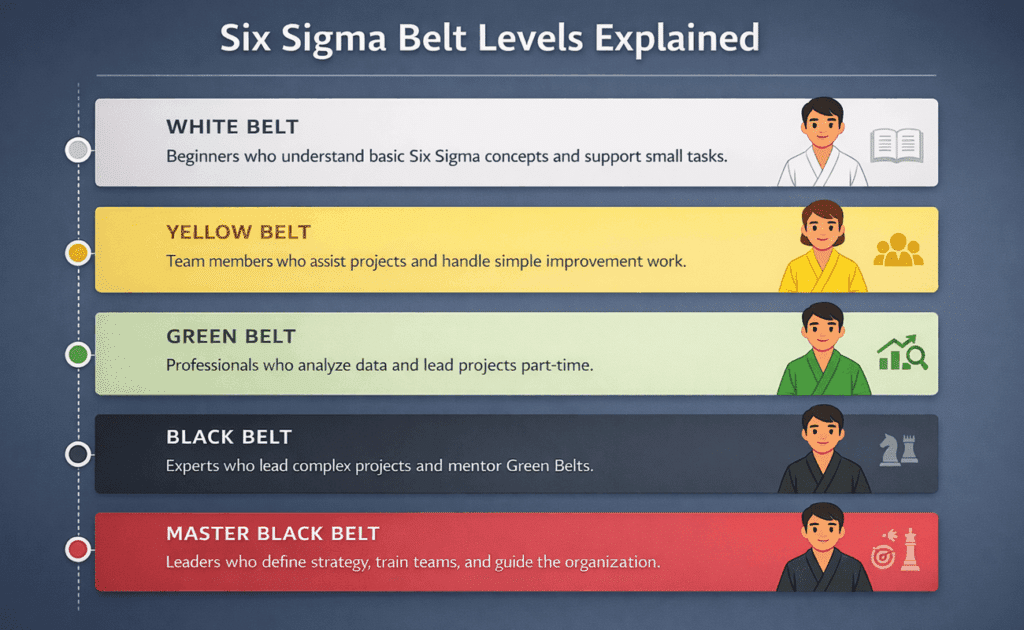
Lean Six Sigma uses a belt system, much like martial arts, to mark progress in knowledge and leadership. Each belt builds on the last. White and Yellow Belts provide awareness; Green Belts lead departmental projects; Black Belts manage great cross-functional efforts; and Master Black Belts set strategy and mentor others. You can begin at any level, but most professionals start with Yellow or Green to gain a solid foundation.
White Belt
A White Belt is an entry point. Training takes about a day and covers basic concepts like variation and waste. White Belts support teams rather than lead projects. They often work in administrative or support roles and use simple tools to identify issues. While there is little industry recognition for this level, it’s useful for absolute beginners who want to speak the same language as improvement teams.
Yellow Belt
Yellow Belt builds on the basics. Training may last two days and introduces core Lean tools, terminology, and simple problem-solving methods. Yellow Belts work as team members, collect data, and help implement improvements under a Green or Black Belt’s guidance. This level is ideal for entry-level professionals in healthcare, logistics, finance, or operations. Many employers recognize the Yellow Belt as a valuable credential for staff who support projects.
Green Belt
Green Belts take on more responsibility. Training, which lasts about four days or a few weeks in an online program, covers the DMAIC (Define-Measure-Analyze-Improve-Control) framework, statistics, and data analysis. Green Belts lead small to mid-size projects and often support Black Belts on larger initiatives. Typical roles include process analyst, operations manager, and quality engineer. According to a 2025 salary guide, Green Belts in the United States earn about $85,000 to $100,000 a year.
Black Belt
Black Belts are advanced leaders. Training often requires 10 days of intensive study or 4 to 7 weeks of online study. Black Belts manage cross-functional projects, use advanced statistical tools, and mentor Green Belts. They work in sectors such as aerospace, supply chain, healthcare, and finance. Average salaries for Black Belts range from $112,000 to $130,000, and moving from Green Belt to Black Belt can lead to a 30–40% pay increase.
Master Black Belt
The Master Black Belt (MBB) represents the highest qualification. Candidates usually need a recognized Black Belt and significant project experience. Training can vary from six to eight weeks and focuses on strategy, program deployment, and coaching. MBBs mentor Black and Green Belts, guide enterprise-wide improvement, and often serve as senior consultants or program leaders. In 2025, MBBs earned around $145,000 and could exceed $200,000 with bonuses.
Who Hires Each Belt Level?
Employers look for different belts based on the scale of their improvement efforts. Yellow Belts are common in analyst or team contributor roles where they support data collection and problem-solving. Green Belts are sought after in operations, quality, supply chain, and process improvement roles. They lead small projects and support larger initiatives.
Black Belts often step into continuous improvement manager, senior operations, or consulting positions and lead high-impact, cross-functional projects. Master Black Belts are hired for program leadership and strategic roles; they oversee deployment, coach other belts, and align improvement with organizational goals.
Comparing Six Sigma Belt Levels: Which One is Right for You?
Choosing between the Yellow and Green Belt depends on your experience and goals. The Yellow Belt is a quick introduction for people new to Lean Six Sigma or those who want to support projects without leading them. If you aim to lead projects and dive deeper into data and DMAIC, Green Belt is a better fit. When deciding between a Green Belt and a Black Belt, consider the scope of work you want.

Green Belts normally handle department-sized projects and often balance improvement duties with other responsibilities. Black Belts commit full-time to improvement and drive organization-wide change. Ready to step up? Black Belt training adds advanced statistics, leadership, and strategic deployment skills.
Career Impact & Salary Trends
Certification brings financial rewards. A 2025 salary guide based on U.S. job boards and compensation reports found that Green Belts earn around $85,000 per year, Black Belts about $112,000, and Master Black Belts about $145,000. Moving from Green Belt to Black Belt often yields a 30–40% salary increase. Industry matters too. Manufacturing salaries range from $78,000 to $135,000; healthcare from $82,000 to $140,000; technology from $95,000 to $160,000; financial services from $90,000 to $150,000; and consulting from $100,000 to $175,000.
Green Belts and Black Belts working in technology or consulting often earn at the high end of these ranges. These figures show that continuous improvement expertise translates into higher pay, especially when paired with high-demand industries.
How to Choose the Best Belt Level for Your Goals
Start by asking yourself what role you want in process improvement. If you’re new to the field or simply want a basic understanding, a White or Yellow Belt offers a quick foundation. Those ready to lead projects should consider Green Belt, especially if they work in operations, quality, supply chain, or project management. Professionals who aspire to lead complex, cross-functional initiatives and mentor others will benefit from a Black Belt.
Master Black Belt suits leaders who want to design and oversee improvement strategies across an organization. Reflect on your current experience, desired level of responsibility, and long-term career goals. Remember that each belt builds on the previous one, so continuous learning is key.
FAQs
Q1. What are the Six Sigma belt levels?
There are five main belts: White, Yellow, Green, Black, and Master Black Belt. Each level represents a deeper understanding and greater responsibility.
Q2. Do I need a Yellow Belt before a Green Belt?
No. You can start with Green Belt if you’re comfortable learning Six Sigma concepts without prior certification. Many beginners find the Yellow Belt helpful as a foundation.
Q3. How long does it take to earn a Six Sigma certification?
The time varies by belt level. Yellow Belt takes one to two weeks, Green Belt about three to five weeks, and Black Belt four to seven weeks. Most programs are self-paced.
Q4. Do Six Sigma certifications expire?
Certifications from reputable providers usually do not expire. Some organizations require periodic recertification, but others, such as SSGI, offer lifetime credentials.
Q5. Is Six Sigma certification worth it?
Yes. Six Sigma improves problem-solving skills, career prospects, and salary potential. Employers across industries value these credentials for process improvement roles.
Q6. Can I skip a belt and go straight to a higher level?
Yes. Many professionals begin with a Green Belt or a Black Belt, depending on their experience. However, starting with a lower belt can make advanced topics easier to grasp.
Summary
Lean Six Sigma gives professionals a clear roadmap to reduce waste, improve quality, and drive change. Each belt level builds on the last, leading from basic awareness to strategic leadership. As the market for Lean and Six Sigma services grows and digital tools enhance methodologies, certification remains a smart investment. By choosing the right belt for your goals and committing to continuous improvement, you can position yourself at the forefront of operational excellence.

I am Mohammad Fahad Usmani, B.E. PMP, PMI-RMP. I have been blogging on project management topics since 2011. To date, thousands of professionals have passed the PMP exam using my resources.