Team-building activities are essential for building a cohesive, engaged team that works effectively to achieve common goals. A strong, connected team doesn’t just happen; it requires continuous effort, time, and the right activities to foster trust, motivation, and collaboration.
Selecting appropriate team-building activities is crucial. The right activities inspire confidence and energize the team, while unsuitable choices can waste resources and demotivate participants. Unlike random groups, teams consist of individuals united by shared objectives, where collective success depends on collaborative efforts rather than independent actions.
These activities allow team members to connect personally, boosting morale and improving job satisfaction.
In today’s article, we will explore various team-building activities and share recommendations to help you create a motivated and high-performing team.
What are Team Building Activities?
Team building activities are exercises or games that help team members connect, improve communication, and build trust. They are designed to make people feel comfortable working together, boosting team productivity and morale.
According to Forbes, team building is “the most important investment you can make for your people.”
Common team-building activities include problem-solving games, trust exercises, and team challenges.
For example, a group might work on a puzzle or complete an obstacle course together. Activities like these encourage people to share ideas and support each other, helping them understand their strengths and weaknesses as a team.
Team-building activities can be indoors or outdoors, depending on the goals and preferences. These activities strengthen and cohesively unite a group by fostering cooperation, respect, and a sense of belonging.
What is the Main Purpose of Team Building Activity?
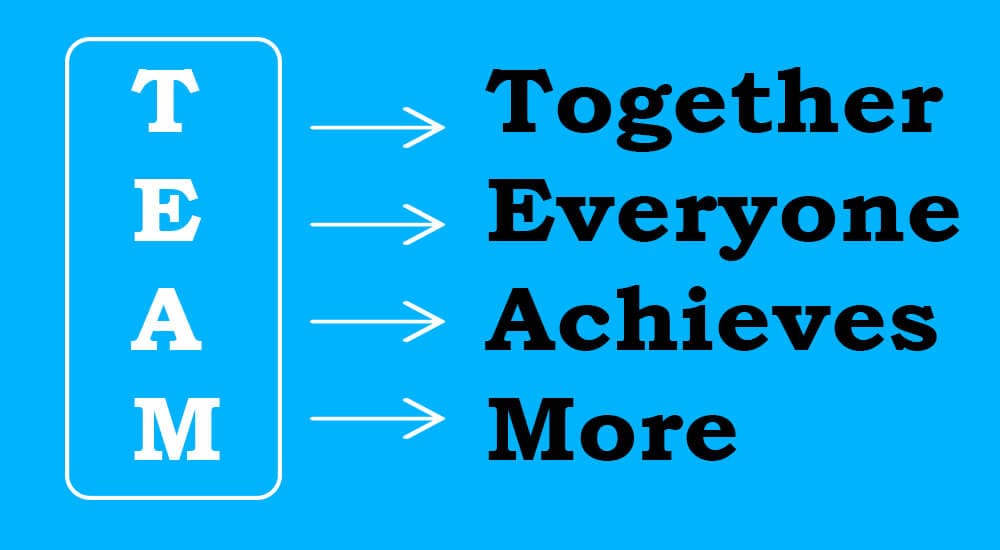
The main purpose of a team-building activity is to strengthen team cohesion and improve collaborative skills within a group. Team-building activities encourage open communication, fostering an environment where team members feel comfortable sharing ideas and addressing issues directly.
This increased trust boosts productivity as team members work more effectively together, making faster and better decisions and relying on each other’s strengths. Research shows that organizations with strong team-building practices report reduced employee turnover and improved morale.
These activities give team members a sense of psychological safety, which in turn promotes creativity and reduces conflicts within the group. Structured activities like problem-solving exercises or trust-building games allow individuals to connect personally and professionally, improving engagement and job satisfaction.?
How to Organize Team-Building Activities
For a successful team-building activity, follow these key steps:
- Select an Activity: Choose an activity that aligns with your business goals and team needs. Ensure it offers valuable outcomes, such as improved communication or problem-solving skills.
- Prepare for the Activity: Gather all necessary materials, assign roles if needed, and set up the space or stage in advance. Understanding the activity’s details helps ensure a smooth experience.
- Explain the Activity: Provide clear instructions and set specific goals. Make sure everyone understands the rules and purpose, and welcome participants with enthusiasm to set a positive tone.
- Conduct the Activity: Let team members engage with minimal guidance. This hands-off approach encourages natural teamwork and lets members fully immerse themselves.
- Debrief the Activity: After the activity, discuss observations, outcomes, and any challenges. Prepare questions in advance to encourage open discussion and reflection.
- Reinforce the Learning: Emphasize how insights from the activity can be applied to everyday work. Encourage participants to use new skills and dynamics in their roles.
23 Most Popular Team Building Activities
Team-building activities are a powerful tool for enhancing teamwork, communication, creativity, and problem-solving within a team. Each theme focuses on specific skills, with activities tailored to strengthen those areas. Here, we explore five team-building activities under the theme of “Teamwork.”
(a) Teamwork Activities

1. Kudos
This activity encourages participants to recognize and appreciate each other’s unique contributions, boosting team morale and creating bonds.
Materials: The ” kudos box ” is A box of candies.”
Steps:
- Introduce the kudos box to the team, explaining that each candy bar represents a recognition reward.
- Team members take turns giving kudos (candy) for actions, traits, or achievements, with each recognition followed by applause.
- Continue until the box is empty or energy declines.
Debrief: Discuss the challenges of giving recognition, the impact of positive feedback, and how recognition might benefit interactions with external partners.
2. “Yes, And…” Exercise
This exercise illustrates how open feedback using “yes, and” can improve collaboration, while “yes, but” can stifle it.
Steps:
- Have pairs plan a dream vacation, starting with “yes, but” feedback, then switch to “yes, and.”
- Compare the experiences with both phrases.
Debrief: Discuss how each approach impacts creativity and collaboration in real-life situations.
3. Strength Envelopes
This activity helps team members identify and appreciate individual strengths within the group.
Materials: Envelopes, writing sheets, pens, and a timer.
Steps:
- Give each person an envelope and ask them to write their name. Then, pass the envelopes around, with each member writing a strength they admire about the person whose envelope they have.
- After the rotation, each person reads their strengths, promoting appreciation and team unity.
Debrief: Discuss how recognizing each other’s strengths can improve collaboration and role alignment.
4. Build-a-Shake
This activity creates connections as participants share unique handshakes.
Steps:
- Each participant pairs with someone to create and learn a unique handshake.
- They then teach their handshake to a new partner, repeating the process across the group.
Debrief: Reflect on learning from peers and the value of diversity in team interactions.
5. Human Knot
This activity emphasizes teamwork as members work together to “untangle” themselves without breaking the chain.
Materials: Moderate space for movement.
Steps:
- Form a circle, with each person grabbing hands across from others to form a “knot.”
- The team then works together to untangle without letting go of each other’s hands.
Debrief: Discuss how patience, planning, and collaboration helped achieve the goal.
(b) Communication Activities

These team-building activities enhance communication skills through interactive exercises. Here, we will explore four effective activities:
6. Card Triangles
This negotiation activity challenges teams to complete playing cards by trading card pieces. It builds perspective-taking and persuasive skills.
Steps:
- Divide a deck of cards into pieces and distribute them randomly across envelopes for each team.
- Form teams of three to four and distribute an envelope to each.
- Teams review their pieces and plan a bartering strategy for completing their cards.
- Allow eight minutes for bartering, with the team that collects the most complete cards declared the winner.
Debrief: Discuss experiences, effective negotiation tactics, and how this applies to real-world resource negotiation.
7. Origami
This activity demonstrates the importance of clear communication, with participants folding paper based solely on verbal instructions.
Steps:
- Distribute a sheet of paper to each participant and instruct them to close their eyes.
- Give step-by-step folding instructions without any clarifications.
- Once completed, participants compare results to see differences in interpretation.
Debrief: Reflect on the impact of clear instructions and how misunderstandings could be avoided with open communication.
8. Minefield
This trust-building activity enhances listening skills, requiring participants to follow guidance precisely.
Materials: Blindfolds, balls as “treasures,” and obstacles.
Steps:
- Pair participants with one blindfolded and guided by their partner through a designated “minefield” to retrieve an object.
- If the blindfolded participant hits an obstacle, they must step back before proceeding.
- Record the time each group spent completing the task.
Debrief: Discuss feelings of trust and the importance of clarity in everyday instructions.
9. Blind Square-Rope Game
This activity emphasizes planning and collaborative communication as participants form a rope square while blindfolded.
Materials: 20-meter rope and blindfolds for each participant.
Steps:
- Arrange participants in a circle with a rope and blindfolds.
- After a 15-minute planning session, blindfold participants and give them 10 minutes to shape the rope into a square.
Debrief: Discuss how effective planning, attention to detail, and clear communication contributed to success.
(c) Coping Activities
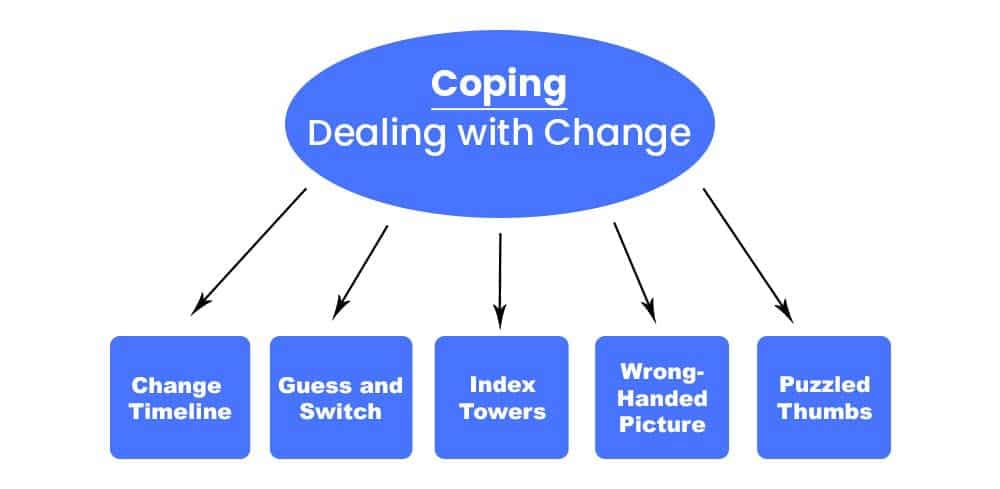
These activities are designed to improve coping skills, helping participants handle change and adapt flexibly to new circumstances. Here, we’ll look at the Change Timeline and Index Towers activities.
10. Change Timeline
This activity prompts participants to reflect on major life changes they have managed, fostering empathy and understanding among team members. It also encourages individuals to see commonalities in their experiences and how they have coped with change.
Steps:
- Give each participant a pen and paper and ask them to recall and mark five major life events on a personal timeline.
- Participants then pair up to discuss the impact of each change using questions like:
- How did you feel before, during, and after the change?
- Was the change difficult? Why or why not?
- What strategies helped you cope?
Debrief: Discuss feelings around sharing experiences, insights from each other’s coping strategies, and how they can apply these lessons at work. This activity reinforces that change is universal and manageable.
11. Index Towers
This exercise tests adaptability by challenging teams to build a structure that must be redesigned midway. It demonstrates the importance of flexibility and open-mindedness in unexpected changes.
Steps:
- Divide participants into teams of three to five, each receiving 25 index cards.
- Ask each team to build the tallest free-standing tower possible. Measure the height.
- Announce a rule change requiring all teams to restart with new cards.
- After the second round, measure the towers and identify the tallest structure.
Debrief: Discuss questions such as:
- How did your team approach the initial structure?
- How did you feel about the rule change?
- Did your team discover new building techniques?
- How can adaptability in this activity apply to your role at work?
Both activities help participants embrace change and build resilience, emphasizing adaptability as a valuable workplace skill.
12. Guess and Switch
This activity encourages participants to adapt quickly to changing situations and helps improve problem-solving and decision-making skills.
Steps:
- Divide participants into pairs. One person will guess an object’s name or characteristic based on clues from the partner.
- After a few rounds, instruct the pairs to switch roles, with the guesser becoming the clue-giver.
- Increase the difficulty by limiting clue types or adding time constraints.
Debrief: Discuss how switching roles impacted participants’ thought processes. Questions include:
- How did you feel when roles were reversed?
- What strategies worked best for giving or interpreting clues?
- How does switching roles relate to adapting to workplace roles?
13. Wrong Handed Picture
This creative activity highlights adaptability by asking participants to perform a familiar task in an unfamiliar way. It helps build resilience, creativity, and out-of-the-box thinking.
Materials: Paper, pens, or markers.
Steps:
- Instruct each participant to draw a picture using their non-dominant hand.
- Set a time limit and encourage everyone to focus on completing the picture rather than making it perfect.
Debrief: Reflect on how using the non-dominant hand influenced the approach and outcome. Questions to ask:
- How did it feel to draw with your non-dominant hand?
- What strategies did you use to adapt?
- How can tackling tasks differently support problem-solving in the workplace?
14. Puzzled Thumbs
This activity demonstrates the importance of patience and teamwork as participants work with limited dexterity. It teaches adaptability and reinforces the need for collaboration.
Materials: Puzzle pieces or a small construction set (e.g., blocks).
Steps:
- Tape each participant’s thumbs to their palms, limiting hand mobility.
- In teams, participants attempt to complete a puzzle or build a structure without thumb use.
- Allow time for participants to discuss and strategize before starting.
Debrief: Discuss challenges and teamwork strategies that emerged. Suggested questions include:
- How did you adapt to working without thumbs?
- What role did communication play in completing the task?
- How can working through challenges together apply to collaborative projects?
(d) Creativity Activities
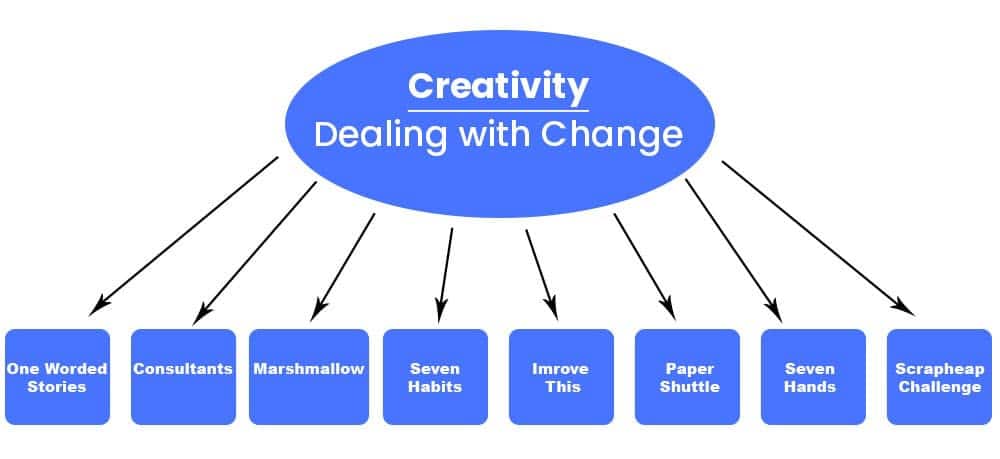
These activities help improve creativity.
We will discuss four creative activities for team building.
15. Consultants
This activity allows participants to collaboratively brainstorm solutions for work or related issues, fostering creativity and diverse perspectives.
Steps:
- Provide each participant with a sheet of paper and two minutes to write down a work-related challenge or concern at the top.
- Each participant passes their paper to the right.
- Each person reads the problem on their new sheet and has one minute to write a suggestion.
- Continue passing the sheets around until all participants have provided feedback or until time runs out.
- Return the papers to their original owners, who can review and combine suggestions using the SCAMPER technique (Substitute, Combine, Adapt, Modify, Put to another use, Eliminate, Rearrange).
Debrief: Discuss how participants felt about suggesting and receiving ideas. Sample questions:
- How many received ideas that could truly help with their issue?
- How did it feel to offer advice?
- Why don’t we typically ask for help from colleagues?
This activity highlights problem-solving through shared perspectives.
16. One-Word Stories
This exercise encourages creativity and collaborative storytelling, challenging participants to build upon each other’s contributions.
Steps:
- Explain that each participant will contribute one word at a time to form a story.
- Choose a participant to begin with a single word (e.g., “Once”).
- Each subsequent participant adds a word to continue the story.
- Continue until the story naturally ends or energy drops, then begin a new round if desired.
Debrief: Reflect on the collaborative story compared to individual ideas. Sample questions:
- Was the collective story more creative than expected?
- Did anyone contribute an unpredictable word?
This activity improves adaptability, creativity, and group synergy.
17. Marshmallow Challenge
This classic team-building exercise demonstrates the importance of planning, communication, and creativity in collaborative problem-solving.
Materials: 20 spaghetti sticks, 1 marshmallow, 1 yard of tape, 1 yard of string, scissors, a ruler, and a timer.
Steps:
- Challenge teams to build the tallest freestanding structure that can hold a marshmallow on top.
- Set a time limit of around 20 minutes.
- After the time is up, measure each structure’s height. The team with the tallest structure wins.
Debrief: Discuss the experience and key takeaways. Sample questions:
- What strategies worked best for building stability?
- How did you handle unexpected challenges?
This activity reinforces the value of planning, adaptability, and teamwork in problem-solving.
18. Scrapheap Challenge
In this activity, teams design a product to protect an egg when it is dropped, stimulating creativity and innovation.
Materials: Scrap materials like newspaper, scissors, eggs, and tape.
Steps:
- Divide participants into teams of 4-8.
- Each team has 10 minutes to plan a design and 30 minutes to build it using the provided materials.
- Once complete, the facilitator tests each team’s design by dropping it from a specified height to see if the egg remains intact.
Debrief: Reflect on design approaches and teamwork. Sample questions:
- How did the team approach the design challenge?
- Did all team members contribute to the design?
This activity showcases creativity, adaptability, and the importance of diverse input in problem-solving.
19. Seven Habits
This activity is inspired by Stephen Covey’s Seven Habits of Highly Effective People, helping participants develop habits that support teamwork and personal effectiveness. Each “habit” is explored as an actionable step or behavior to improve individual and group success.
Steps:
- Introduce the seven habits, explaining each one briefly.
- Assign each participant one habit, asking them to reflect on how it applies to their work.
- Have participants pair up to discuss their assigned habit and brainstorm ways to incorporate it into their team’s practices.
- Reconvene as a group to share insights and identify the most impactful habits.
Debrief: Reflect on how these habits could improve team performance. Sample questions:
- Which habit resonates most with you, and why?
- How can we adopt these habits to enhance collaboration and productivity? This activity encourages participants to think about personal growth habits that can strengthen the team.
20. Improve This
In this activity, participants practice problem-solving by suggesting improvements to an everyday item or process, fostering creativity and innovation.
Steps:
- Present a common object or process to the group (e.g., a coffee cup or a desk layout).
- Give participants a few minutes to brainstorm individually on improving this item.
- Form small groups and have participants discuss their ideas.
- Each group presents their best improvement ideas to the larger group.
Debrief: Discuss the creative ideas shared and their potential impact. Sample questions:
- What made you choose this specific improvement?
- How could this change make work easier or more enjoyable? This activity helps participants develop innovative thinking and see opportunities for enhancement in everyday items or tasks.
21. Paper Shuttle
This activity involves creating a simple paper shuttle (airplane) and iteratively improving it, which teaches adaptability and process improvement.
Materials: Paper sheets, measuring tape, stopwatch.
Steps:
- Give each participant a sheet of paper to create a paper airplane (shuttle).
- Set a distance goal and let participants throw their shuttles to see how far they go.
- Allow time for modifications to the shuttle design to improve performance.
- After each round, participants tested their updated designs to see if improvements were effective.
Debrief: Reflect on iterative improvement and learning from mistakes. Sample questions:
- What design changes improved the shuttle’s performance?
- How did trial and error play a role in your design process? This activity promotes experimentation and adaptive thinking, demonstrating the value of continuous improvement.
22. Seven Hands
This activity emphasizes teamwork and coordination. Participants work together using only “seven hands” to complete a task.
Steps:
- Divide participants into groups and assign tasks (e.g., building a small structure, sorting objects).
- Inform the group they can only use seven hands collectively for the task.
- Set a time limit for completing the task while maintaining the “seven hands” rule.
- If the group uses more than seven hands, they must restart.
Debrief: Discuss teamwork and coordination. Sample questions:
- How did the team decide who would use their hands?
- What challenges arose, and how did you overcome them?
This activity reinforces the importance of strategic planning, coordination, and team communication to achieve a shared goal.
(e) Problem Solving
Here, we will discuss one activity, i.e., a virtual scavenger hunt.
23. Virtual Scavenger Hunt
The Virtual Scavenger Hunt is a lively, interactive team-building game perfect for virtual settings. Participants race to find everyday items, bringing excitement and promoting creativity, speed, and problem-solving. The first person or team to gather all items wins, but the focus remains on engagement and collaboration rather than simply winning.
Steps:
- Prepare a List: Compile a list of common items participants will likely have on hand, like a phone charger, hand sanitizer, coffee mug, shopping bag, or face mask. Make sure the items are accessible but fun to find.
- Set Up the Virtual Platform: Host the game on a video-enabled platform like Zoom. Allow everyone time to join and get comfortable.
- Form Teams: Divide participants into small groups and encourage each team to come up with a fun team name. You can even create breakout rooms for teams to meet and discuss. Bring everyone back together for introductions and a quick rundown of the teams.
- Give Instructions: Set clear rules, like requiring real items (no images or screenshots) and giving points to the team based on group participation. For instance, if three out of five members find the items, award the team full points to foster collaboration.
- Start the Hunt: When everyone understands the instructions, initiate the hunt with a countdown timer (usually around 10 minutes). Let teams return to breakout rooms to search for the items.
- Announce the Winner: After the timer ends, gather everyone in the main room to review team submissions. Share photos or videos of each team’s findings, tally up the scores, and celebrate the winning team.
A virtual scavenger hunt is a fun, interactive game in which you search, snap, and connect—perfect for energizing virtual teams.
How to Get Started with Team Building Activities?
Starting with team-building activities is an opportunity to energize, connect, and engage your team. Here are steps to help you plan and execute effectively:
- Find or Create an Activity: Explore sources like team-building websites, books, or professional networks. You can find a mix of classic options, like icebreakers and creative ideas designed for specific skills or bonding. Consider customizing an activity to align it with your team’s unique goals. For example, adapting a scavenger hunt to highlight company values can make the experience more relevant.
- Schedule the Activity: Choose a date and time that accommodates most team members to ensure high participation. When possible, incorporate team-building activities into regular meetings or retreats, especially if schedules are tight. Sending out a calendar invite well in advance and choosing a convenient, accessible location—virtual or in-person—can help streamline attendance.
- Promote the Activity to Your Team: Announce the event, explaining its purpose and benefits, such as strengthening relationships or improving collaboration. Use email, team chat platforms, or even posters in the office. Create anticipation by highlighting what they can expect (fun, learning, team connection) and consider offering incentives or refreshments to enhance interest.
How to Choose the Right Team Building Activity?
Choosing the right team-building activity for your team is essential for maximizing engagement and achieving the intended goals. Here are key factors to consider:
- Team Size: Some activities work best for small groups where individuals can easily interact, while others are designed for larger teams and can handle higher participant numbers without compromising engagement. For example, activities like “Human Knot” are suited for small groups, while virtual trivia games are ideal for larger teams.
- Team Interests: Consider the preferences and personalities of your team members. Active or adventurous teams may enjoy outdoor challenges, while quieter or introspective teams might prefer problem-solving activities or creative workshops. Gathering input on interests can increase enthusiasm and participation.
- Goals of the Activity: Identify the main objectives, whether it’s to build trust, improve communication, develop problem-solving skills, or boost morale. Activities like trust exercises help strengthen bonds, while problem-solving activities like escape rooms foster collaboration. Aligning the activity with the desired outcomes will help create lasting impacts.
- Time and Budget: Consider the time available and budget constraints. Short activities like icebreakers are great for limited timeframes, while a retreat might be suitable if more time and resources are available.
Benefits of Team Building Activities
Team-building activities provide multiple benefits that positively impact both individual team members and the group as a whole. Here are some key benefits:
1. Improved Communication
Team-building exercises encourage open communication by requiring members to work together to solve problems or accomplish tasks. This helps break down communication barriers and fosters a more open exchange of ideas, which can benefit work-related communication. This improvement leads to better coordination and less miscommunication in the workplace.
2. Enhanced Collaboration and Trust
Collaborative activities like problem-solving games and group challenges emphasize the value of teamwork. Working on tasks together helps build trust among team members, who rely on one another to complete challenges. Trust and collaboration make it easier to share responsibilities and seek help when needed in a work setting.
3. Increased Morale and Motivation
Engaging in enjoyable, purposeful activities lifts morale by providing a break from regular routines. Team-building activities can remind employees of the joy of working together toward a shared goal. This morale boost often translates to higher job satisfaction and a greater motivation to contribute effectively at work.
4. Developed Problem-Solving Skills
Many team-building activities are designed to challenge problem-solving and critical-thinking skills. These exercises allow team members to think creatively and develop quick solutions, enhancing their ability to approach real-world problems at work with more confidence and a collaborative mindset.
5. Enhanced Adaptability
Activities that require flexibility—like adapting to new rules in a game or handling unexpected challenges—can improve adaptability. This is an important skill in workplaces where change is frequent, helping teams to adjust efficiently to new situations, processes, or goals.
6. Reinforced Company Culture
Team-building activities aligned with company values can reinforce the organization’s culture. For example, activities focusing on collaboration or innovation align with cultures emphasizing teamwork or creativity. This alignment encourages team members to internalize company values, fostering a sense of shared purpose.
7. Improved Conflict Resolution Skills
When team members engage in exercises that simulate high-pressure scenarios or require negotiation, they practice resolving conflicts in a controlled, low-stakes environment. This experience translates into better conflict management in the workplace, where disagreements or differing perspectives can be resolved more constructively.
8. Enhanced Leadership Skills
Certain activities allow individuals to take on leadership roles, helping them develop essential leadership qualities like decision-making, empathy, and communication. This can benefit the organization by preparing more employees to take on leadership responsibilities in the future.
9. Increased Creativity and Innovation
Activities that encourage brainstorming or improvisation help employees think outside the box. These experiences can spark creativity, making team members more likely to return innovative ideas to their work.
10. Strengthened Employee Relationships
Through shared experiences, team members build stronger relationships and often gain a greater understanding of each other’s strengths, weaknesses, and working styles. This camaraderie can lead to a more harmonious work environment and better teamwork.
Summary
Incorporating team-building activities into organizational culture and project management is essential for developing positive team dynamics. These activities enhance morale and promote a supportive work environment by strengthening relationships and communication among team members. Through shared experiences, team-building helps develop team attitude and bonding, which are critical for effective collaboration and increased productivity.
When team members feel connected and valued, they’re more likely to contribute enthusiastically and committedly to organizational goals, resulting in efficient and impactful team output. Making team-building a consistent part of company culture is a key investment in long-term organizational success.
Further Readings:
- 31 Fun Icebreaker Ideas for Small Groups
- 35 Fun Icebreakers for Virtual Meetings
- 580 Best Trivia Questions with Answers for Team Bonding
- 21 Introduction Icebreakers to Start Your Conference
- 9 Fun Games for Team Meetings at Work to Improve Engagement
- 254 Great Icebreaker Questions to Start the Conversation
References:
- Gershman, Jennifer. Drug Topics. Apr2019, Vol. 163 Issue 4, p29-29. 1p., Database: Business Source Corporate Plus
- Brian Miller. Quick Team-Building Activities for Busy Managers? 50 Exercises That Get Results in Just 15 Minutes. New York: AMACOM, 2004. v. 1st ed, ISBN 9780814472019. Disponível em: https://search.ebscohost.com/login.aspx?direct=true&db=e220xww&AN=100156&site=ehost-live. Acesso em: 14 Jan. 2022.
- https://www.pmi.org/learning/library/team-building-new-strategic-weapon-5140

I am Mohammad Fahad Usmani, B.E. PMP, PMI-RMP. I have been blogging on project management topics since 2011. To date, thousands of professionals have passed the PMP exam using my resources.