
Communication plays a vital role in the success of any project. As teams grow, the number of communication channels increases, making coordination more difficult. You must understand how these communication paths develop to avoid confusion and delays.
This is where the communication channels formula becomes essential. The communication channels formula helps project managers calculate the total number of possible communication channels within a team. By understanding communication channels early in project planning, you can design clearer communication structures and reduce misunderstandings. In project management, poorly managed communication channels often lead to missed information and slow decisions.
Using the communication channels formula helps you control the communication flow, improve collaboration, and achieve better project outcomes.
In today’s blog post, I will explain the communication channels, their formula, and how to calculate communication channels.
What Are Communication Channels in Project Management?
A communication channel is any path through which information can flow between two people. In a project setting, this includes direct conversations, video calls, chat messages, and emails. When there are only two people, there is one direct channel — they can talk to each other. Add a third person, and each person now has two potential partners, for a total of three channels. With every additional team member, the number of possible connections grows quickly.
For example, four people can create six direct channels. Each person can potentially reach every other person, even if they never need to.
The PMBOK Guide refers to these potential channels when discussing communications complexity. They remind us that planning how information flows is as important as planning schedules and budgets.
When I led a small team of five, it felt easy to keep everyone aligned through daily check-ins. Later, when we merged with another department and grew to fifteen people, we found ourselves drowning in emails and unclear messages. Counting communication channels is a simple way to visualize that jump in complexity and to decide how to structure communication.
Why Counting Communication Channels Matters
Counting communication channels is not just a math exercise. It helps you understand how communication complexity grows and why a small team can collaborate informally while a large project needs a communication plan. Poor communication isn’t a minor annoyance; research shows it can cripple projects and businesses.
A workplace survey found that 86% of employees and executives blame ineffective collaboration and communication for workplace failures. Another study reported that 32% of professionals say communication is the biggest issue in project management. These numbers are more than statistics—they reflect what many of us experience when teams miscommunicate, duplicate work, or miss critical updates.
Understanding the Communication Channels Formula
The number of potential communication channels in a project is calculated with a simple combinatorial formula. If n is the number of people involved, the number of channels is:
Communication channels=n*(n-1)/2
In plain language: multiply the number of people by one less than that number, then divide by two. This calculation is equivalent to counting the number of unique pairs in a group.
The formula assumes that everyone could, in theory, communicate directly with everyone else. In real life, you may limit this—for instance, by routing customer feedback through a product owner or using a hierarchy. But for planning purposes, it still helps to understand how quickly the number of possible paths grows. Knowing this gives you a sense of the communication overhead you might face if no structure is imposed.
Visual Explanation
The following infographic summarizes the formula and illustrates communication paths among a few team members:
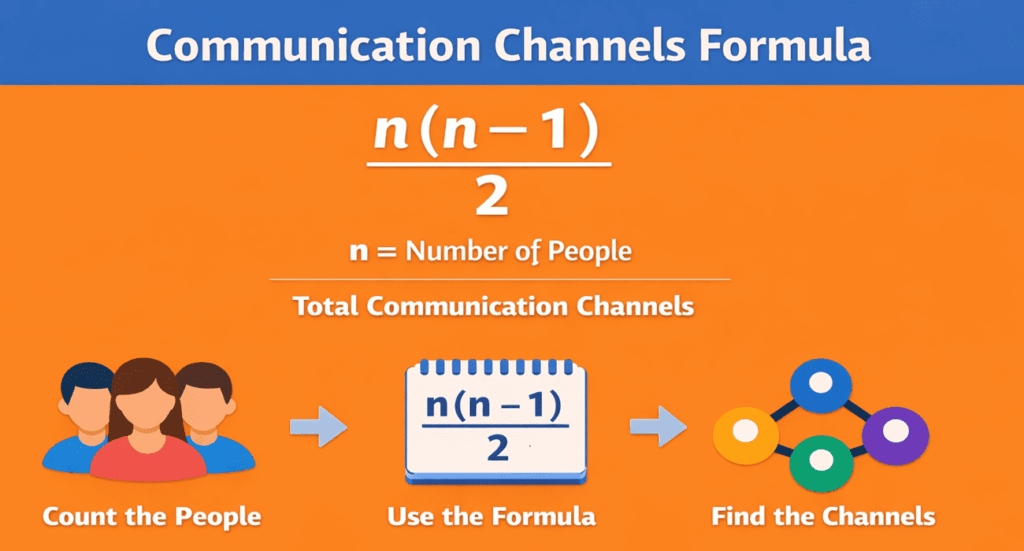
In the graphic above, the formula appears in the center, and a group of four people is connected by lines. Each line is one possible communication channel. With four people, the formula gives 4 × (4 – 1) ÷ 2 = 6, which matches the number of lines drawn.
Table: Team Members vs. Potential Channels
The table below shows how communication channels grow as the team expands. Even for modestly sized teams, the number becomes large.
| Team Members | Communication Channels |
| 1 | 0 |
| 2 | 1 |
| 3 | 3 |
| 4 | 6 |
| 5 | 10 |
| 6 | 15 |
| 7 | 21 |
| 8 | 28 |
| 9 | 36 |
| 10 | 45 |
| 15 | 105 |
| 20 | 190 |
| 50 | 1,225 |
| 100 | 4,950 |
The jump from 10 people to 20 increases the number of channels from 45 to 190. At 100 people, there are almost 5,000 potential paths. Without structure, it is impossible for everyone to keep up with all those interactions.
Visualizing Growth
Numbers in a table tell one part of the story, but a graph makes the explosive growth easier to grasp. The line chart below illustrates how the count of communication channels accelerates as team size increases from two to ten members:
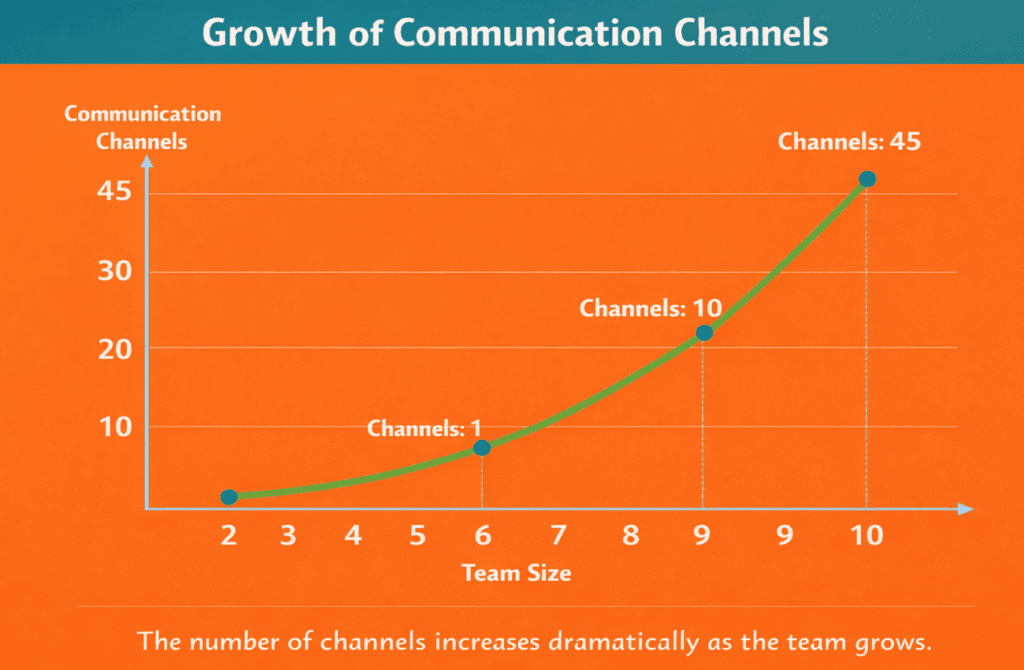
As the chart shows, the growth is not linear. Adding one person to a small team has a modest effect, but as the team grows, each additional member adds many more potential connections. That’s why communication becomes a significant challenge in large projects.
Tips for Managing Many Communication Channels
Counting channels tells you how complex communication can become, but it does not solve the challenge on its own. The following strategies can help you manage communication effectively as your team grows:
- Create a communication plan. Define who needs what information, when they need it, and how it will be delivered. Specify the frequency of meetings, reports, and updates. A clear plan reduces uncertainty and prevents information overload.
- Use communication tools wisely. Adopt digital platforms like Slack, Microsoft Teams, or dedicated project management software to centralize conversations. Encourage the use of channels and tags to keep discussions organized and searchable.
- Assign roles and responsibilities. Designate a communications lead or coordinator for large projects. Use a responsibility assignment matrix (sometimes called RACI) to clarify who is responsible for sending, receiving, and approving information.
- Set meeting guidelines. Many teams waste time in long, unproductive meetings. Keep meetings short, focused, and limited to those who need to attend. Share agendas in advance and end with clear action items.
- Encourage feedback and clarity. Ask team members if messages are clear and provide space for questions. Encourage summarizing decisions in writing. This reduces misunderstandings and aligns expectations.
- Review and adjust. As the project evolves, revisit your communication plan. If the team grows or shrinks, recalculate the potential channels and adjust your approach. A plan that works for ten people may not suit a team of fifty.
By following these practices, you can keep everyone informed without overwhelming them. Good communication is not about talking more; it is about sharing the right information with the right people at the right time.
FAQs
Q1. What is the formula for calculating communication channels?
The formula is n×(n – 1) ÷ 2, where n is the number of people involved. It counts the number of unique pairs of individuals who can communicate.
Q2. Why should I care about the number of communication channels?
Understanding this number helps project managers anticipate complexity and design communication plans. More channels increase the risk of miscommunication and information overload.
Q3. Does the formula apply to remote teams?
Yes. Whether people are onsite or remote, each pair can communicate. Remote work may require more structured channels, such as dedicated chat rooms and regular video calls.
Q4. How do communication channels impact the PMP exam?
The PMP exam tests your knowledge of project communications. You may be asked to calculate channel capacity for a given team size and to interpret what that number means for planning.
Q5. Can tools reduce the number of actual communication channels?
Yes. By defining clear paths for information (for example, through a communications coordinator), you can reduce the number of active channels even if the theoretical number remains high.
Summary
Managing communications is as important as managing scope, time, and cost. As teams grow, the number of possible communication paths increases rapidly. Counting these potential channels helps you decide how much structure is needed and prevents chaos.
The communication channels formula helps project managers understand how quickly complexity increases with each additional stakeholder. By calculating communication paths early, you can plan better communication structures, reduce confusion, and avoid costly misunderstandings. When used correctly, this simple formula supports stronger collaboration, faster decision-making, and better project outcomes. Managing communication proactively is not optional—it is a critical project management skill.

I am Mohammad Fahad Usmani, B.E. PMP, PMI-RMP. I have been blogging on project management topics since 2011. To date, thousands of professionals have passed the PMP exam using my resources.