The PMI-ACP passing score is one of the most searched topics among agile professionals preparing for certification. Many candidates want to know the PMI-ACP passing score before starting their study plan to have a clear target. In reality, PMI does not publish an official passing score for the PMI-ACP.
Instead, PMI uses psychometric analysis to evaluate exam performance and determine whether a candidate passes. This makes preparation, practical knowledge, and agile understanding more important than chasing a fixed percentage.
The PMI-ACP exam tests mindset, leadership, product delivery, and agile practices through situational questions. With the right strategy, consistent practice tests, and a strong understanding of agile principles, you can improve your confidence and increase your chances of passing the PMI-ACP exam on your first attempt.
Key Takeaway
For readers who need a quick overview, here are the key facts about the PMI-ACP exam:
- Exam structure: The test contains 120 multiple-choice questions and lasts three hours. You get one ten-minute break.
- Domain distribution: Questions cover four domains: Mindset (28%), Leadership (25%), Product (19%) and Delivery (28%).
- Scoring method: PMI uses psychometric analysis to set the passing threshold. The institute does not publish a fixed passing score.
- Retake policy: You may attempt the exam up to three times within a year if you do not pass.
- Earning power: Professionals with the PMI-ACP certification reports an average U.S. base salary of around $128,000 per year.
These points underscore that success depends on understanding agile concepts and strategic preparation rather than chasing a specific numeric score.
PMI-ACP Exam Overview
The PMI-ACP is designed for people who work on agile teams or lead agile initiatives. To sit for the exam, you must meet several prerequisites. You need a secondary degree or its global equivalent, 21 contact hours of training in agile practices, twelve months of general project experience within the last five years (a current PMP or PgMP counts here) and eight months of agile project experience within the last three years.
These requirements ensure that candidates have hands-on exposure to both traditional project management and agile work.
PMI-ACP Exam Format and Domains
Once your application is accepted, you schedule your exam and pay the fee. On test day, you will face 120 multiple-choice questions. You have three hours to complete the exam and may take a ten-minute break.
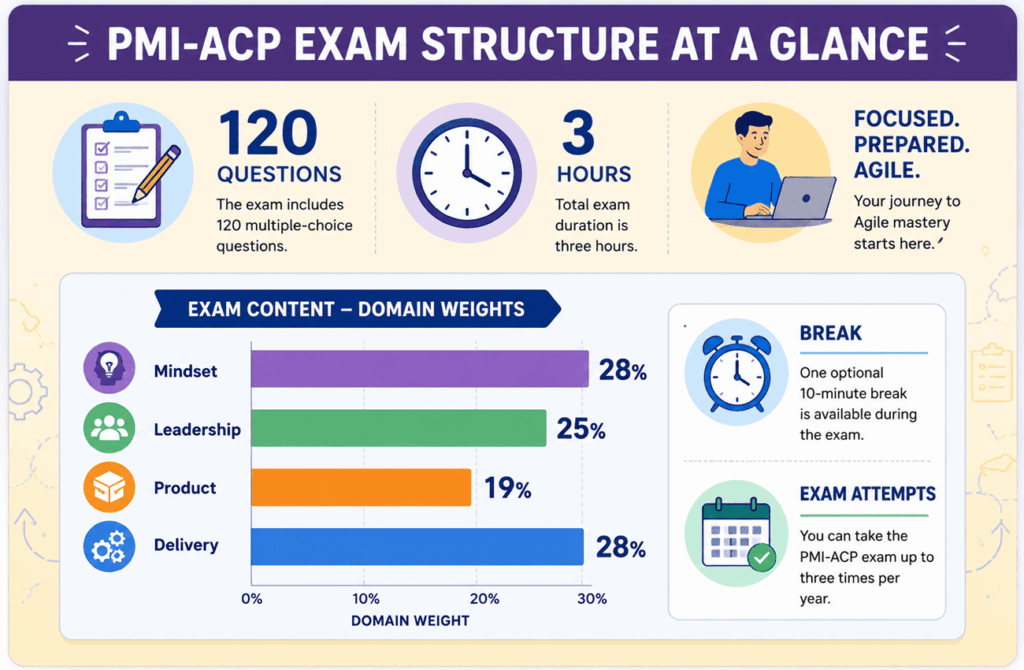
The exam covers four domains that reflect agile practice areas:
| Domain | Weight | Description |
| Mindset | 28% | Focuses on agile values and principles and how they shape team culture and decision making. |
| Leadership | 25% | Assesses servant leadership, coaching and facilitation skills that empower teams. |
| Product | 19% | Tests understanding of product vision, backlog refinement and stakeholder management. |
| Delivery | 28% | Covers planning, estimation, quality and continuous improvement practices. |
You can take the exam at a Pearson VUE test center or online. If you do not pass, PMI allows up to three attempts within one year. To maintain your credential, you must earn 30 professional development units (PDUs) every three years.
How PMI-ACP Exam Scoring Works
The Project Management Institute does not publish a fixed passing score for the PMI-ACP exam. Instead, the institute explains that “the passing score for all PMI credential examinations is determined by sound psychometric analysis”. This means subject-matter experts evaluate exam questions to set a difficulty threshold. Your performance is reported in categories such as Above Target, Target, and Below Target. Because the exam questions vary in difficulty from one test form to another, no single percentage guarantees a pass.
Industry estimates place a comfortable practice-test target at around 60–70%, but the key is to build a deep understanding of agile concepts rather than chase a number.
Why Pursue the PMI-ACP Certification?
Agile adoption continues to grow across industries ranging from software to finance. Organizations seek professionals who can lead agile projects and apply practices like Scrum, Kanban and Lean. By earning the PMI-ACP, you signal to employers that you understand agile principles and can adapt them to different situations. PayScale’s 2026 data show that PMI-ACP holders in the United States earn an average base salary of about $ 128,000 per year, reflecting the high demand for agile expertise. Beyond salary, the credential expands career opportunities and strengthens your professional network.
Understanding PMI-ACP Exam Metrics
Passing Score and Psychometric Analysis
Many test-takers want to know the exact score needed to pass. PMI keeps this information confidential. As explained earlier, the passing score is determined through psychometric analysis and PMI does not release it. Psychometric analysis involves experts evaluating each question’s difficulty and adjusting the passing threshold accordingly. Because the exam uses scaled scoring, two people who answer the same number of questions correctly may receive different performance levels depending on the difficulty of the questions they answered.
Performance Rating Categories
Rather than a percentage, your exam results will show a performance level for each domain. The categories are:
- Above Target: Indicates a strong command of agile concepts. You answered more questions correctly than required for this section.
- Target: Demonstrates adequate proficiency. You met the required number of correct responses for the section.
- Below Target: Suggests that further study is needed. You answered fewer questions correctly than the threshold.
The goal is to achieve Target or Above Target in each domain. If you fall Below Target in several domains, you may need to retake the exam.
PMI-ACP Certification Pass Rate
Because PMI does not disclose pass rates, there is no official statistic. In practice, candidates who prepare thoroughly and apply agile principles in their work often pass on the first attempt. Many training organizations observe that aiming for 60% to 70% on practice exams indicates readiness. Keep in mind that this is an estimate and not an official standard. The emphasis should be on understanding concepts, practicing under exam-like conditions, and learning from mistakes.
Realistic Pass Rate and Salary Insights
Why the pass rate remains unknown
PMI has chosen not to publish pass rate statistics for any of its certification exams. This policy helps protect the integrity of the testing process and discourages a sole focus on numbers. Instead of worrying about a magic pass rate, focus on mastering the material. Consistent study and hands-on practice will improve your chances.
Salary and career benefits
Agile skills are in high demand. According to PayScale’s 2026 report, professionals in the United States with the PMI-ACP certification earn an average base salary of about $128,000 per year. Salaries vary by role, experience and location, but the data suggests that agile certification has a positive impact on earning power. When combined with experience and leadership skills, PMI-ACP holders may qualify for roles such as agile coach, scrum master or product owner. These positions often command salaries above the industry average.
Retake policy and continuing education
If you do not pass on your first try, PMI allows you to retake the exam up to three times within one year. Plan your study schedule accordingly and allow enough time between attempts to strengthen your weak areas. After earning the credential, you must complete 30 PDUs every three years to maintain active status. PDUs can be earned through formal training, teaching, volunteering or reading industry publications.
Tips to Pass the PMI-ACP Exam
Passing the PMI-ACP exam requires more than rote memorization. It calls for a solid grasp of agile values and the ability to apply them to real projects.

Below are proven strategies to help you succeed:
- Build an agile mindset. The exam emphasizes core values and principles. Read the Agile Manifesto and reflect on how its values influence project decisions. Understand servant leadership and team empowerment.
- Study the exam domains. Focus your study around the four domains—Mindset, Leadership, Product and Delivery. Spend more time on areas where you lack experience. Use the official PMI exam content outline to guide your study.
- Use practice tests. Take full-length practice exams to familiarise yourself with question styles and pacing. Aim for scores in the 60–70% range as a readiness indicator, but remember that deeper understanding matters more than a specific number.
- Apply agile at work. Practical experience solidifies theory. Volunteer for agile projects or apply agile frameworks in your current role. Real-world examples will help you answer situational questions.
- Plan your study schedule. Create a realistic timeline that balances study, work and family. Break your study sessions into focused blocks and review regularly.
- Understand scoring and retake rules. Knowing that PMI uses psychometric analysis and allows up to three attempts per year helps manage anxiety. Remember, there is no penalty for incorrect answers, so answer every question.
FAQs
Q1. Is there an official passing score for the PMI-ACP exam?
No. PMI explains that the passing score for all PMI credential examinations is determined by psychometric analysis. They do not release a fixed percentage. You should aim for a deep understanding rather than a particular score.
Q2. How long is the PMI-ACP exam and how many questions does it have?
The exam contains 120 multiple-choice questions, lasts three hours, and includes a ten-minute break. Questions span four domains: Mindset, Leadership, Product and Delivery.
Q3. How many times can I take the PMI-ACP exam in a year?
PMI allows up to three attempts within a one-year period. If you do not pass on your first try, use the feedback to strengthen weak areas before your next attempt.
Q4. Do I need a PMP certification to sit for the PMI-ACP exam?
No. A current PMP or PgMP satisfies the general project experience requirement, but it is not mandatory. You can qualify with a secondary degree, 21 contact hours of agile training, 12 months of project experience and eight months of agile experience.
Q5. What is the average salary for PMI-ACP certified professionals?
PayScale’s 2026 survey indicates that PMI-ACP holders in the U.S. earn an average base salary of about $128,000 per year. Actual salaries vary by role, experience and location.
Summary
The PMI-ACP certification can help agile professionals grow their careers, improve project delivery skills, and increase earning potential. Since PMI does not publish an official PMI-ACP passing score, candidates should focus on understanding agile principles, practicing real-world scenarios, and building confidence through mock exams. A structured study plan and strong knowledge of the exam domains can greatly improve the chances of success. With consistent preparation and the right mindset, passing the PMI-ACP exam becomes a realistic and rewarding achievement for long-term career growth.
References:

I am Mohammad Fahad Usmani, B.E. PMP, PMI-RMP. I have been blogging on project management topics since 2011. To date, thousands of professionals have passed the PMP exam using my resources.