
Choosing the right certification can shape your future. Two widely recognized credentials, such as the Project Management Professional (PMP) and the PMI Agile Certified Practitioner (PMI-ACP), represent very different approaches to project work. The PMP exam assesses knowledge of predictive (waterfall) methods, while the PMI-ACP exam focuses on agile frameworks.
Understanding these certifications is essential because they influence how you plan, execute, and deliver projects.
This blog post compares the PMP and PMI-ACP certifications, explains the methodologies behind them, and uses recent data to show how each one can impact your career.
Let’s get started.
Understanding the PMP Certification
What is the PMP Certification?
The PMP certification is awarded by the Project Management Institute (PMI) to professionals who demonstrate advanced knowledge of project management across people, processes, and business environments.
The exam was updated in 2021 to reflect a balance of predictive, agile, and hybrid approaches. It contains 180 questions, including 175 scored and 5 unscored, and candidates have 230 minutes to complete the test. There are two optional 10-minute breaks. The exam measures competence in three domains:
- People (42% of questions) – Leading teams, resolving conflict, and engaging stakeholders.
- Process (50%) – Managing project processes such as scheduling, cost control, and risk.
- Business Environment (8%) – Aligning projects with organizational strategy and benefits.
You may need a four-year degree, at least 36 months of project management experience, and 35 hours of project management education. Those without a degree need 60 months of experience. While the PMI does not publish an official passing score, preparation often involves extensive study of the PMP exam content outline, the PMBOK Guide, and practice exams.
Predictive (Waterfall) Methodology
The PMP exam emphasizes predictive or waterfall methods. Waterfall projects move through a sequence of steps such as planning, executing, and testing, without returning to earlier phases. Teams develop a detailed plan before any work begins. During execution, they build the product according to that plan, and changes are managed through formal change requests. Testing happens after development is complete.
Because the entire scope is defined at the start, waterfall projects are predictable and work well when requirements are stable. Teams may use them when clients have completed similar projects, want thorough documentation, and prefer to review the finished product before accepting it.
Understanding the PMI-ACP Certification
What is the PMI-ACP Certification?
The PMI-ACP certification recognizes proficiency in agile frameworks such as Scrum, Kanban, Extreme Programming, and Lean. The exam content outline was updated in 2024. It features 120 exam items, including multiple-choice, drag-and-drop, and exhibit questions, 20 of which are unscored.
Test takers have three hours to complete the exam. A ten-minute break appears after question sixty and, once taken, you cannot return to previous items. The exam assesses four domains: Mindset (28%), Leadership (25%), Product (19%), and Delivery (28%). Candidates must have a secondary degree, 21 hours of formal agile training, and at least 12 months of general project experience plus eight months of agile experience.
Earning the certification signals that you can apply agile values and principles across multiple frameworks and at scale.
Agile Methodology
Agile methods prioritize delivering value quickly. Rather than completing an entire product before users see it, teams work in short cycles called sprints. At the start of each sprint, they plan which high-priority items from a backlog will be delivered. They design, build, and test those items within two to four weeks. At the end of the sprint, the project team demonstrates working features to stakeholders. Because feedback is continuous, teams can adapt to changes in business needs without derailing the whole project.
Agile practices suit environments where requirements change frequently or speed to market matters, such as software development and product design.
Waterfall Vs Agile Methodologies
Project teams often debate whether waterfall or agile is better. Each approach has strengths and trade-offs. In a predictive or waterfall approach, planning happens once at the start. This creates clear expectations and schedules, which help teams control scope and budget. However, if requirements change late in the project, adapting can be difficult because each phase depends on the last.
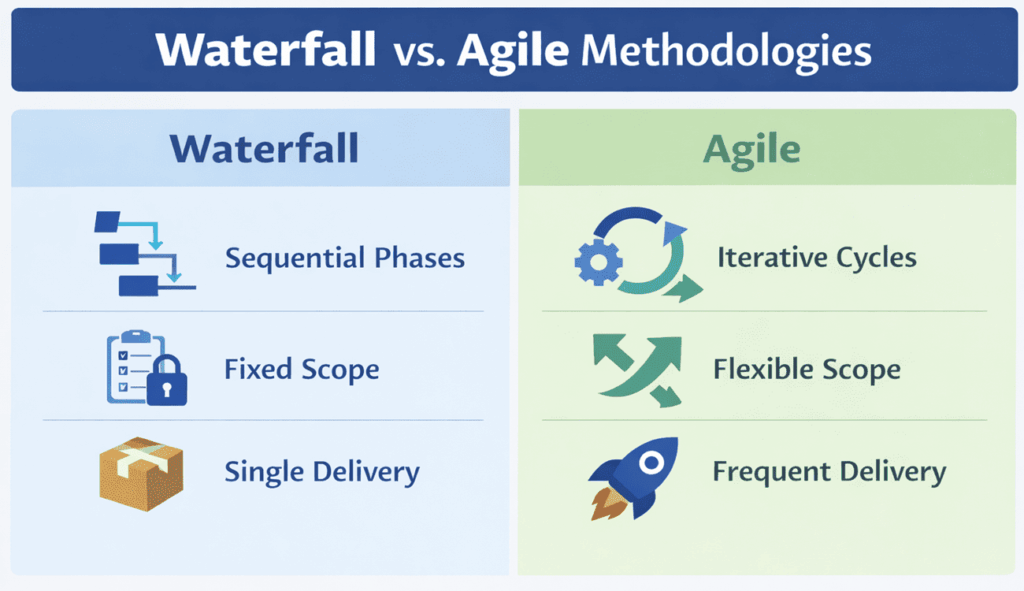
Agile teams, on the other hand, welcome change. Planning takes place at the beginning of each sprint, so the team only commits to work it can deliver in the short term. Products evolve through iterations, allowing clients to see progress and provide feedback early. Yet because agile projects lack a fixed scope, estimating final timelines and costs can be less precise. The choice depends on the nature of the work: stable, well-understood projects benefit from the waterfall approach; innovative or rapidly changing projects often benefit from agile.
PMP Vs PMI-ACP: Exam and Methodology Comparison
Choosing between the PMP and PMI-ACP exams requires understanding how they differ in structure and philosophy.
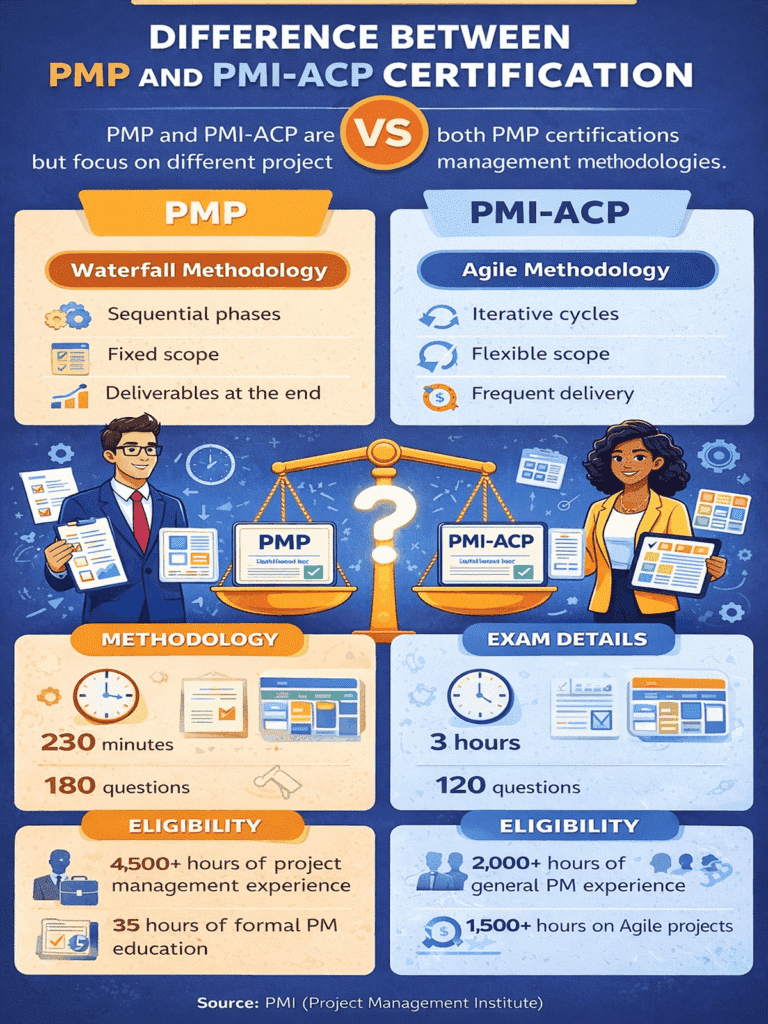
The table below summarizes key aspects.
| Parameter | PMP Certification | PMI ACP Certification | Notes |
| Methodology Focus | Emphasizes predictive (waterfall) and hybrid approaches | Emphasizes agile values, principles, and frameworks | Both exams have some overlap, but PMP leans more toward predictive planning, while PMI ACP is purely agile. |
| Exam Format | 180 questions (175 scored; 5 pretest), 230 minutes; two 10-minute breaks | 120 questions (100 scored; 20 pretest), 3 hours; one 10-minute break | PMP questions may include multiple-choice, multiple-response, matching, and hotspot formats; PMI ACP questions include multiple-choice, drag-and-drop, and exhibits. |
| Experience Requirements | Four-year degree plus 36 months of project management experience (or 60 months with a secondary diploma); 35 hours of project management education | Secondary degree plus 12 months of general project experience and 8 months of agile experience; 21 contact hours of agile training | Requirements ensure candidates have hands-on experience before taking the exam. |
| Focus Areas/Domains | People (42%), Process (50%), Business Environment (8%) | Mindset (28%), Leadership (25%), Product (19%), Delivery (28%) | PMP includes more emphasis on business strategy; PMI ACP focuses on mindset and leadership within agile teams. |
| Continuing Education | 60 professional development units (PDUs) every three years | 30 PDUs every three years | Both credentials require ongoing learning to maintain. |
Salary and Career Impact
Certification can influence your earning potential and career trajectory. According to the Project Management Institute’s Project Management Salary Survey, 14th Edition, professionals holding a PMP credential earn a 17% higher median salary than those without the certification across 21 countries.
In the United States, PMP-certified respondents reported a median salary of $135,000, which is 24% higher than that of their non-certified peers. The same survey found that nearly 60% of PMP-certified respondents received a raise in the past year, with three-quarters seeing increases of up to 10%. These figures highlight the financial advantage of earning a PMP.
The PMI also projects a global need for 30-million project professionals by 2035. With digital transformation, sustainable development, and increased project complexity, demand for skilled managers will remain high. Agile expertise is equally valuable; organizations seek practitioners who can guide teams through rapid change.
While PMI does not publish specific salary data for PMI-ACP holders, employers often value agile certifications in technology and product-driven industries. Holding both PMP and PMI-ACP credentials can demonstrate versatility, predictive planning skills, and agile adaptability.
Choosing the Right Certification: PMP Vs PMI-ACP
Deciding between the PMP and the PMI-ACP hinges on your career goals and work environment. Ask yourself a few questions:
- What kind of projects do I lead? If you manage construction, manufacturing, or regulatory projects with fixed scopes, the predictive techniques studied for the PMP may align with your needs. If you work in software development, product design, or any field where requirements change rapidly, PMI-ACP agile skills may serve you better.
- How does my organization deliver value? Companies with rigid governance structures often expect certified project managers to follow established processes. Organizations embracing continuous improvement and customer feedback might prioritize agile expertise.
- Do I want a broad or specialized credential? The PMP covers a wide range of project management knowledge across industries. The PMI-ACP focuses specifically on agile practices. Many professionals earn both certifications to broaden their opportunities.
- Am I prepared for the exam commitments? The PMP exam is longer and covers a broader set of domains. Preparing may require more study time and coursework. The PMI-ACP exam is shorter but requires hands-on agile experience.
No matter which path you choose, both certifications require continued learning. Maintaining your credential through professional development units ensures that you stay current as methodologies evolve.
FAQs
Q1. Is the PMP harder than the PMI-ACP?
The PMP exam covers more domains and takes nearly four hours, so preparation is more extensive. However, difficulty also depends on your experience. Agile practitioners may find the PMI-ACP more intuitive.
Q2. Can I hold both certifications?
Yes. Many professionals earn the PMP first and then add the PMI-ACP to demonstrate agile expertise. Maintaining both requires meeting separate continuing education requirements.
Q3. Do I need a PMP before taking the PMI-ACP?
No. The PMI-ACP requires agile experience and training, but does not require the PMP. You can pursue whichever credential aligns with your background and goals.
Q4. What kind of jobs prefer PMI-ACP?
Agile certifications are especially valuable for roles such as Scrum Master, product owner, agile coach, and software project manager. Organizations adopting agile frameworks look for people with proven knowledge of agile practices.
Q5. Is it worth investing in certification?
According to PMI’s salary survey, PMP-certified professionals earn a median salary of $135,000 in the United States and generally report higher raises. Certifications also increase confidence, credibility, and career mobility.
Summary
Choosing between PMP and PMI-ACP depends on your career goals and project environment. PMP builds strong skills in structured planning and leadership across industries, while PMI-ACP focuses on flexibility, speed, and agile delivery. Both certifications offer strong career growth and higher earning potential. If you want versatility, consider earning both. In today’s fast-changing world, combining predictive and agile knowledge helps you stay competitive and lead projects with confidence across different business needs.
Reference:

I am Mohammad Fahad Usmani, B.E. PMP, PMI-RMP. I have been blogging on project management topics since 2011. To date, thousands of professionals have passed the PMP exam using my resources.



Seems the exam fees for members & non-members just got reversed due some typo ?