Every organization wants a clear path from strategy to results. Two frameworks help leaders make that connection: the Balanced Scorecard (BSC) and Objectives and Key Results (OKRs). Both have been around for decades, yet many teams struggle to decide which to use or whether to combine them.
In this blog post, I will break down how each framework works, compare their strengths and weaknesses, and show how they can complement each other.
Let’s get started.
What is the Balanced Scorecard?
The Balanced Scorecard (BSC) is a strategic management framework that helps organizations translate their vision into clear, measurable actions. Instead of focusing solely on financial results, the BSC considers performance across four interconnected perspectives: Financial, Customer, Internal Processes, and Learning and Growth. This balanced view ensures that short-term results do not harm long-term success.
The framework starts with strategy. Leaders define strategic objectives for each perspective and then select measures, targets, and initiatives to track progress. For example, improving customer satisfaction may require stronger internal processes and employee skills, which ultimately support financial performance.
The Balanced Scorecard also improves alignment. Teams can see how their daily work supports the strategy, which increases accountability and focus. By linking goals, metrics, and actions, the BSC helps organizations manage performance systematically and make better strategic decisions over time.
How BSC Works: A Commuter Rail Example
Imagine a commuter rail system that wants to improve its performance. The organization could design a Balanced Scorecard like this:
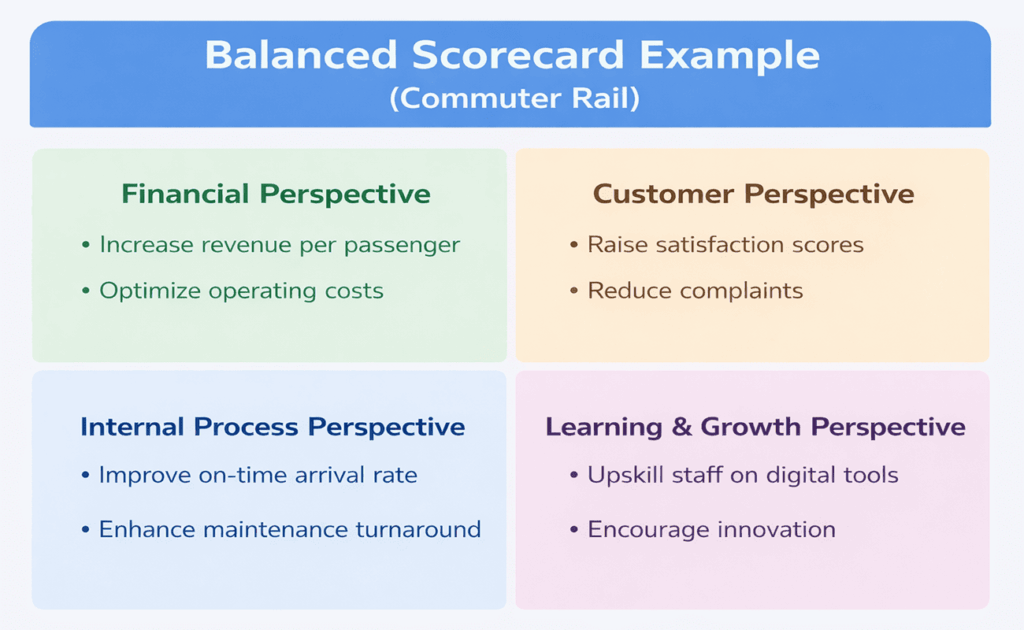
In the Financial perspective, goals might include increasing revenue per passenger and optimizing operating costs. Under Customer, the team might strive to raise satisfaction scores and reduce complaints. Internal Process objectives could focus on on-time arrivals and faster maintenance. Learning & Growth might emphasize digital skills and innovation. Each objective has one or two measures, and teams plan initiatives to drive those outcomes.
What Are OKRs?
Objectives and Key Results (OKRs) originated at Intel in the 1970s and were later popularized by venture capitalist John Doerr. They are now mainstream: according to the State of the Industry Report by OKR International, about 90% of organizations worldwide use OKRs as their primary goal-setting framework.
OKR is a goal-setting framework used to align teams and track progress toward clear outcomes. An Objective describes what you want to achieve in simple, inspiring language. Key Results show how success is measured using specific, measurable outcomes. OKRs are set for short periods, such as a quarter, and reviewed often. This encourages focus, transparency, and learning.
You can use OKRs to prioritize what matters most, adapt quickly to change, and stay aligned with company goals. OKRs work best when they are ambitious, visible to everyone, and not directly tied to individual compensation.
How OKRs Work: Ride Review Program Example
To illustrate, let’s revisit the commuter rail company. After defining the long-term strategy through its Balanced Scorecard, the team uses OKRs to execute a specific initiative: a ride review program.

This OKR example shows how a transport team turns a clear goal into measurable results. The objective is to launch a ride-review call-to-action after every bus ride to improve customer feedback. Each key result tracks a specific outcome: launching the CTA by a set date, prompting most riders to leave reviews, collecting a large number of reviews within the first month, and responding quickly to feedback.
Together, these key results make progress visible, keep teams focused, and ensure the objective is achieved in a practical, measurable way.
Comparing Balanced Scorecard and OKRs
While both frameworks connect strategy with action, their structures and rhythms differ. The table below summarizes the key distinctions:
- Strategic focus: The Balanced Scorecard provides a long-term, holistic view, while OKRs encourage short-term, actionable goals.
- Structure: BSC relies on four perspectives and can contain up to fifteen objectives. OKRs consist of one objective with three to five key results.
- Measurement: BSC emphasizes lagging indicators and financial outputs. OKRs emphasize leading indicators, encouraging teams to drive inputs such as new features or regional expansions.
- Number of objectives and measures: In BSC, there may be ten or more objectives with one or two measures each; OKRs limit objectives to two or three and allow three to five key results.
- Cadence: The Balanced Scorecard is drafted annually and reviewed annually. OKRs are set quarterly or monthly and reviewed weekly or monthly.
- Compensation: BSC targets are often tied to bonuses or performance reviews. OKRs should remain separate from compensation to keep teams ambitious.
These differences explain why the frameworks can complement each other. A Balanced Scorecard helps leaders articulate long-term strategy and ensure that financial, customer, internal process, and learning investments remain balanced. OKRs encourage teams to break the strategy into specific, measurable, time-bound goals.
Cadence and Review Cycles
The cadence of goal-setting and review is a major difference between the two frameworks. A Balanced Scorecard typically stays in place for at least a year and may not require formal check-ins. That long horizon gives leaders the space to monitor slow-moving metrics such as customer retention or training outcomes. However, without frequent reviews, it’s easy for teams to lose sight of their objectives.
OKRs, in contrast, encourage regular reflection. Objectives and key results are set for a quarter or a month. Weekly conversations, feedback, and recognition (CFRs) help teams adjust their approach. This continuous performance management ensures that goals remain relevant as conditions change.
Compensation and Incentives
The Balanced Scorecard originated in finance-focused settings, so results are often tied to bonuses and pay. This can make goals clear, but it can also push people to chase numbers instead of real improvement. Laszlo Bock, Google’s former people leader, warns that tying pay directly to OKRs can lead to bad behavior. OKRs work best when they encourage teams to aim high without fear of punishment. Many organizations review personal performance separately and use OKRs mainly to guide learning and improvement.
Can You Use BSC and OKRs Together?
Absolutely. These frameworks serve different purposes and are most powerful when combined. A long-term Balanced Scorecard outlines the strategic destination and ensures that financial, customer, internal process, and learning investments remain balanced. OKRs drive near-term execution and encourage experimentation.
Real-world examples show the value of this integration. In a case study, a Peruvian electronic security company combined the Balanced Scorecard with OKRs and saw productivity increase by 10.5% in the first quarter and 11% in the second quarter of 2024. Sales grew 18% year-over-year, compared with 12% in the same period the previous year, and customer satisfaction reached 77.6%. These results highlight how a Balanced Scorecard can guide strategic focus while OKRs drive execution.
Where Are These Frameworks Used?
The Balanced Scorecard has a long history in corporate strategy and is used by major companies such as Volkswagen, Wells Fargo, Apple, and Verizon. It also appears in government agencies and nonprofits. OKRs have spread widely through technology firms, startups, and enterprises of all sizes. As adoption grows, many leaders use the Balanced Scorecard to frame their annual strategy and OKRs to drive quarterly execution.
Tips for Implementing Each Framework
- Start with strategy: Craft a clear mission and vision before selecting measures. The Balanced Scorecard helps translate vision into objectives across the four perspectives.
- Limit objectives: Avoid creating too many. Under a Balanced Scorecard, keep each perspective focused; with OKRs, select two or three high-impact objectives.
- Use leading and lagging indicators: Combine outcome measures (lagging) with input measures (leading). For example, track revenue per passenger alongside review participation.
- Review regularly: Use quarterly or monthly check-ins for OKRs and schedule periodic strategic reviews for the BSC.
- Separate compensation: Reward performance separately so that OKRs remain a learning tool rather than a weapon.
- Integrate frameworks: Use the BSC to define long-term strategic themes, then write OKRs that support each theme. Review progress and adjust as needed.
FAQs
Q1. What’s the main difference between a Balanced Scorecard and OKRs?
A Balanced Scorecard organizes long-term strategy across four perspectives and uses lagging metrics. OKRs focus on short-term objectives and leading indicators.
Q2. How often should we set and review OKRs?
OKRs are typically set for a quarter or month and reviewed weekly or monthly to ensure they remain relevant.
Q3. Can OKRs be tied to bonuses?
Experts recommend keeping OKRs separate from compensation so that teams feel safe pursuing ambitious goals.
Q4. Is it necessary to choose one framework over the other?
No. Many organizations use the Balanced Scorecard to set the strategic direction and OKRs to drive execution. This case study found that combining them improved productivity and sales.
Summary
OKRs and the Balanced Scorecard both help organizations turn strategy into action, but they serve different needs. The Balanced Scorecard provides long-term structure and balance across key business areas, while OKRs offer speed, focus, and flexibility. Choosing the right approach depends on your goals, culture, and planning horizon. Many organizations successfully combine both, using the Balanced Scorecard for strategic direction and OKRs for execution. When applied thoughtfully, each framework can improve alignment, accountability, and overall performance.

I am Mohammad Fahad Usmani, B.E. PMP, PMI-RMP. I have been blogging on project management topics since 2011. To date, thousands of professionals have passed the PMP exam using my resources.