What makes a team truly thrive? While much of the focus in modern business is placed on strong leadership, sustainable success is actually built on a powerful partnership. This article explores the dynamic between servant leadership and followership, two essential forces that shape how people work together.
Many professionals focus only on developing leadership skills. Yet research shows that strong organizations also depend on committed followers who support the mission and help leaders succeed. Understanding the definition of servant leadership and the principles of followership in the workplace is key to building a resilient, high-performing team.
Servant leaders guide others by serving first. They remove obstacles, listen carefully, and help team members grow. Followers contribute energy, ideas, and teamwork to move the vision forward. When these roles work together, trust grows, and teams perform better.
Understanding the difference between servant leadership and followership helps professionals build stronger relationships, contribute more effectively, and prepare for future leadership opportunities. Both roles matter in every successful organization.
Understanding the Servant Leadership and Followership
The words “servant leadership” and “followership” describe more than job titles. They describe attitudes and behaviors. To understand the difference between servant leadership and followership, it helps to look at their core focus. Servant leadership is a leadership style that puts the needs of the team first. Followers are the people who support a leader’s vision and carry out the work. Both roles are essential in any organization. When leaders serve, and followers engage, trust grows, and organizations become healthier.
Servant Leadership: Serving First
Servant leaders think of themselves as helpers. They ask, “How can I remove obstacles so you can succeed?” instead of “Why haven’t you finished yet?” They listen carefully, share power, and empower others rather than control them. Research shows that companies embracing servant leadership tend to have less staff turnover, higher job satisfaction, and better performance. In other words, when leaders serve their teams, employees are more likely to stay and give their best.
Followership: Active Participation
Followership is sometimes misunderstood as blind obedience. Good followers are not passive; they are active partners. They take initiative, communicate openly, and give feedback. Gallup’s Global Leadership report notes that 64% of followers need to see hope from their leaders, and only 33% thrive when hope is absent. When leaders meet that need, the share of thriving followers rises to 38%. The same report shows that hope and trust account for roughly 80% of all desired leadership traits. In practical terms, followers want leaders who believe in the mission, communicate clearly, and treat people fairly.

Good followers do more than wait for orders. They join projects early, share ideas, and help each other succeed. In my current team, even junior developers lead code reviews and propose new features. This engaged followership keeps us moving forward. It also makes leaders’ jobs easier because they can trust their teams to solve problems.
Key Differences at a Glance
| Parameter | Servant Leadership | Followership |
| Main role | Serve and empower the team | Support and execute the vision |
| Focus | Team growth and well-being | Results, collaboration, and initiative |
| Use of power | Shares decision-making and authority | Respects structure while influencing through feedback |
| Skills needed | Listening, mentoring, empathy, removing barriers | Communication, teamwork, problem-solving, and self-management |
| Daily actions | Clear roadblocks, coach, encourage | Deliver work, speak up, offer solutions |
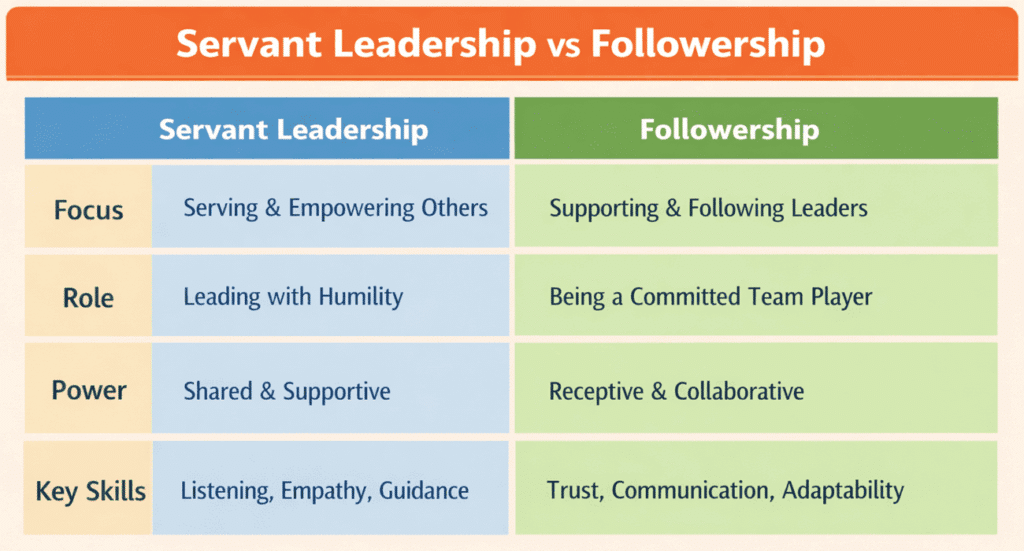
The infographic below visually summarizes these differences and can serve as a helpful reminder of each role’s core attributes.
FAQs
Q1. What is the main idea behind servant leadership?
Servant leadership means putting others first, listening carefully, and empowering team members. It focuses on removing obstacles so people can succeed rather than controlling them.
Q2. Is followership just taking orders?
No. Good followership involves initiative, communication, and problem-solving. Followers support a leader’s vision while actively contributing their own ideas and efforts.
Q3. How do these roles work together in Christian tech?
Servant leaders create an environment of trust and hope. Engaged followers respond with creativity and commitment, making projects more effective and better aligned with ministry goals.
Q4. Can anyone become a servant leader?
Yes. Servant leadership is not about a title. It is about a heart posture. Anyone can practice it by listening, caring, and sharing power, whether or not they lead a team.
Summary
Servant leadership and followership work best when they support each other. Servant leaders guide teams by serving first, building trust, and helping people grow. Followers strengthen the team by taking initiative, sharing ideas, and supporting the mission. When both roles are practiced well, workplaces become more collaborative and productive. Understanding these concepts helps professionals contribute more effectively and prepare for future leadership roles. Strong teams succeed not only because of great leaders, but also because of engaged followers who work toward the same goal.

I am Mohammad Fahad Usmani, B.E. PMP, PMI-RMP. I have been blogging on project management topics since 2011. To date, thousands of professionals have passed the PMP exam using my resources.