Starting a career in business analysis can feel confusing at first. Many beginners ask where to start and what skills matter most. The ECBA certification requirements give you a clear path. This entry-level credential helps you learn core concepts and build confidence.
In this guide, you will understand the ECBA certification eligibility requirements in simple terms, along with exam details and preparation steps. You will also learn about ECBA eligibility, exam format, and cost. If you want to become a business analyst, this certification can be your first strong step.
Let’s get started.
Key Takeaway
- No formal prerequisites: The ECBA exam has no formal prerequisites. Candidates must agree to IIBA’s Code of Ethical Conduct and Certification Terms.
- Updated exam format: The exam lasts 75 minutes and contains 50 situation-based and multiple-choice questions.
- Comprehensive blueprint: The exam covers nine domains spanning planning, elicitation, life?cycle management, analysis, strategy, evaluation, and foundational concepts.
- Fee includes membership: The ECBA fee ($395 or less) now includes IIBA membership, a practice exam, and a structured learning journey.
- Preparation matters: While there are no formal prerequisites, studying the Business Analysis Standard and BABOK Guide increases your chances of success.
What is ECBA Certification?
The ECBA certification is the starting point in the IIBA certification framework. It validates foundational knowledge of business analysis principles, terminology, and techniques. By passing the ECBA exam, you demonstrate to employers that you are ready to contribute to projects and grow in the field. ECBA certification often provides the confidence needed to speak up during meetings and ask insightful questions. It signals that you have invested in your professional development.
ECBA Exam Details
The ECBA exam focuses on job-ready skills and practical application of the Business Analysis Standard and the BABOK Guide. According to the ECBA Handbook, the test lasts 75 minutes and consists of 50 situation-based and standard multiple-choice questions. It is delivered online via remote proctoring, so you can take it from home or another quiet location as long as you meet the technology and identification requirements.
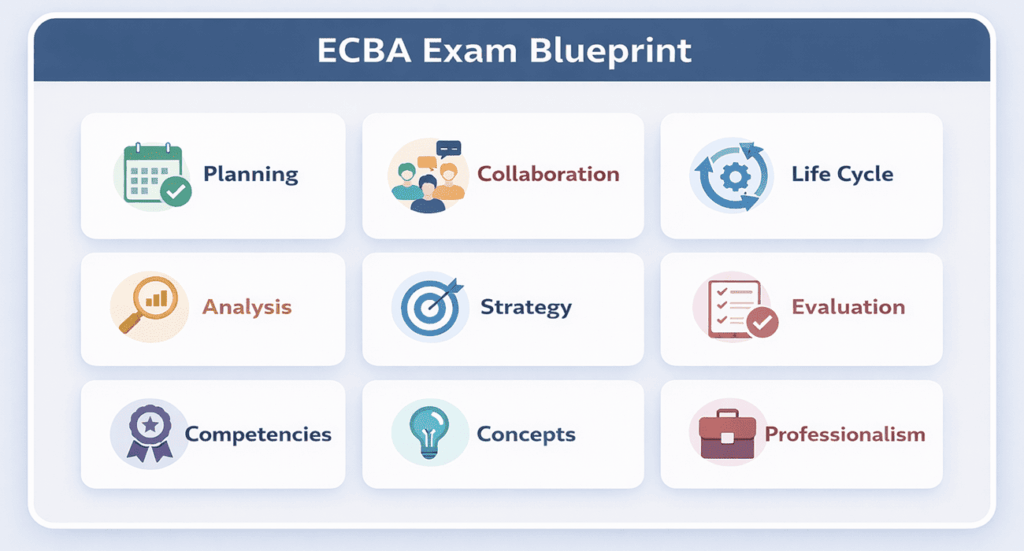
The exam blueprint outlines nine domains. The first three come from the Business Analysis Standard: planning & monitoring, elicitation & collaboration, and life-cycle management. The remaining six draw on the BABOK Guide, covering requirements analysis and design, strategy analysis, solution evaluation, underlying competencies, key concepts, and professional standards. The exam emphasizes scenario-based thinking, so questions ask you to apply concepts rather than recall definitions.
Eligibility Criteria
One of the most appealing aspects of the ECBA is that there are no formal eligibility requirements. The IIBA certification FAQ states that candidates need to agree to the Code of Ethical Conduct and Certification Terms. There are no mandatory work experience or educational prerequisites.
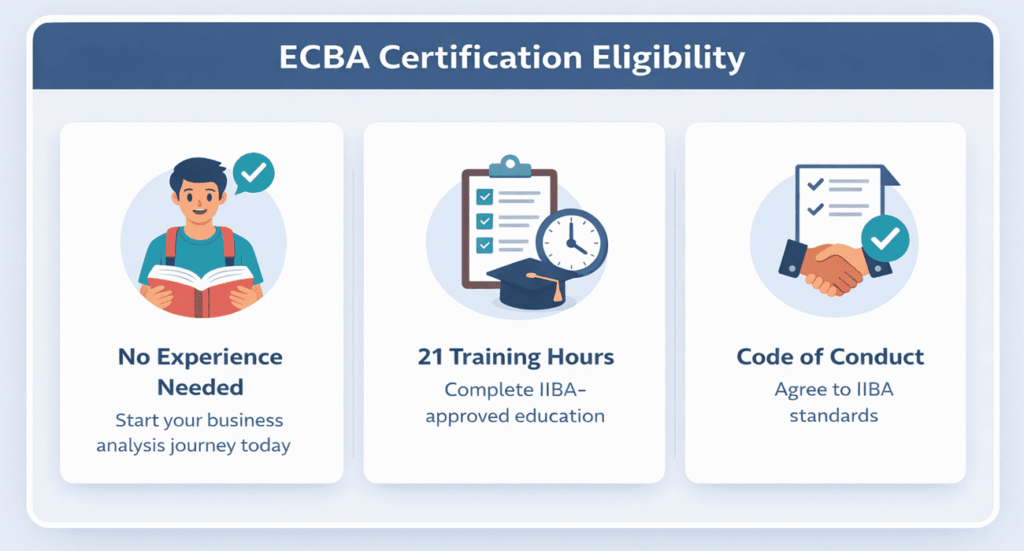
However, a basic understanding of business analysis concepts will help you grasp the exam content. Consider investing in at least 21 hours of professional development through IIBA-approved courses or self-study programs to build a strong foundation.
ECBA Exam Fee and Membership
As of April 2026, the ECBA exam costs $395 or less, depending on your region, and this fee includes the first year of IIBA membership. Membership provides access to the BABOK Guide, a practice exam, and the ECBA learning journey. Students may qualify for discounted rates (around $315). Exam rewrite fees are separate and not included in the initial purchase.
Recommended Prerequisites and Preparation Tips
Although anyone can take the ECBA exam, you can improve your chances by following these preparation steps:
- Study the core references. Read the Business Analysis Standard and the BABOK Guide to understand fundamental concepts and terminology.
- Join a training course. Enroll in an IIBA-endorsed training program to earn professional development hours and receive guided instruction.
- Create a study plan. Break the exam blueprint into manageable topics and allocate time each week to review materials and practice questions. Use study tables or mind maps to organize information.
- Take practice exams. Use the official ECBA practice exam to familiarise yourself with question formats and gauge your readiness.
- Engage with the community. Join discussion forums, attend IIBA chapter events, and participate in study groups to learn from peers and experts.
- Set a realistic schedule. When scheduling your exam, allow enough time to prepare thoroughly. Remember that you have 6 months to take the exam after purchasing it.
Beyond ECBA: Building a Business Analyst Career
The ECBA is an entry-level credential. As your experience grows, you can pursue advanced certifications such as the Certified Business Analysis Professional (CBAP) and the Certification of Capability in Business Analysis (CCBA). Both certifications require documented work experience and professional development hours.
Specialized credentials such as the Agile Analysis Certification (AAC) or the Cybersecurity Analysis Certification (CCA) can also broaden your expertise. Aligning your certification path with your career goals, whether in product management, data analysis, or agile project management, will help you stay competitive.
FAQs
Q1. What topics does the ECBA exam cover?
The exam covers nine domains, including planning & monitoring, elicitation & collaboration, life-cycle management, requirements analysis & design, strategy analysis, solution evaluation, and foundational concepts.
Q2. Is there an age or education requirement for ECBA?
No. Candidates of any age or educational background may sit for the exam, provided they agree to IIBA’s ethical standards.
Q3. How long does it take to prepare for the exam?
Preparation time varies by individual, but most learners spend four to eight weeks studying, depending on prior knowledge and the intensity of their schedule.
Q4. Can I retake the ECBA exam if I don’t pass?
Yes. You can purchase a rewrite at an additional fee. Use your result feedback to focus on weaker areas before retaking the exam.
Q5. What are the benefits of IIBA membership?
Membership includes access to the BABOK Guide, practice exams, the learning journey, community events, and discounts on exams and training.
Summary
Securing the ECBA certification is a practical step for those starting a career in business analysis. The exam now reflects real-world situations, focusing on competencies that employers value. With no formal prerequisites and a straightforward registration process, the ECBA provides an accessible entry point into the profession. By preparing diligently, leveraging IIBA resources, and engaging with the business analysis community, you can pass the exam with confidence and set the stage for future growth.
References:

I am Mohammad Fahad Usmani, B.E. PMP, PMI-RMP. I have been blogging on project management topics since 2011. To date, thousands of professionals have passed the PMP exam using my resources.