Choosing the right PMI certification can significantly shape your project management career. With many options available, it can be hard to decide which path fits your goals and experience.
This blog post will help you choose PMI certification options that match your skills, whether you are a beginner or an experienced professional. Understanding each PMI certification and its benefits will help you make a smart decision.
If you want better job opportunities, higher pay, and strong career growth, selecting the right PMI certification is an important step forward in your professional journey.
Why PMI Certifications Matter
Project management sits at the heart of modern business. Certified professionals earn more and enjoy better job prospects. In 2025, PMI’s Earning Power report found that people holding a Project Management Professional (PMP) certification earned 17% higher median salaries than non-certified peers across 21 countries. The same report noted that two-thirds of certified respondents received raises within a year.
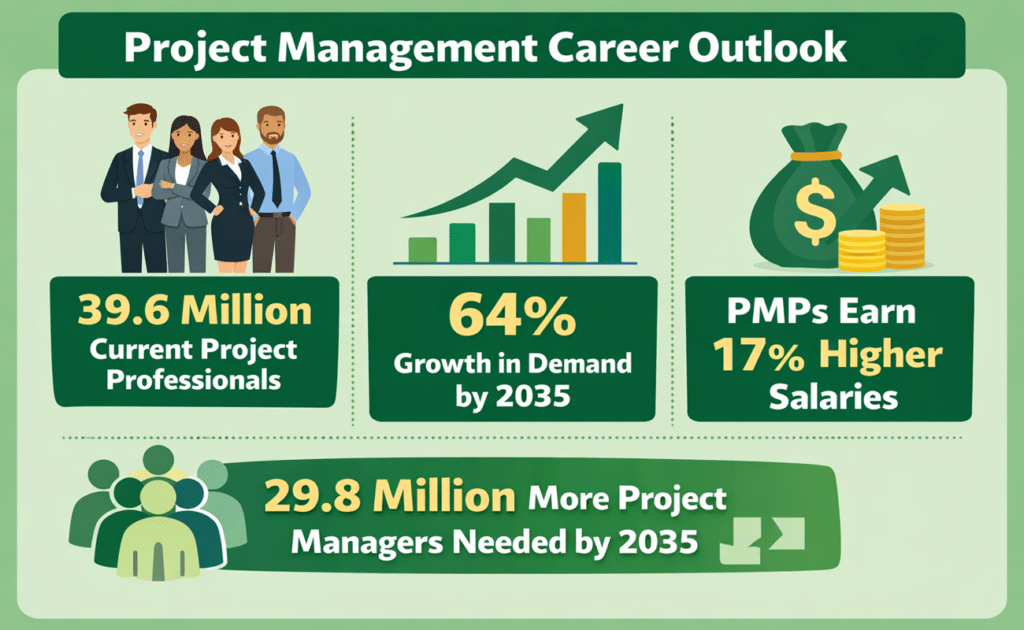
PMI’s Global Project Management Talent Gap analysis shows that there are 39.6 million project professionals worldwide, and demand could grow by 64% by 2035, leaving a shortfall of 29.8 million qualified people. These numbers prove that gaining a recognised credential can lead to economic security and open doors in a growing field. Certification also demonstrates a commitment to ethics and continuous learning, qualities employers value.
Overview of PMI Certifications
PMI divides its credentials into core (general) and specialised categories. Core certifications build foundational and advanced project management skills, while specialised certifications focus on specific roles or methodologies. The table below summarizes the main options.
| Certification | Experience Level | Key Purpose | Maintenance |
| Certified Associate in Project Management (CAPM) | Entry level; no professional experience required | Introduces basic project management processes, terminology, and frameworks | Exam re-taken every five years |
| Project Management Professional (PMP) | 3–5 years of project management experience | Validates ability to lead teams using predictive, agile, and hybrid methods; recognised worldwide | 60-Professional Development Units (PDUs) every three years |
| Program Management Professional (PgMP) | 4 years of project management plus 4 years of program management | Demonstrates ability to coordinate multiple related projects; prepares leaders for portfolio management | 60-PDUs every three years |
| Portfolio Management Professional (PfMP) | 8 years of business experience and portfolio management expertise | Confirms ability to align programs and projects with organisational strategy and manage enterprise resources | 60-PDUs every three years |
| PMI Risk Management Professional (PMI-RMP) | 2 years of project risk management experience | Focuses on identifying and mitigating risk across projects | 30-PDUs every three years |
| PMI Scheduling Professional (PMI-SP) | 2 years of project scheduling experience | Specialises in developing and maintaining project schedules | 30-PDUs every three years |
| PMI Agile Certified Practitioner (PMI-ACP) | 1 year of general project experience plus eight months on agile teams | Demonstrates knowledge of agile principles, including Scrum, Kanban, and lean | 30-PDUs every three years |
| PMI Professional in Business Analysis (PMI-PBA) | 3–5 years of business analysis experience | Validates ability to define requirements and manage stakeholders; bridges business and IT | 60-PDUs every three years |
| PMI PMO Certified Professional (PMI-PMOCP) | 3 years of project or PMO experience | Certifies skill in building and leading a Project Management Office (PMO) and tailoring it to organizational needs | 30-PDUs every three years |
CAPM: The Gateway Certification
The Certified Associate in Project Management (CAPM) certification is designed for people new to the discipline. It requires no professional experience, though PMI recommends at least 23 hours of project management education. The exam consists of 150 questions taken over three hours. Passing the CAPM shows employers that you understand project terminology and can work within established processes. It is an excellent entry point for students, recent graduates, or professionals changing fields.
When to choose CAPM: Pick CAPM if you lack project management experience and want a recognised credential to build confidence. Many people use CAPM as a stepping stone toward PMP once they gain on-the-job experience.
PMP: The Gold Standard
The Project Management Professional (PMP) remains the most widely recognised certification in the field. As of 2026, more than one million professionals hold this credential. The PMP exam tests your ability to manage projects using predictive, agile, and hybrid approaches. Certification holders report significantly higher salaries and steady raises, making this credential a wise investment. You need at least 3 years of project management experience and 35 hours of project management education. The exam includes multiple-choice questions, drag-and-drop items, and scenario-based questions.
When to choose PMP: Choose PMP if you lead projects regularly, want to validate your skills, and aim for senior roles. This certification signals that you can adapt to changing work models, including agile and hybrid environments.
PgMP: Managing Multiple Projects
The Program Management Professional (PgMP) certification is for experienced managers overseeing multiple related projects. Candidates must have four years of project management experience and four years of program management experience. The credential demonstrates that you can coordinate projects to achieve strategic objectives. It prepares you to move into portfolio or enterprise-level leadership.
When to choose PgMP: Consider PgMP if you already manage large programs and want to formalise your expertise. It is ideal for those seeking director-level roles overseeing complex initiatives.
PfMP: Aligning Strategy and Execution
The Portfolio Management Professional (PfMP) credential proves that you can manage a collection of programs and projects to meet organisational goals. This certification is now fully established and no longer in a trial phase. Applicants need eight years of business experience and portfolio management expertise. PfMP holders learn to balance resource demands, select the right projects, and align investments with strategy. Maintaining the certification requires 60 PDUs every three years.
When to choose PfMP: Choose PfMP if you already work at the executive or strategic level and want to ensure your organisation is doing the right projects, not just doing projects right.
PMI-RMP: Specialising in Risk Management
The PMI Risk Management Professional (PMI-RMP) focuses on identifying, analysing, and responding to risk. Candidates need at least two years of project risk management experience and specialised education. The exam covers risk strategy, planning, identification, analysis, response, and monitoring. It is ideal for risk managers, project managers, or engineers who want to highlight their expertise in protecting projects from threats.
PMI-SP: Mastering Scheduling
Scheduling lies at the core of successful project delivery. The PMI Scheduling Professional (PMI-SP) certification validates skill in building realistic schedules, monitoring progress, and updating plans. Applicants should have two years of scheduling experience. The exam addresses scheduling strategy, planning, and control techniques. It suits those who coordinate timelines and resources across multiple teams.
PMI-ACP: Embracing Agile Methods
Agile is now mainstream across industries. The PMI Agile Certified Practitioner (PMI-ACP) recognises professionals who understand agile principles such as Scrum, Kanban, and Lean. You need 1 year of general project experience and 8 months of experience working on agile teams. This credential signals that you can lead adaptive projects and support continuous improvement. Many organisations now require agile knowledge even for traditional projects.
PMI-PBA: Bridging Business and Technology
Effective communication between business and technology teams is critical. The PMI Professional in Business Analysis (PMI-PBA) focuses on defining requirements, engaging stakeholders, and ensuring that solutions deliver value. Candidates must have several years of business analysis experience. The credential helps project managers deepen their analytical skills and positions business analysts for leadership roles.
PMI-PMOCP: Leading Project Management Offices
The newest addition to PMI’s portfolio is the PMI PMO Certified Professional (PMI-PMOCP)™. This certification certifies expertise in leading and shaping Project Management Offices. It emphasises flexibility and customised approaches rather than one-size-fits-all models.
The PMI-PMOCP exam is tailored for PMO leaders, team members, and project coordinators with at least three years of project or PMO experience. Earning this credential demonstrates that you can design, assess, and improve PMOs to ensure they deliver strategic value.
When to choose PMI-PMOCP: Pick this certification if you are responsible for building or transforming a PMO, or if you lead teams that set organisational standards. It can also help experienced project managers move into governance and strategic roles.
How to Decide Which PMI Certification Fits You
Here are some questions to help narrow your choice:
- Where are you in your career? If you are just starting out, CAPM offers a strong foundation. If you already manage complex projects, PMP or PgMP may be more appropriate.
- Do you need specialised skills? Roles in risk management, scheduling, or agile teams benefit from PMI-RMP, PMI-SP, and PMI-ACP, respectively.
- Are you steering the strategy? For executives and senior managers, PfMP and PMI-PMOCP demonstrate how to align projects with organisational goals and drive transformation.
- Do you want to bridge business and technology? Choose PMI-PBA to strengthen your ability to translate business needs into actionable project requirements.
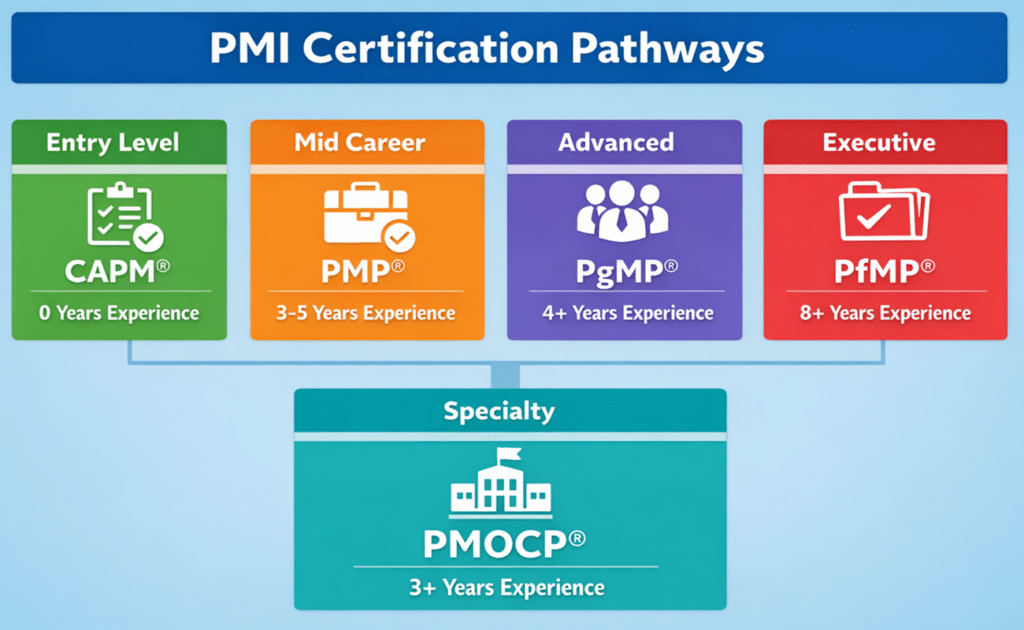
Comparing PMI Certifications: A Visual Guide
The infographic below summarises experience requirements for PMI’s core and new certifications. It uses contrasting colours to guide your eye and makes it easy to compare options at a glance.
Project Management Career Outlook
Demand for project professionals continues to surge. The second infographic distils the key statistics from PMI’s latest surveys (the first and second surveys): there are 39.6 million project professionals worldwide; demand is projected to grow by 64% by 2035; and PMP holders earn 17% more than their peers. These facts highlight why investing in certification makes sense in today’s economy.
FAQs
Q1. What is the easiest PMI certification to start with?
If you have little or no experience, the CAPM is considered the most accessible. It introduces basic principles and helps you gain confidence without strict prerequisites.
Q2. Do PMI certifications expire?
Yes. Most PMI credentials require ongoing professional development. PMP, PgMP, PfMP, and PMI-PBA holders must earn 60 PDUs every three years, while PMI-RMP, PMI-SP, and PMI-ACP holders need 30 PDUs every three years. CAPM holders re-take the exam every five years.
Q3. Does PMI offer a certification for PMO leaders?
PMI introduced the PMI-PMOCP certification in 2025. It validates your ability to design, operate, and improve a Project Management Office, ensuring it delivers strategic value.
Q4. How does PMP compare with CAPM?
CAPM is entry-level and focuses on terminology and process basics. PMP requires more experience and demonstrates your ability to manage projects using various methodologies. PMP holders typically command higher salaries and senior roles.
Summary
Certifications from the Project Management Institute can accelerate your career and help you stand out in a crowded market. By matching your experience and goals to the right credential, you take control of your professional growth. Ask yourself where you are today, where you want to be, and which skills you need to get there. The project management field is expanding, and employers value certified professionals. Whether you choose CAPM, PMP, PgMP, PfMP, PMI-RMP, PMI-SP, PMI-ACP, PMI-PBA, or the new PMI-PMOCP, you are investing in a brighter future.

I am Mohammad Fahad Usmani, B.E. PMP, PMI-RMP. I have been blogging on project management topics since 2011. To date, thousands of professionals have passed the PMP exam using my resources.