Agile delivery is no longer a niche practice. Today, most software and product teams iterate, adapt, and release continuously. Earning the Project Management Institute Agile Certified Practitioner (PMI-ACP) credential proves that you can lead those teams. It signals that you understand adaptive methods, can guide people through change, and know how to deliver real value.
But why is the PMI-ACP certification so sought-after? Do you want to show employers that you can keep projects on course no matter how fast things change?
This blog post will help you decide if PMI-ACP is right for you. It explains how Agile adoption has grown, what the PMI-ACP exam covers, who is eligible to take it, and how the credential can boost your career. You’ll also find exam preparation tips and answers to common questions. By the end, you’ll have a clear plan for becoming an Agile-certified leader.
Let’s get started.
Why Agile Certification Matters
Agile practices continue to expand beyond IT. According to the 17th State of Agile report, about 70 percent of survey respondents use an Agile Software Development Life Cycle (SDLC). The same report found that 69 percent of information technology teams and 68 percent of software development and delivery teams use Agile, while nearly half of engineering and R&D teams have adopted it.
Business operations and marketing departments are also catching up, with around 28% and 20% using Agile methods, respectively. This widespread adoption shows that Agile is now a core business practice, not just a technical choice.
Demand for project management skills is also rising. A recent project management study reported that there are about 40 million project management professionals worldwide, yet up to 30 million more will be needed by 2035 to meet global demand. Salaries reflect this demand; the current range for project managers is approximately $104,000–$183,000 per year, with a median total pay of $136,000.
Professionals who hold certifications like the PMP earn higher median salaries than those without certifications. If you want to stand out in a growing field, mastering Agile practices and earning a specialized credential can position you for leadership roles.
Understanding the PMI-ACP Credential
The PMI-ACP certification is a professional credential offered by the Project Management Institute (PMI). Unlike single-framework certifications, PMI-ACP covers multiple Agile approaches, including Scrum, Kanban, Lean, Extreme Programming (XP), and Test-Driven Development. This breadth ensures that certified practitioners can adapt to a variety of projects and industries.
PMI created the Agile Certified Practitioner credential to address a growing need for leaders who can bridge traditional project management and modern iterative methods. The certification demonstrates your ability to lead teams using Agile values and principles, prioritize value delivery, and guide stakeholders through iterative cycles. Employers recognize it as proof that you can help teams deliver quality work faster and adapt to change.
Personal Perspective
When I first explored Agile, the flexible mindset was both exciting and challenging. Traditional project plans felt rigid, but Agile frameworks let me experiment and learn quickly. Studying for the PMI-ACP exam made me think beyond a single framework and focus on the values behind iterative work. That shift helped me guide cross-functional teams more effectively. If you enjoy solving problems through collaboration and continuous improvement, this credential may resonate with you, too.
PMI-ACP Eligibility and Requirements
To apply for the PMI-ACP exam, you need to meet specific experience and education requirements. These requirements ensure that candidates have a practical understanding of both traditional and Agile project delivery.
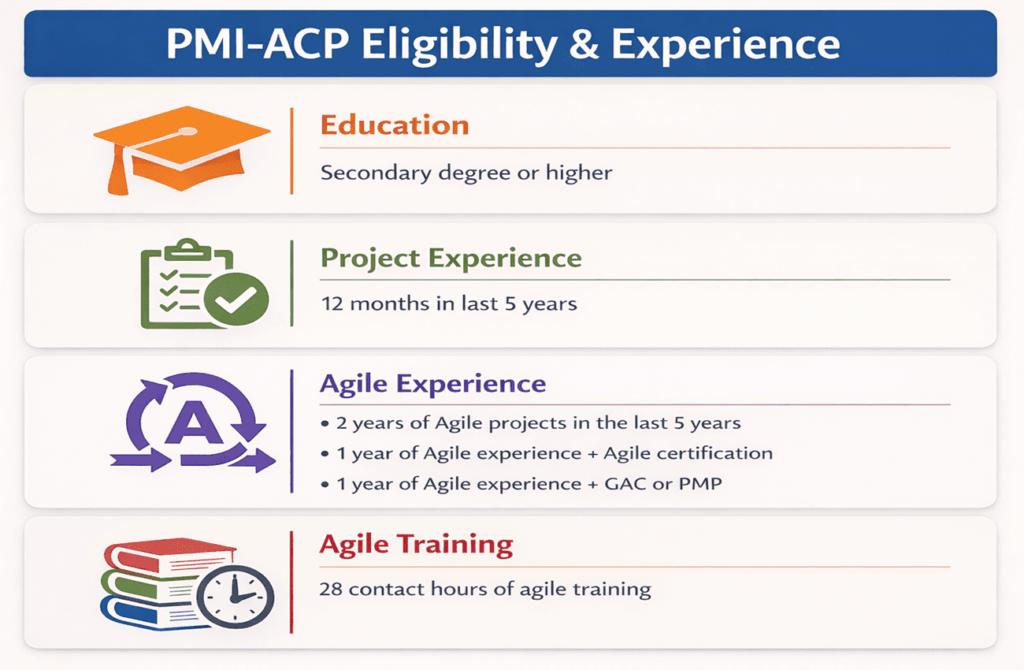
The eligibility criteria are:
- Education: You must hold a secondary degree (high school diploma, associate’s degree, or global equivalent).
- General project experience: At least 12 months of project management experience gained within the last five years. This experience can be in any methodology (predictive, hybrid, or Agile).
- Agile project experience: At least 24 months of Agile project experience within the last five years; you can substitute with 12 months of Agile experience if you also hold an active Project Management Professional (PMP) credential, a third-party Agile certification (older than one year), or a degree from a PMI-accredited program.
- Agile training: 28 contact hours of formal training in Agile practices. This training can come from instructor-led courses, online training, or accredited workshops.
If you meet these requirements, you can create an account on PMI.org, document your experience and training hours, submit the online application, and then schedule your exam. PMI typically reviews applications within ten business days.
Exam Structure and Domains
The PMI-ACP exam is a three-hour, computer-based test with 120 questions. Of these, 100 are scored, and 20 are unscored pre-test questions used to validate future exam items. You may take a short break halfway through the test.
Questions are drawn from four domains, each weighted to reflect its importance. Understanding these domains helps you focus your study efforts. The infographic below summarizes the exam domains and their weightings.
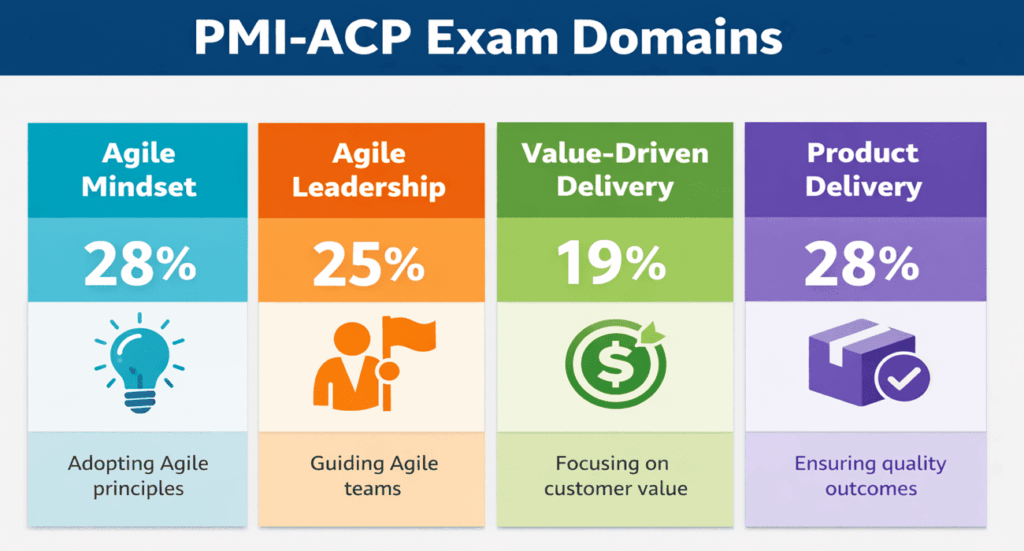
- Agile Mindset (28%) – Understanding Agile values and principles. You will need to demonstrate how to cultivate an environment of trust, collaboration, and continuous improvement.
- Agile Leadership (25%) – Leading teams through servant leadership, facilitation, empowerment, and conflict resolution. You’ll explore how to build high-performing teams and remove impediments.
- Product Delivery (28%) – Managing the flow of work, defining user stories, maintaining backlogs, and ensuring that deliverables meet customer needs. This domain blends product management and project management skills.
- Value-Driven Delivery (19%) – Prioritizing work to deliver value early and often. You’ll need to understand incremental delivery, feedback loops, and performance metrics.
Exam Fees and Format
For PMI members, the exam fee is currently USD 435; non-members pay USD 495, and retake fees are lower for members. You can take the exam either at a Pearson VUE testing center or online with a proctor. After passing, you will earn the PMI-ACP credential, valid for three years.
Benefits of PMI-ACP Certification
Earning a PMI-ACP credential carries several benefits:
Enhanced career prospects: Agile certified professionals are in high demand. This report shows that the enterprise agile transformation services market is projected to grow rapidly (18% CAGR from 2024–2032) due to the increasing adoption of Agile practices in organizations. This growth reflects how organizations across industries use Agile to improve responsiveness and innovation. With demand high, PMI-ACP certification can help you stand out when seeking jobs.
Salary potential: In the United States, professionals with PMI-ACP certification report average annual salaries of about $123,000, with top earners reaching $150K+ and salary uplifts of 20–28 percent compared with non-certified peers. These figures align with broader project management salary ranges; project managers generally earn between $104,000 and $183,000 per year.
Recognition and credibility: PMI’s certifications are recognized in more than two hundred countries. Because PMI-ACP covers multiple Agile frameworks, employers trust that credential holders can adapt to diverse contexts rather than rely on a single method.
Versatility: PMI-ACP teaches not only Scrum but also Kanban, Lean, XP, and other frameworks. This cross-framework knowledge helps you choose the right tool for each project.
Cross-industry applicability: Agile methods are used in software, marketing, manufacturing, healthcare, and product development. With PMI-ACP, you can move between industries more easily because you understand the underlying principles of adaptive work.
Maintaining Your PMI-ACP Credential
PMI requires PMI-ACP holders to earn 30 professional development units (PDUs) during each three-year renewal cycle. These PDUs encourage continuous learning and include both educational and giving-back activities, such as mentoring others or volunteering. You will need to submit PDUs through PMI’s online system and pay a renewal fee. The renewal process helps ensure that your skills remain current as Agile practices evolve.
Staying Engaged
To keep your skills sharp, join Agile communities, attend webinars, and read case studies. Participating in local PMI chapters or online forums offers opportunities to share experiences and learn from others. Continuous involvement not only helps you meet PDU requirements but also deepens your understanding of how different teams apply Agile principles.
How PMI-ACP Stands Out
PMI-ACP is broader than role-specific certifications like Certified ScrumMaster (CSM) or Product Owner credentials. Those certifications focus on a single framework or role, such as facilitating Scrum ceremonies or managing the product backlog. PMI-ACP covers a range of methods and emphasizes principles over tools. It also requires prior experience and training, which signals to employers that you have both theoretical knowledge and hands-on experience.
Compared with the Project Management Professional (PMP) certification, which focuses on predictive and hybrid frameworks, PMI-ACP places greater emphasis on iterative, value-driven delivery.
Study Tips for Success
Preparing for the PMI-ACP exam requires deliberate practice and reflection. Here are some practical study tips:
- Build a study schedule: Dedicate 8–10 hours per week over several weeks. Break your plan into short daily sessions and review your progress regularly.
- Use multiple resources: Combine PMI’s official resources with Agile textbooks, practice exams, and flashcards. Practicing under timed conditions helps build stamina for the three-hour test.
- Focus on real scenarios: Don’t just memorize definitions. Think about how Agile principles apply to your own projects. Practice writing user stories, conducting retrospectives, and prioritizing backlogs.
- Join an Agile community: Learn from peers by joining local meetups or online forums. Hearing how others handle challenges will deepen your understanding of Agile in practice.
- Reflect on your experiences: Throughout your career, you’ve likely used some aspects of Agile. Reflecting on successes and failures helps you internalize the values behind the practices.
FAQs
Q1. What does the PMI-ACP exam cost?
The exam fee is USD 435 for PMI members and USD 495 for non-members. Retake fees are lower for members. Membership may be worth the investment if you plan to pursue multiple credentials or need access to PMI’s resources.
Q2. How long should I study for the PMI-ACP exam?
Many candidates spend two to three months preparing, averaging 8–10 hours per week. The exact time varies based on your prior Agile experience and familiarity with the domains.
Q3. Is PMI-ACP harder than the PMP certification?
PMI-ACP focuses on Agile frameworks, while PMP emphasizes predictive and hybrid methods. Difficulty depends on your background. If you have extensive Agile experience, you may find PMI-ACP more intuitive. Both exams require rigorous study and practical experience.
Q4. Do PMI-ACP certified professionals earn more?
Yes. Surveys show that PMI-ACP holders in the United States earn an average of about $123,000 and often see salary boosts of 20–28 percent. This aligns with broader data showing that certified project managers earn higher median salaries.
Q5. What happens if I don’t meet the experience requirements?
If you lack the required Agile experience, start by joining cross-functional projects at your workplace or volunteering for Agile initiatives. You can also earn a third-party Agile certification or a degree from a PMI-accredited program to reduce the Agile experience requirement.
Summary
Agile is no longer optional. As organizations worldwide adopt iterative methods and demand for adaptive leaders grows, the PMI-ACP credential stands out as a powerful way to validate your skills. By meeting the eligibility requirements, mastering the exam domains, and maintaining your certification through ongoing learning, you position yourself for long-term success. The next wave of projects will be more complex and dynamic than ever. Will you be ready to guide your team through it?

I am Mohammad Fahad Usmani, B.E. PMP, PMI-RMP. I have been blogging on project management topics since 2011. To date, thousands of professionals have passed the PMP exam using my resources.