Present value shows what a future amount of money is worth today. It is based on the idea that money now can earn a return, so it has more value than the same amount in the future. To find the present value, you discount the future amount using a rate that reflects risk, inflation, or expected return. A higher rate or longer time lowers the present value. People use it to compare investments, evaluate projects, and plan finances.
For example, would you take $10,000 today or the same amount after three years? Present value helps you answer that with clarity.
Present Value (PV) Calculator
Use this calculator to find the current worth of a future amount based on a discount rate and time period.
Present Value Calculator
Enter the future value, discount rate, and number of periods.
How to Calculate Present Value
You can calculate present value in a few simple steps:
- Identify the future value: Start with the amount you expect to receive in the future.
- Choose the discount rate: This rate reflects opportunity cost, inflation, risk, or your required return.
- Determine the number of periods: Use years, months, or any equal time unit, as long as the rate matches the period.
- Apply the formula: Discount the future amount back to today.
- Review the result: The answer shows how much that future money is worth now.
Present Value Formula
The formula for present value is:
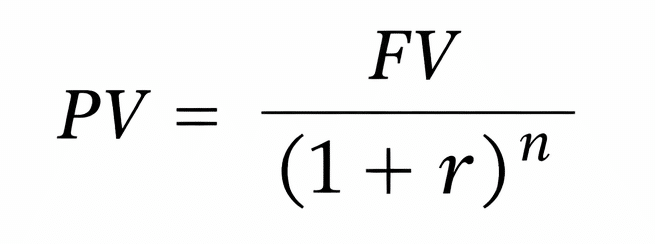
Where:
- PV = Present Value
- FV = Future Value
- r = Discount Rate per period
- n = Number of periods
This formula discounts a future amount into today’s dollars. A higher discount rate or a longer time period lowers the present value. That is the heart of the time value of money.
Present Value Example
Suppose you expect to receive $10,000 after 3 years, and your discount rate is 8%.
Given:
- Future Value = $10,000
- Discount Rate = 8%
- Number of Periods = 3
Step 1: Convert the discount rate into a decimal
r = 8% = 0.08
Step 2: Apply the formula
PV = 10,000 / (1 + 0.08)^3
PV = 10,000 / 1.2597
PV = 7,938.32
Step 3: Interpret the result
The present value of $10,000 received after 3 years at an 8% discount rate is $7,938.32.
This means that receiving $7,938.32 today is financially equal to receiving $10,000 in 3 years, assuming an 8% return. Pretty useful, right?
Importance of Present Value
Present value helps you make better financial decisions. It shows whether a future payment, benefit, or return is attractive in today’s terms. It is useful when comparing project benefits, loan offers, lease agreements, investment returns, and retirement goals.
For project managers, PV supports cost-benefit analysis and business case development. For investors, it helps compare future returns against what money is worth now. For anyone planning ahead, it cuts through guesswork.
FAQs
Q1. What is present value used for?
Present value is used to determine what a future sum of money is worth today. It supports investment analysis, project selection, budgeting, valuation, and long-term planning.
Q2. What happens if the discount rate increases?
If the discount rate rises, the present value falls. This is because future money becomes less valuable when the required return is higher.
Q3. Can I use monthly periods instead of yearly periods?
Yes. Just keep the rate and time units consistent. If you use months, use a monthly discount rate and the number of months.
Q4. What is the difference between present value and net present value?
Present value discounts a future amount to today's value. Net present value compares total discounted cash inflows and outflows to show whether an investment adds value. The reference post you shared explains NPV in that broader investment context.
Summary
Present value is one of the most important concepts in finance. It tells you what future money is worth today and helps you make smarter decisions. Whether you are reviewing an investment, planning a project, or comparing financial options, PV gives you a clear basis for judgment.
A present value calculator saves time and reduces manual errors, but the real value lies in choosing the right discount rate and interpreting the results well.

I am Mohammad Fahad Usmani, B.E. PMP, PMI-RMP. I have been blogging on project management topics since 2011. To date, thousands of professionals have passed the PMP exam using my resources.