
A Rough Order of Magnitude estimate is an early project estimate. You can use it when the scope is still broad and complete data is not available. It helps management decide whether a project looks viable before spending more time and money on detailed planning.
Depending on the industry and project conditions, those ranges may be about -25% on the low side and +75% on the high side.
A ROM calculator makes this process easier. You enter a base estimate, the expected accuracy range, and the tool gives you a lower and upper bound in seconds. That helps you discuss options, compare scenarios, and make early business decisions with less guesswork.
Rough Order of Magnitude (ROM) Calculator
Use this ROM calculator to estimate a project’s possible cost range.
ROM Calculator
Enter the base estimate and ROM accuracy percentages to calculate the cost range.
How to Calculate ROM
You can follow these steps to calculate the ROM range:
Step 1: Find the Base Estimate
Start with your best early estimate. This may come from expert judgment, past project data, parametric estimating, or high-level assumptions.
Step 2: Define the Accuracy Range
Choose the lower and upper percentage range for uncertainty. Early estimates often use broad ranges because the project is not yet fully defined. Early estimates are based on a very limited definition, and wide ranges are normal.
Step 3: Calculate the Lower Estimate
Reduce the base estimate by the lower percentage.
Step 4: Calculate the Upper Estimate
Increase the base estimate by the upper percentage.
Step 5: Review the Result
The output gives you a range, not a single final number. This range helps with early budgeting and go or no-go decisions.
Rough Order of Magnitude Formula
The ROM formula is as follows:
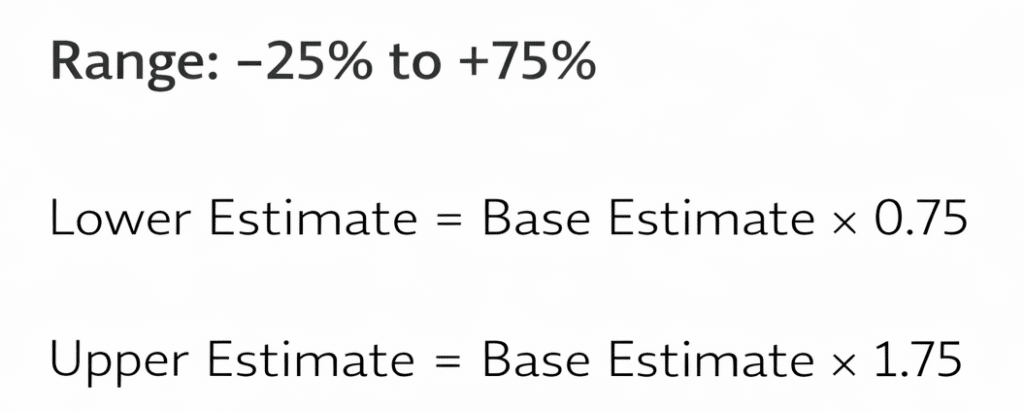
ROM Example
Imagine your early project estimate is 100,000.
You decide to use:
- Lower Accuracy Range = 25%
- Upper Accuracy Range = 75%
Now calculate the range:
- Lower Estimate = 100,000 × (1 – 25/100)
- Lower Estimate = 100,000 × 0.75 = 75,000
- Upper Estimate = 100,000 × (1 + 75/100)
- Upper Estimate = 100,000 × 1.75 = 175,000
So, your Rough Order of Magnitude range is:
- Lower Estimate = 75,000
- Upper Estimate = 175,000
What does this mean?
It means the final project cost may fall anywhere between 75,000 and 175,000 based on current information. That’s a wide band, sure, but that is the point of a ROM estimate. It shows uncertainty early, before the team has full details.
Importance of a ROM Calculator
A ROM calculator saves time and reduces manual mistakes. You can test several scenarios in minutes. That is helpful when leaders want a quick answer, and the project is still in the idea stage.
It also improves communication. Instead of giving a single number that seems too certain, you show a realistic range. That leads to better discussions about risk, funding, and next steps. Early estimates are meant for screening and concept evaluation, not final control budgets, and wide ranges are expected at that stage.
When Should You Use a ROM Estimate?
Use a ROM estimate when:
- The project is still in the concept stage
- Detailed drawings or requirements are not ready
- Management needs an early funding view
- You want to compare multiple options
- You need a fast estimate for a feasibility review
It works well for early planning. It does not replace a detailed project estimate later.
Limitations of ROM Estimates
ROM estimates are useful, but they have limits.
First, they are not highly accurate. The project definition is still weak, so the estimate range can be broad. Second, the result depends on assumptions. If your assumptions are weak, the range will not help much. Third, a ROM estimate should not be used as a contract price or a final approved baseline. AACE’s estimate classification guidance makes clear that early-order estimates rely on limited information and broad uncertainty.
FAQ
Q1. What is a ROM estimate in project management?
A ROM estimate is an early cost estimate used when project details are limited. It gives a broad cost range for planning and decision-making.
Q2. How do you calculate a Rough Order of Magnitude?
You start with a base estimate, then subtract the lower percentage and add the upper percentage to get the possible range.
Q3. Is a ROM estimate accurate?
It is less accurate than later estimates. It gives a broad range because the project is still in the early stages.
Q4. What is a ROM calculator?
A ROM calculator is a tool that quickly shows the lower and upper cost range based on a base estimate and accuracy percentages.
Q5. When should I use a ROM calculator?
Use it during the concept or initiation stage when you need a quick estimate before detailed planning begins.
Summary
A Rough Order of Magnitude calculator helps you create an early project cost range with little effort. It is useful when you need a fast estimate, and the project still lacks detail. The result will not be exact, but it gives decision-makers a practical range for planning. Use ROM estimates for screening, budgeting discussions, and feasibility checks. Then refine the estimate later as scope, design, and project data become clearer.

I am Mohammad Fahad Usmani, B.E. PMP, PMI-RMP. I have been blogging on project management topics since 2011. To date, thousands of professionals have passed the PMP exam using my resources.