Productivity plays a key role in how businesses, economies, and individuals achieve better results with limited resources. It shows how efficiently inputs such as labor, time, and capital are converted into useful output. When productivity improves, organizations can produce more without increasing costs. This leads to higher profits, better wages, and stronger economic growth.
Today, productivity is not just about working harder; it is about working smarter. Technology, remote work, and efficient processes all shape our productivity. Understanding productivity helps you make better decisions, whether you manage a company or plan your daily tasks.
In today’s blog post, I will explain productivity, its types, and examples.
Let’s get started.
Key Takeaways
- Productivity compares output to input. It shows how much output we get from certain resources, such as labor, capital, or materials.
- Growth in productivity drives prosperity. Rising productivity supports higher wages, increased corporate profits, and better living standards.
- Labor and total factor productivity are common measures. Labor productivity is output per hour worked, while total factor productivity accounts for labor, capital, and other inputs.
- Technology and management influence productivity. Generative AI can save workers hours each week, and remote work has reshaped how industries operate.
- Measuring and tracking productivity helps everyone. Whether running a factory or managing your day, understanding productivity helps allocate resources wisely.
What is Productivity?
Productivity shows how efficiently we use resources to produce goods or services. It compares output to input, such as time, labor, or money. When productivity is high, we get more results with the same effort.
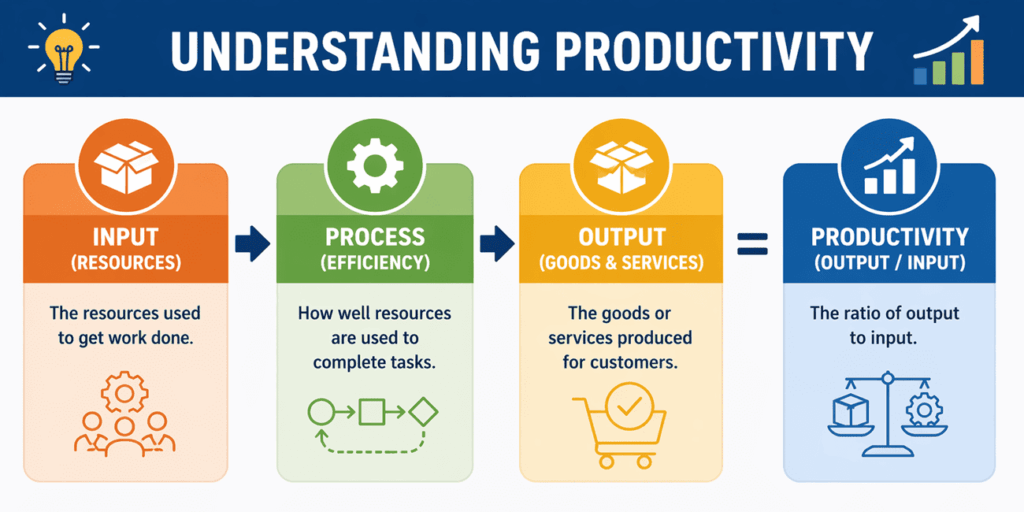
For example, if a worker produces more units in fewer hours, productivity improves. Businesses use productivity to measure performance and control costs. Economists use it to track economic growth and living standards. Better productivity often leads to higher profits, better wages, and lower prices. Today, tools like automation and digital systems help improve productivity.
In simple terms, productivity means doing more in less time without reducing quality.
Type of Productivity
Productivity can be measured in different ways depending on what you want to analyze. The three common types are labor, economic, and business productivity.
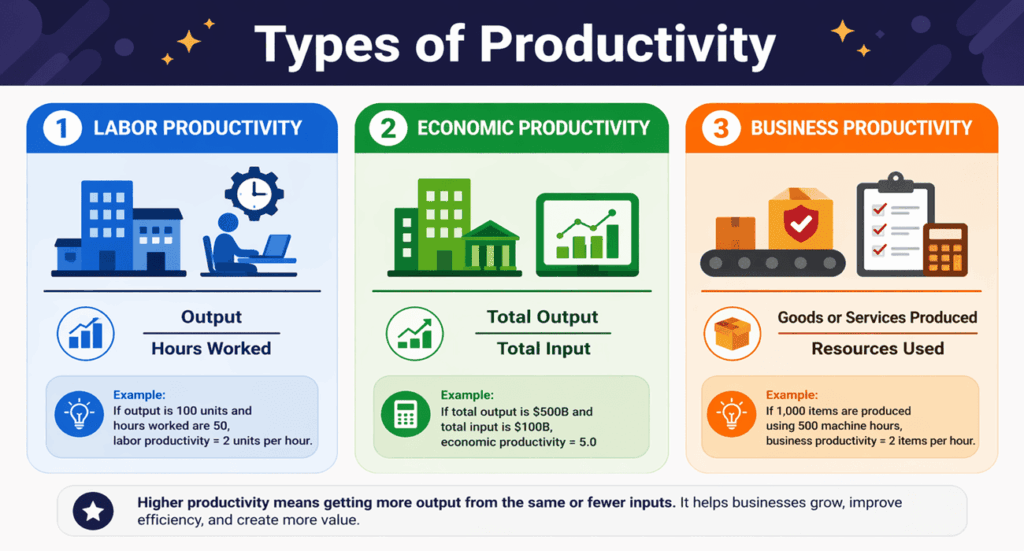
Labor productivity focuses on how much output a worker produces in a given time. It is usually calculated by dividing total output by hours worked. For example, if a worker produces 100 units in 50 hours, labor productivity is 2 units per hour. It helps companies understand employee efficiency.
Economic productivity looks at the overall efficiency of an economy. It compares total output, often measured as GDP, to total input, such as labor and capital. This type shows how well a country uses its resources to create value and support growth.
Business productivity measures how efficiently a company uses all its resources, including labor, machines, and materials. It focuses on the goods or services produced relative to the resources used. This helps managers improve operations, reduce waste, and increase profits.
Why Productivity is Important
Growth and Living Standards
When productivity grows, economies can pay higher wages without pushing up inflation. More efficient production also increases corporate profits and tax revenues, allowing governments to invest in infrastructure and social services. Economists see sustained productivity growth as the foundation for long-term prosperity.
Investment and Innovation
Investment in equipment, research and development, and employee training often improves productivity. For example, the BLS reports that capital input grew 2.7% in 2025, while labor composition grew 0.6%. These investments help businesses adopt new technologies, streamline operations, and compete globally. Conversely, policies that discourage saving or reward short-term consumption can limit productivity growth.
Technology and AI
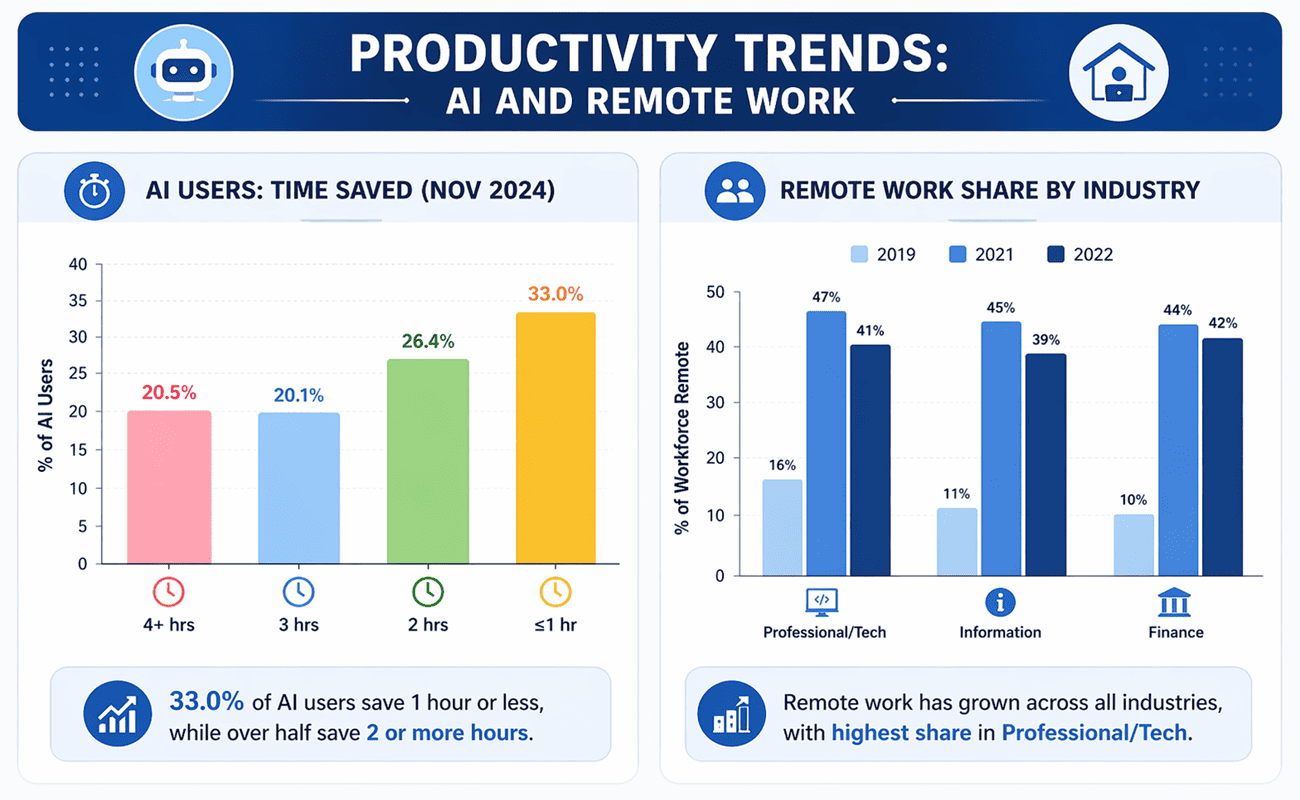
New technologies can dramatically enhance productivity. A survey by the St. Louis Federal Reserve found that 20.5% of workers who used generative AI in the previous week saved four hours or more, while 26.4% saved two hours. On average, generative AI saved users 5.4% of their work hours in November 2024, equivalent to 2.2 hours per week for a 40-hour workweek. These gains show how AI tools can free up time for higher-value tasks.
Remote Work
Remote work surged during the COVID-19 pandemic. In 2019, only 6.5% of workers in the private business sector worked primarily from home. By 2021, the share of remote workers exceeded 40% in professional, scientific, technical services, information, and finance industries. Remote work can improve productivity by reducing commuting time and increasing flexibility, though its impact varies across industries and individuals.
How to Measure Productivity
Measuring productivity sounds complex, but it’s really about comparing results with effort.
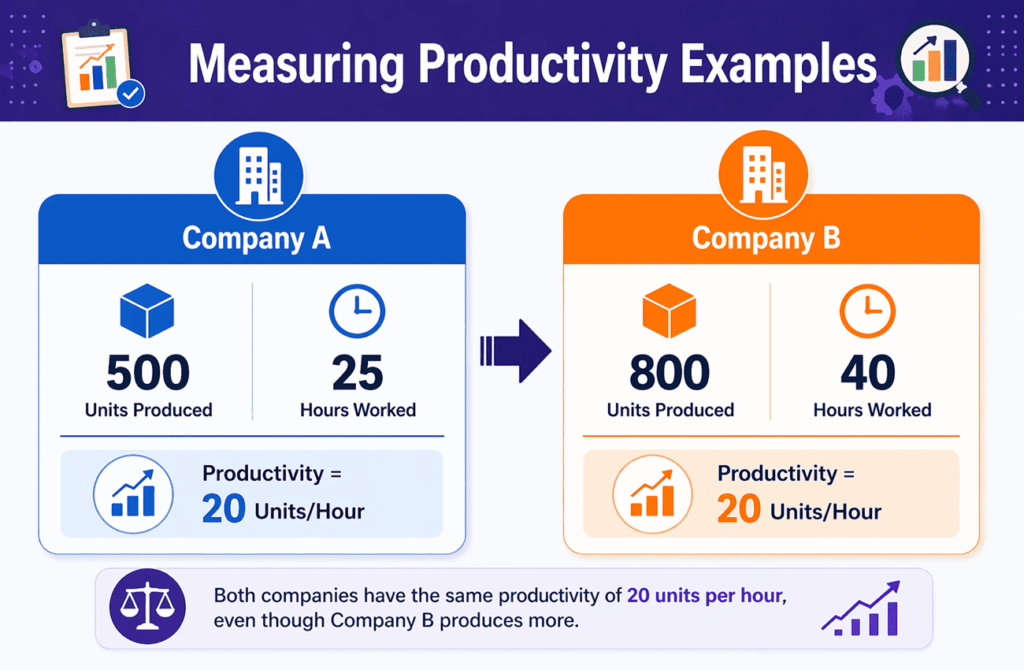
Let’s break it down:
Labor productivity is the easiest to measure. You divide the total output by total hours worked. For example, if a team produces 500 units in 25 hours, productivity is 20 units per hour. This shows how efficiently workers use their time.
Economic productivity looks at the whole economy. Economists divide total output, usually GDP, by total inputs like labor and capital. So, if a country increases GDP without much increase in labor or capital, productivity improves. This tells us how efficiently the economy uses its resources.
Business productivity focuses on company performance. You compare goods or services produced using all resources, such as labor, machines, and materials. For example, if a company increases output without raising costs, its productivity improves.
In simple terms, measuring productivity always comes down to one idea:
How much output do you get from what you use?
Factors Influencing Productivity
Several factors determine whether productivity rises or falls.
Compensation and Incentives
Fair wages, benefits, and performance bonuses can motivate workers to produce more. When employees feel valued and have opportunities for advancement, they tend to be more engaged and productive.
Training and Skill Development
Workforce education, both formal schooling and on-the-job training, raises productivity. Skilled workers can use complex equipment, apply sophisticated techniques, and adapt to new technologies.
Technology Adoption
Adopting digital tools, automation, and artificial intelligence accelerates productivity. For example, generative AI tools can draft documents, analyze data, or automate customer service, freeing human workers to focus on creative or strategic tasks.
Workplace Environment
Comfortable, well-organized workspaces reduce distractions and support concentration. Flexible scheduling and remote work options can also help workers balance personal needs and maintain high productivity.
Management and Culture
Clear communication, achievable goals, and supportive leadership encourage productivity. Micromanagement or poor communication can have the opposite effect, leading to frustration and inefficiency.
How to Improve Productivity
For Economies
Governments can foster productivity growth by investing in infrastructure, education, and research. Stable monetary and fiscal policies encourage savings and investment, which finance capital improvements and innovation. Policies that support competition and entrepreneurship also spur productivity gains.
For Companies
- Invest in technology: Automation, software, and AI tools can reduce repetitive tasks and boost output.
- Train employees: Regular training ensures workers have the skills to use new tools effectively.
- Streamline processes: Adopt lean manufacturing or agile project management to eliminate waste and optimize workflows.
- Create a positive culture: Recognize achievements, encourage collaboration, and give workers autonomy.
For Individuals
- Set clear goals: Break projects into small tasks with deadlines.
- Prioritize tasks: Focus on the most important work when energy levels are highest.
- Use productivity tools: Time-tracking apps, calendar reminders, and automation can help manage tasks.
- Take breaks: Short breaks restore focus and prevent burnout.
Example Calculation
Let’s discuss an example of productivity.
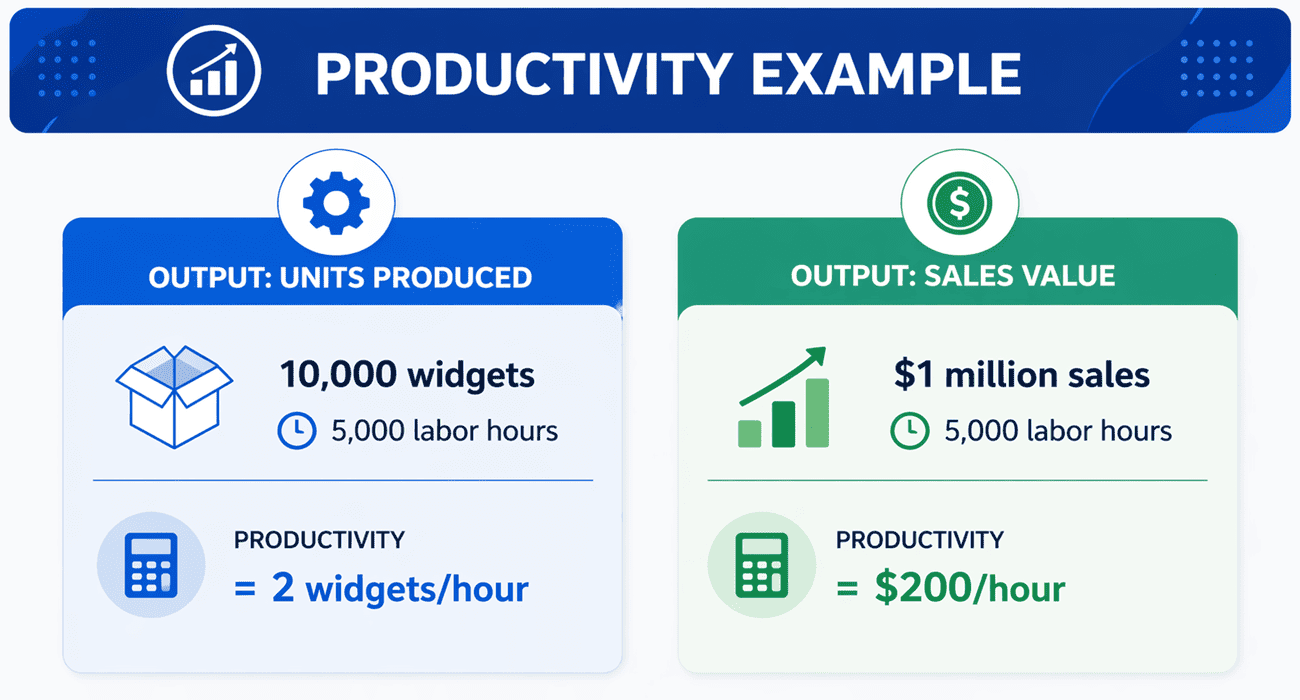
Consider a factory that produces 10,000 widgets in a month using 5,000 labor hours. Productivity is the output divided by the input:
Productivity = 10,000 widgets / 5,000 hours = 2 widgets per hour
If those widgets generate $1 million in sales, we can calculate sales productivity:
Sales Productivity = $1,000,000 / 5,000 hours = $200 per hour
These simple ratios show how much output each hour of labor produces. The same approach applies to other inputs, such as capital or materials.
Impact of AI and Remote Work on Productivity
Generative AI
A recent St. Louis Fed survey highlights how generative AI affects productivity. Among workers who used generative AI in the previous week, 20.5% saved four hours or more, and 26.4% saved two hours. On average, users saved 5.4% of their work hours, or about 2.2 hours per week, in November 2024. These gains suggest that AI tools can reduce time spent on repetitive tasks and allow employees to focus on more valuable work.
Remote Work Trends
Remote work has transformed several industries. In professional, scientific, and technical services, the percentage of remote workers jumped from 16.5% in 2019 to 46.5% in 2021, remaining above 40% in 2022. Similar increases occurred in the information and finance sectors. Working from home eliminates commuting, which can improve work–life balance and productivity. However, the impact varies: some studies find small positive effects, while others note short-term declines when workers lack proper equipment or experience.
Combined Effects
Both generative AI and remote work highlight how technology and flexibility can reshape productivity. AI tools automate routine tasks, while remote work changes where and when work happens. Together, they challenge managers to rethink processes, training, and measurement.
FAQs
Q1. What is productivity in the workplace?
Productivity in the workplace is the amount of work an employee completes within a given time. It can be measured by units produced, sales closed, or customers served.
Q2. Is productivity a good indicator of an economy’s health?
Not always. Productivity can rise even when output and employment decline, as happened during the 2009 recession. It’s one of many indicators economists use.
Q3. What factors affect productivity in the workplace?
Pay, training, technology, work environment, management quality, and employee motivation all influence productivity.
Q4. How does remote work impact productivity?
Remote work reduces commuting and can increase flexibility. Its effect on productivity depends on industry, tasks, technology, and management practices.
Q5. How can generative AI improve productivity?
Generative AI automates drafting, coding, and data analysis. Surveys show it can save workers several hours per week, allowing them to focus on creative and strategic tasks.
Summary
Productivity helps you get more value from the same effort. It supports business growth, higher profits, and better living standards. By measuring labor, economic, and business productivity, you can find gaps and improve performance. Tools like automation and better work practices make a real difference. Small changes can lead to big results over time. Focus on working smarter, not harder, and you will see steady improvement in output, efficiency, and overall success.

I am Mohammad Fahad Usmani, B.E. PMP, PMI-RMP. I have been blogging on project management topics since 2011. To date, thousands of professionals have passed the PMP exam using my resources.