If you have spent years working on business analysis projects, earning the Certified Business Analysis Professional (CBAP) credential can signal your expertise to employers and clients. Many experienced analysts wonder what it takes to qualify for this senior designation.
This guide explains the CBAP Certification requirements, describes the application process, outlines exam details and fees, and offers tips to help you succeed. By the end, you will understand how CBAP certification can elevate your career and why investing your time in this credential makes sense.
Let’s get started.
What is CBAP Certification?
The Certified Business Analysis Professional (CBAP) is the flagship credential offered by the International Institute of Business Analysis (IIBA). It recognizes senior practitioners who lead complex projects and mentor others. Holders of the CBAP designation often earn higher salaries and enjoy greater mobility across industries.
According to the U.S. Bureau of Labor Statistics, management analysts, a category that includes many business analysts, earned a median annual wage of $101,190 in May 2024. Employment in this field is projected to grow 9 percent between 2024 and 2034, resulting in about 98,100 job openings each year. The IIBA’s annual salary survey reports that professionals with the CBAP certification earn about 13percent more on average than those without the credential. Wouldn’t you like to stand out in a crowded job market?
Why Pursue CBAP Certification?
Several benefits make CBAP certification worthwhile:
- Demonstrated Expertise: The CBAP signals that you have thousands of hours of business analysis experience and a deep understanding of the BABOK Guide. Employers view CBAP holders as senior problem solvers.
- Career Growth and Earning Potential: The IIBA salary survey shows that CBAP-certified professionals earn higher salaries. Combined with the strong job outlook for management analysts, this credential can improve your negotiating power for raises and promotions.
- Global Recognition: The certification is recognized worldwide. Whether you work in IT, finance, healthcare, or government, the CBAP helps you secure leadership roles.
- Credibility and Trust: Clients and colleagues know that a CBAP holder adheres to the IIBA Code of Conduct and follows proven analysis practices.
CBAP Certification Requirements
Before you apply, make sure you meet the CBAP eligibility criteria established by the IIBA:
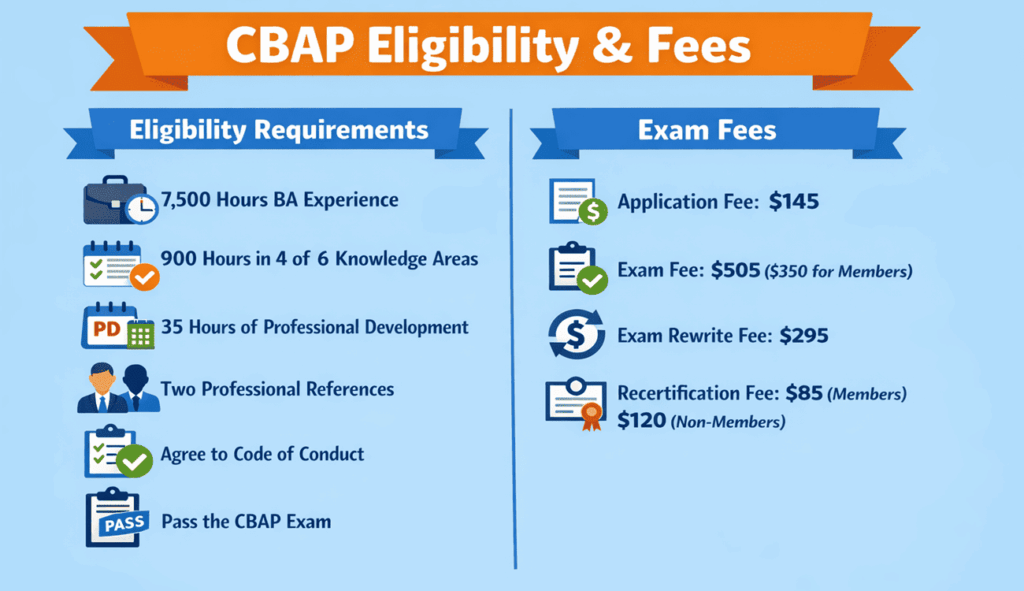
- Business Analysis Experience: You need to document 7,500 hours of business analysis work within the last 10 years. Within those hours, you must accumulate at least 900 hours in four of the six BABOK knowledge areas (this totals 3,600 hours of the 7,500 hours requirement). These knowledge areas cover planning and monitoring, elicitation and collaboration, requirements life cycle management, strategy analysis, requirements analysis and design definition, and solution evaluation.
- Professional Development: You need 35 hours of professional development in business analysis completed within the last four years. Training from IIBA-endorsed providers can satisfy this requirement.
- References: You must supply two references, often from a current manager, client, or a CBAP holder. These references attest to your experience and professionalism.
- Agreement to Ethical Standards: Applicants must agree to the IIBA Code of Conduct and Terms and Conditions.
- Exam Pass: Finally, you must pass the CBAP exam. The exam is discussed later in this guide.
The infographic below summarizes these requirements and the associated fees. Keep the visual handy as you plan your path to certification.
CBAP Application Process: Step by Step
Navigating the application process becomes easier once you know what to expect.

Follow these steps to stay organized and avoid delays:
- Join or renew IIBA membership (optional): Becoming a member is not mandatory, but it reduces the exam fee and unlocks access to resources. Membership costs around $125 per year. Many candidates decide to join for the savings and networking opportunities.
- Complete your 35 professional development hours: Attend an IIBA-endorsed course. Ensure that the training aligns with BABOK v3.
- Log your work experience and PD hours: Use the IIBA Certification portal to record your experience and training hours. Be thorough, include project dates, tasks performed, and the knowledge areas involved.
- Pay the application fee and submit your application: The fee is $145 andnon-refundable. You will need to enter your work history, PD hours,s and references in the portal. After submitting the application, the IIBA reviews it and may audit a sample of candidates.
- Receive approval and schedule your exam: Once approved, you have one year to take the exam. During this eligibility period, you can take the exam up to three times. Scheduling is done through the PSI testing platform, which offers both online proctored and in-person options. Exam fees are explained in the next section.
- Prepare for the exam: Develop a study plan, review the BABOK Guide, and practice with sample questions. Many candidates join study groups to stay motivated.
- Take the exam: Sit for the 3.5-hour exam consisting of 120 multiple-choice questions. When you pass, you become CBAP-certified for a three-year cycle.
- Maintain your certification: To keep your credential active, you must report 60 Continuing Development Units (CDUs) every three years and pay a recertification fee (see below). Continuing education ensures your skills remain current.
The second infographic combines the exam blueprint and application steps into a single visual reference.
CBAP Exam Structure and Fees
The CBAP exam is rigorous, but understanding its structure and cost helps you prepare.
Exam structure: The exam consists of 120 multiple-choice questions to be completed in 3.5 hours. Questions are scenario-based and test your ability to apply BABOK principles. The exam blueprint divides the questions across six knowledge areas as shown in the infographic above: Business analysis planning and monitoring (14%), Elicitation and collaboration (12%), Requirements life cycle management (15%), Strategy analysis (15%), Requirements analysis and design definition (30%), and Solution evaluation (14%).
Exam Fees
The current fees listed by the IIBA are as follows:
- Application fee: $145 (non-refundable).
- Exam fee: $505 for non-members; members pay $350. The exam fee includes the first year of IIBA membership.
- Exam rewrite fee: $295. If you need to retake the exam, you pay this fee each time.
- Recertification fee: $85 for members and $120 for non-members. This fee is due every three years when you renew your certification.
Always check the IIBA website before applying, as prices may change.
Maintaining Your CBAP Certification
Achieving your CBAP is only the beginning. To remain certified, you must earn and report 60 Continuing Development Units (CDUs) every three years. CDUs can be earned through professional development courses, self-directed learning, giving presentations, volunteering in the business analysis community, or providing professional services. You will also pay the recertification fee (see above) and agree to adhere to the IIBA Code of Conduct. Tracking your CDUs throughout the cycle makes the renewal process painless.
Tips for Success
- Start with the BABOK Guide: Read each knowledge area carefully and note key tasks, techniques, and competencies. Create flash cards or summaries to reinforce your learning.
- Enroll in a structured course: An instructor-led prep course provides a clear study plan, expert guidance, and practice questions.
- Use practice exams: Sample questions reveal how the exam presents scenarios and help you manage time. Aim to complete practice tests in a single sitting to build stamina.
- Join a study group: Discussing BABOK concepts with peers deepens your understanding and keeps you accountable. Online forums and local IIBA chapters often host study groups.
- Plan for renewal: As soon as you earn your CBAP, create a simple plan to accumulate CDUs. Attend webinars, volunteer on projects, or mentor others to keep your skills sharp.
FAQs
Q1. How long does the CBAP application process take?
Completing your work history and professional development log can take a few hours. Once submitted, the IIBA typically reviews applications within two to four weeks.
Q2. What counts as professional development hours?
Training must align with the BABOK Guide and can include instructor-led courses, self-study programs, and webinars. The key requirement is that the content relates to business analysis.
Q3. Do I need to be an IIBA member to apply?
Membership is optional. However, members receive discounted exam fees and access to additional resources.
Q4. How soon can I retake the exam if I fail?
You can schedule a retake immediately after receiving your results. There is no waiting period, but you will pay the exam rewrite fee.
Q5. Can I earn CDUs from volunteer work?
Yes. You can earn CDUs by volunteering for IIBA chapters, mentoring junior analysts, or presenting at industry events. Documenting these activities helps with your renewal.
Q6. Is remote proctoring available?
Yes. The CBAP exam can be taken online via remote proctoring or in person at a PSI test centre. Choose the option that suits your circumstances.
Summary
Earning the CBAP designation requires commitment, but the rewards are significant. You will join a community of seasoned professionals, improve your earning potential, and demonstrate your ability to lead complex business analysis initiatives. With a clear understanding of the eligibility requirements, fees, and study tips outlined in this guide, you are now ready to start your CBAP journey. When you feel prepared, consider enrolling in a CBAP exam preparation course and take the next step toward advancing your business analysis career. Your future clients and employers will thank you.
References:

I am Mohammad Fahad Usmani, B.E. PMP, PMI-RMP. I have been blogging on project management topics since 2011. To date, thousands of professionals have passed the PMP exam using my resources.