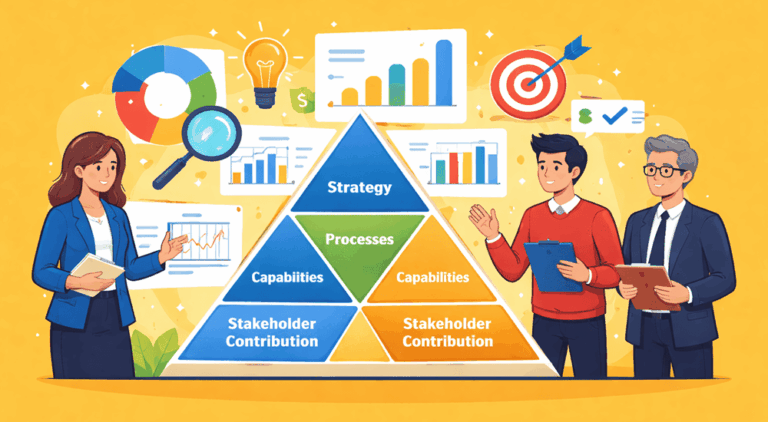
Construction projects often face delays, cost overruns, and poor coordination. Many plans look good on paper but fail during execution. The Last Planner System solves this problem by improving how teams plan and deliver work. It focuses on collaboration, clear commitments, and steady workflow. Instead of top-down scheduling, it involves the people closest to the work.
This approach makes plans more realistic and reliable. As a result, you can complete more tasks on time and reduce waste. In today’s complex projects, better planning is not optional. It is essential. The Last Planner System offers a simple and proven way to improve project performance and achieve consistent results.
Key Takeaway
- LPS promotes a reliable workflow. It helps teams plan what should be done, what can be done, what will be done, what was done and what was learned.
- Productivity remains a concern. Construction productivity has declined for decades; disputes still consume a third of budgets.
- Lean approaches save money. Research shows that adopting lean methods such as LPS can deliver cost savings of roughly 10%–15% across many activities.
- Collaboration reduces waste. Pull planning, daily huddles and commitment management improve coordination, reduce rework and create more predictable schedules.
What is the Last Planner System?
The Last Planner System is a framework for production planning and control. It involves the people closest to the work, the “last planners” in making reliable commitments. Instead of one manager dictating a schedule, the crew leaders, trade foremen and designers collaborate to develop plans they can meet. Because these individuals understand the work deeply, their commitments are realistic.
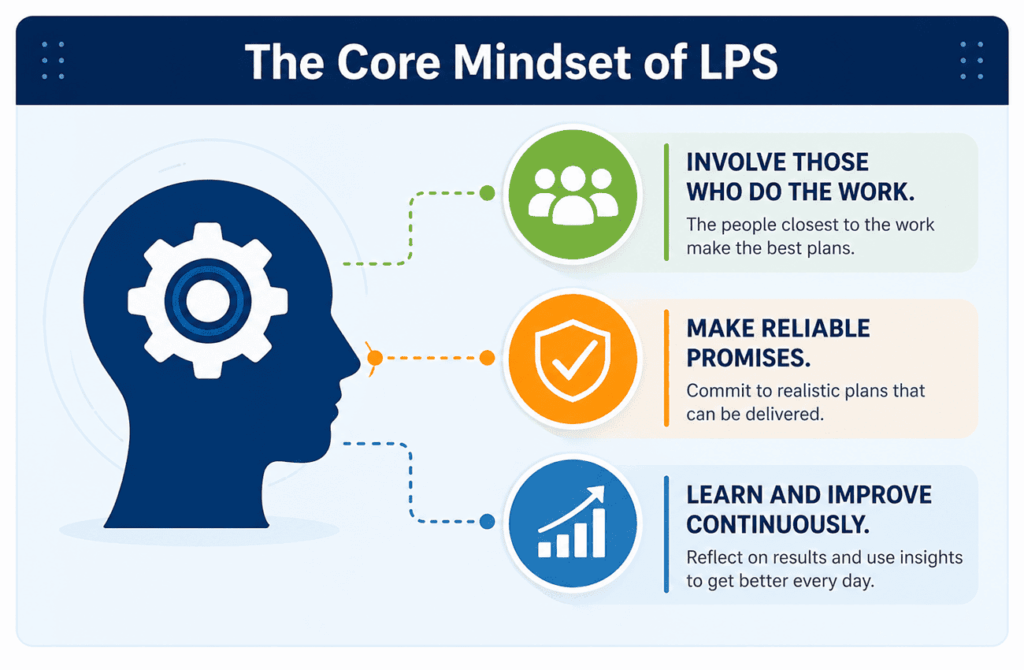
LPS breaks planning into five conversations: should, can, will, did and learn.
- Should: Teams identify what should be done to meet project goals.
- Can: They assess whether tasks can be performed by removing constraints and ensuring materials, equipment and information are ready.
- Will: They promise what will be done, typically during weekly work planning.
- Did: They track what was done and whether promises were kept.
- Learn: They reflect on results and capture lessons to improve future plans.
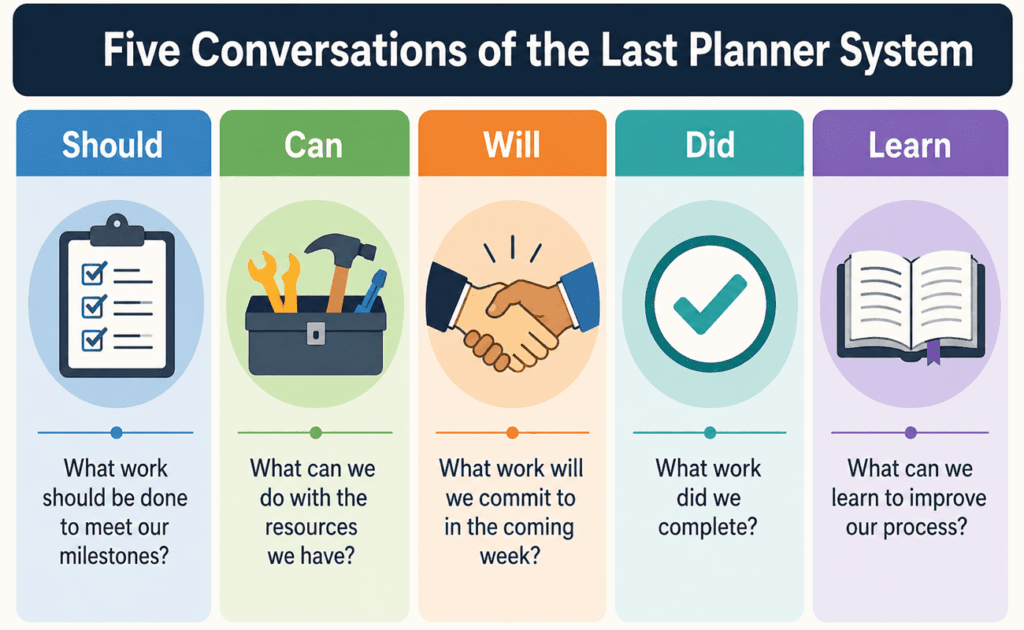
The name “last planner” comes from production researchers Glenn Ballard and Greg Howell. They recognized that commitments made by supervisors or trade foremen directly control the flow of work. When these commitments align with upstream plans, tasks get completed on time and waste is reduced.
Why the Last Planner System Matters
The Last Planner System is important because it improves how construction teams plan and deliver work. It replaces guesswork with clear commitments from the people doing the job. This makes plans more realistic and easier to follow. LPS also reduces delays by identifying and removing constraints early. Teams communicate better through regular meetings and daily check-ins.
This leads to smoother workflow and fewer surprises on site. Another key benefit is continuous learning. Teams review what worked and what did not, then improve future plans. Over time, this builds trust, accountability, and strong teamwork. In simple terms, LPS helps projects finish on time, reduce waste, and deliver better results.
How LPS Addresses Productivity Challenges
- Collaborative scheduling: In traditional scheduling, a planner sets tasks and pushes work forward. LPS uses pull planning: tasks are defined by those performing them. Each trade identifies the handoffs needed, ensuring resources arrive exactly when required.
- Commitment-based planning: Weekly work plans specify tasks each trade will complete. Because commitments come from field supervisors, promises are realistic, and the percent plan complete (PPC) is tracked each week.
- Constraint removal: During “can” conversations, teams identify what could prevent tasks from being done (materials, permits, information). Removing these constraints early reduces last-minute surprises.
- Learning cycles: LPS builds reflection into the schedule. At least weekly, teams compare planned versus actual performance and discuss reasons for any variance. Lessons feed forward into subsequent plans.
Lean Tenets and Principles
The Lean Construction Institute outlines six core tenets: Respect for People, Removal of Waste, Focus on Process and Flow, Generation of Value, Continuous Improvement, and Optimize the Whole. LPS supports each tenet:
- Respect for People: By involving those closest to the work in planning, teams harness diverse expertise and create psychological safety.
- Removal of Waste: Pull planning and make-ready conversations reduce waiting, overproduction and other wastes.
- Process and Flow: Daily huddles and constraint management maintain a steady workflow.
- Generation of Value: Planning focuses on work that adds value to customers, not just completing tasks.
- Continuous Improvement: Learning conversations identify root causes and encourage incremental improvements.
- Optimize the Whole: LPS encourages coordination across trades, optimizing the entire project rather than individual interests.
These principles align with broader lean philosophies. For example, the Federal Reserve Bank of Richmond reports that U.S. construction productivity declined despite overall economic growth. LPS counters this trend by creating a culture of continuous improvement and teamwork.
The Five Conversations in Detail
1. Pull Planning (Should)
Pull planning begins at a milestone planning level, where teams map out key handoffs from the end of the project backward. Instead of pushing tasks forward with arbitrary start dates, trades identify the sequence needed to achieve the milestone. Pull planning sessions often use sticky notes on a wall or digital tools. Each note represents a task; trades discuss dependencies and arrange the sequence. This process exposes conflicts, such as overlapping work or missing prerequisites, early on.
2. Make-Ready Planning (Can)
During make-ready planning, teams verify that tasks are ready to be performed. They identify constraints such as missing materials, unresolved RFIs, and unavailable equipment, and assign responsibility for removing them. A simple make-ready checklist might include verifying drawings, ensuring subcontractor availability and confirming permits. If constraints cannot be removed in time, the task is removed from the next week’s plan. This discipline prevents surprises and last-minute chaos.
3. Weekly Work Planning (Will)
The weekly work plan formalizes the promises for the coming week. Each trade foreman commits to completing specific tasks. The plan is developed collaboratively in a short meeting, which is often called a “weekly commitment meeting.” Because commitments come from those doing the work, they are realistic. Teams also avoid overcommitting; they only plan tasks that are truly ready. After the meeting, tasks and responsibilities are documented and shared.
4. Daily Huddles and Commitment Management (Did)
Daily huddles provide quick check-ins to ensure the plan is on track. Crews gather for 10–15 minutes to review what was completed yesterday, what will be done today and whether any new constraints have emerged. This regular cadence encourages accountability. If issues arise, the team can adjust assignments or sequence. Teams track completion using the percent plan complete (PPC) metric, the ratio of tasks finished as promised versus total tasks planned. High PPC values reflect reliable planning.
5. Learning and Improvement (Learn)
At the end of each week, teams conduct a retrospective. They review tasks that were not completed as planned and document the reason for the variance. Common reasons include delayed materials, workforce shortages or incorrect information. Rather than blaming individuals, the team focuses on process improvements. Over time, these lessons inform future plans and reduce repeated mistakes.
Eight Elements of the Last Planner System
Beyond the five conversations, LPS consists of eight practical elements. Understanding these elements helps teams design their own system:
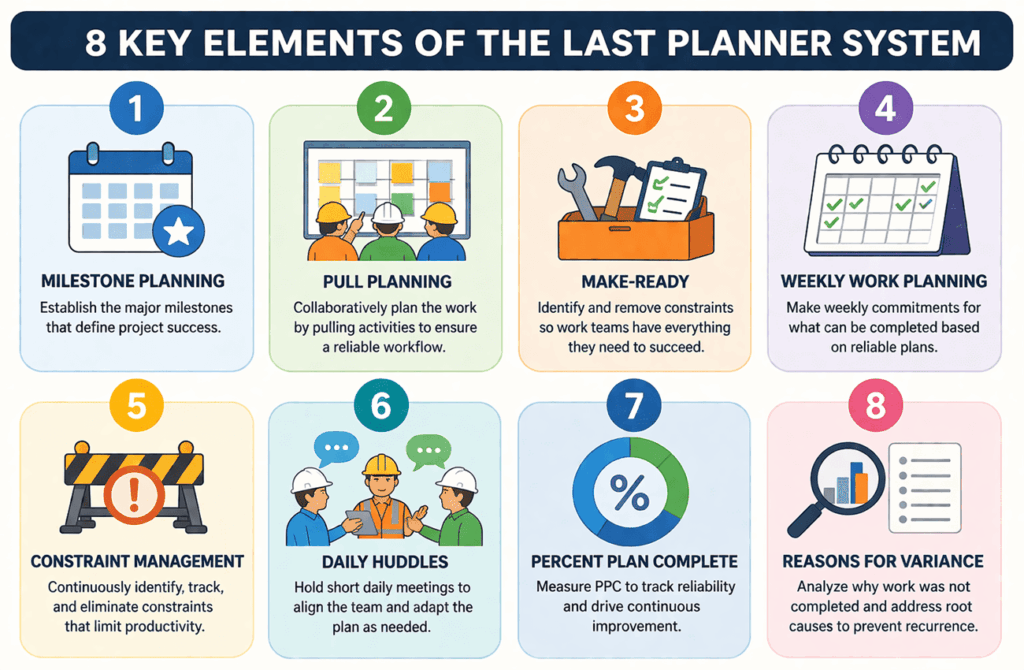
- Milestone Planning: Set incremental goals aligned with the master schedule.
- Pull Planning: Plan handoffs between trades backward from the end of a phase.
- Make-Ready Planning: Remove constraints to ensure tasks are executable.
- Weekly Work Planning: Develop a weekly commitment plan with trade leaders.
- Constraint Management: Identify and eliminate roadblocks to maintain flow.
- Daily Huddles: Hold short meetings to coordinate daily work and adjust as needed.
- Percent Plan Complete (PPC): Measure reliability of commitments by tracking completed tasks versus planned tasks.
- Reasons for Variance: Analyze why tasks were not completed as planned and improve processes.
Alt text: infographic with two rows of numbered circles, each describing one of the eight key elements of the Last Planner System: Milestone Planning, Pull Planning, Make-Ready, Weekly Work Planning, Constraint Management, Daily Huddles, Percent Plan Complete, and Reasons for Variance.
Real-World Outcomes
In practice, the Last Planner System has delivered significant benefits. Boston Consulting Group reports that lean transformations can yield 10%–15% savings across tasks and activities. Savings come from reducing delays, idle time and rework. Case studies show that projects using LPS often increase their percent plan complete (PPC) from around 54% to above 80%. Higher PPC means promises are kept and work flows smoothly.
A major transportation contractor applied LPS and reduced schedule overruns by two months. Another project used the system to spot a potential problem in the enabling works and adjust the process, avoiding expensive rework. These examples demonstrate how small process changes can have a large impact.
FAQs
Q1. What is the Last Planner System in simple terms?
It is a planning method where those closest to the work, e.g., trade leaders and supervisors, make reliable commitments about tasks, track progress daily and adjust plans based on what they learn.
Q2. How does pull planning differ from a traditional schedule?
Pull planning starts from the project’s goal and works backward. Teams define handoffs based on when tasks are needed, ensuring resources arrive just in time rather than being pushed by a fixed start date.
Q3. Why is percent plan complete (PPC) important?
PPC measures the number of promised tasks completed on time. A high PPC shows that the team makes realistic commitments and avoids surprises, improving reliability and trust.
Q4. Can small projects use the Last Planner System?
Yes. The principles apply to projects of any size. Even small teams benefit from collaborative planning, removing constraints and reviewing reasons for variance every week.
Q5. Where can I learn more about LPS?
The Lean Construction Institute offers courses, workbooks and resources on the Last Planner System. Their eLearning platform provides interactive tutorials and case studies.
Summary
The Last Planner System helps construction teams plan better and deliver work on time. It brings people together, improves coordination, and reduces delays. By focusing on clear commitments and regular feedback, teams create a steady workflow. This approach cuts waste and improves results without adding complexity. If you want fewer surprises and smoother projects, LPS is a smart choice. Start small, stay consistent, and you will see real improvement in your projects’ performance.

I am Mohammad Fahad Usmani, B.E. PMP, PMI-RMP. I have been blogging on project management topics since 2011. To date, thousands of professionals have passed the PMP exam using my resources.