What makes some teams adapt quickly while others struggle with change? The answer often lies in their agile mindset. An agile mindset is not just a method. It is a way of thinking that helps teams stay flexible, learn fast, and deliver value step by step. In today’s fast-moving work environment, teams face constant change. A strong agile mindset helps them respond with confidence instead of stress.
When teams adopt an agile mindset, they focus on people, collaboration, and continuous improvement. They break work into small parts, test ideas early, and improve with feedback. This approach leads to better results and stronger teamwork. So, what is an agile mindset? It is a mindset that values learning, adaptability, and progress over rigid plans.
This article explores the agile mindset in detail, outlines its core pillars, and shares practical steps to help you cultivate one.
Key Takeaways
- An agile mindset values respect, continuous flow, innovation, and relentless improvement.
- Project teams with this mindset adapt to change, learn from feedback, and deliver value early.
- Psychological safety, small batches of work, and creative autonomy help teams succeed.
- Recent studies show that 95% of marketers report a positive experience with Agile, and 87% see higher productivity.
What is an Agile Mindset?
An agile mindset is a way of thinking and working that values people, adaptability, and learning. It goes beyond following a process; it is about embracing change and using feedback to make better decisions. Project teams with an agile mindset break big goals into small steps, deliver value early, and iterate based on new information. They treat mistakes as opportunities to learn, not reasons for blame.
This approach differs from traditional project management, which relies on fixed plans and long phases. An agile mindset encourages continuous collaboration and short feedback loops, enabling ideas to be tested quickly. The result is a team that responds to change and creates products that truly meet customers’ needs.
Pillars of Agile Mindset
What makes an agile mindset work in real teams? It comes down to four core pillars. These pillars guide how teams think, act, and improve. They help people collaborate better, adapt faster, and deliver real value with confidence.
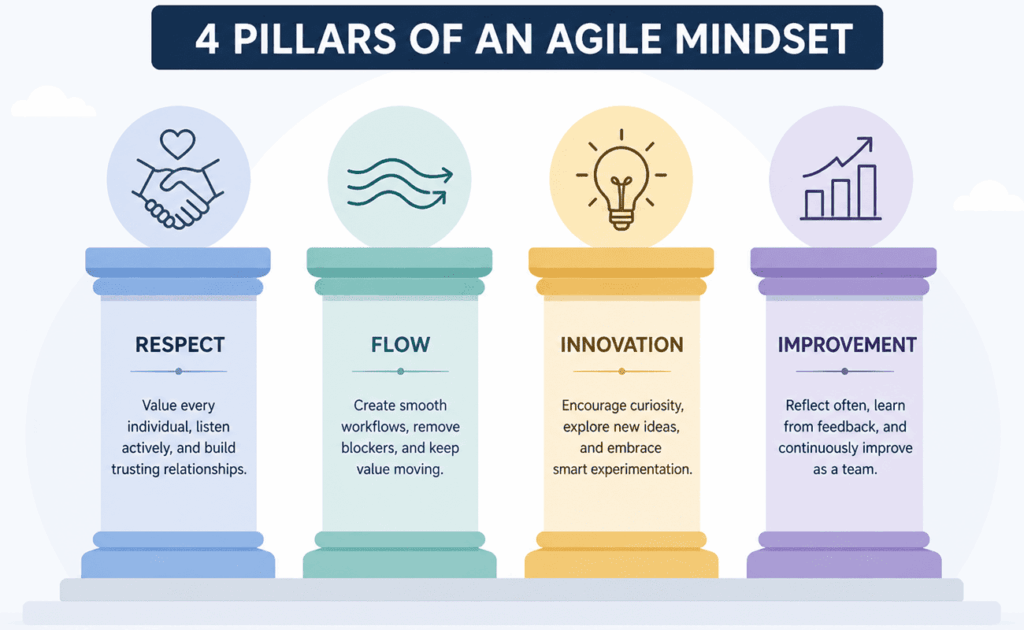
The four pillars of the Agile mindset are as follows:
Pillar 1: Respect and Psychological Safety
Respect is the foundation of an agile culture. It means valuing each team member’s voice, background, and experience. People are encouraged to share ideas and concerns without fear of judgment or retaliation. Psychological safety allows team members to take risks, ask questions, and admit mistakes without feeling embarrassed.
To promote respect:
- Hold regular check-ins where everyone speaks.
- Celebrate small wins and acknowledge contributions.
- Use shared documents, such as open pages in Confluence, to make information visible to everyone.
- Encourage leaders to model the behavior they expect.
Pillar 2: Optimized and Sustainable Flow
Flow refers to how work moves through a team. In an agile environment, it is better to deliver small, complete pieces of value frequently rather than one large batch at the end. Working in small batches helps teams catch defects early, adjust priorities, and maintain a steady pace.
Imagine painting a house. If you paint the entire house and only then inspect your work, fixing mistakes becomes costly. If you paint one wall, step back, and review it, you’ll spot drips and uneven strokes, which are easy to correct. The same logic applies to software features, marketing campaigns, or any project. By slicing work into thin slices and finishing them before starting the next, you keep momentum and avoid burnout.
Tips for optimized flow:
- Break tasks into small pieces that can be completed within days.
- Limit the number of items in progress to prevent multitasking fatigue.
- Use kanban boards to visualize work and manage bottlenecks.
- Schedule regular demonstrations to gather feedback early.
Pillar 3: Encouraging Innovation
Innovation thrives when people have room to experiment and share ideas. An agile mindset rewards curiosity and recognizes that creative thinking leads to better outcomes. Teams should be empowered to try new techniques, explore tools, and suggest improvements.
Ways to encourage innovation:
- Allocate time for hack days or innovation sprints.
- Use brainstorming templates in Confluence to capture and vote on ideas.
- Invite diverse perspectives, including customers or stakeholders, to ideation sessions.
- Treat experiments as learning exercises; even “failures” teach important lessons.
Pillar 4: Relentless Improvement
An agile mindset sees improvement as a continuous process, not an occasional event. At the end of each iteration, teams reflect on what went well and what could be better. They then agree on small changes to try next time. This cycle of reflection, experimentation, and learning drives sustainable improvement.
Retrospectives are the main tool for relentless improvement. During these meetings, everyone shares candid feedback about the process, relationships, and outcomes. A good retrospective fosters openness and results in one or two actionable commitments. By repeating this pattern, teams evolve their practices and culture over time.
To practice continuous improvement:
- Schedule regular retrospectives and stick to them.
- Use simple formats like “stop-start-continue” or “mad-sad-glad” to structure discussions.
- Focus on processes and systems rather than individual blame.
- Celebrate progress to keep the team motivated.
Benefits of Adopting an Agile Mindset
Adopting an agile mindset is not just a philosophical shift; it has measurable benefits. According to the 2026 State of Agile Marketing report, 95% of marketers have a positive experience with Agile ways of working. This high satisfaction suggests that the approach resonates across diverse teams.
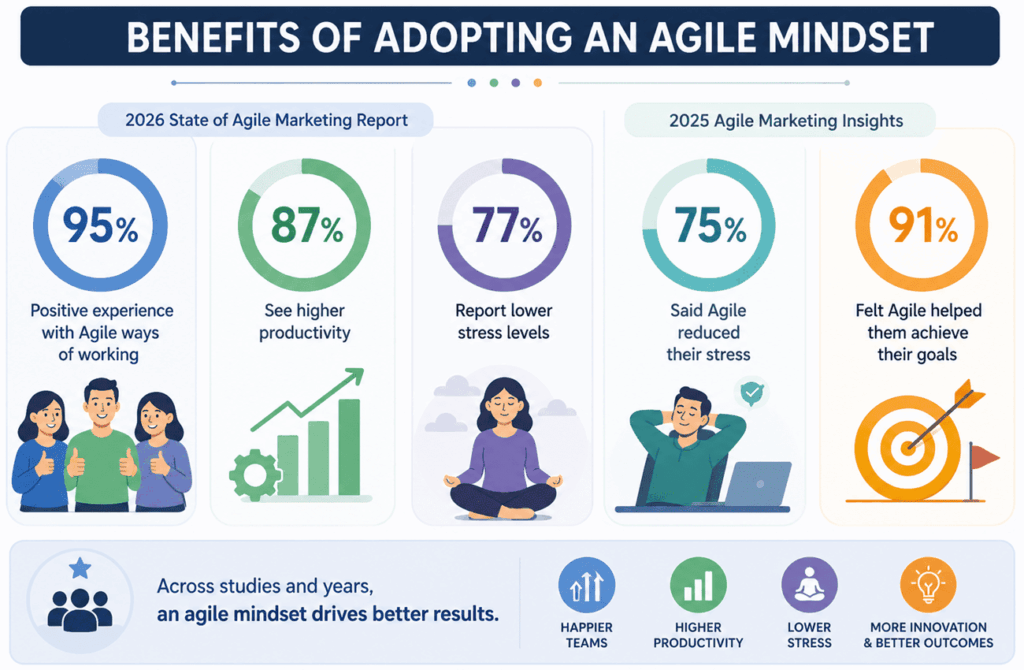
The same report found that 87% of respondents reported higher productivity than with Agile. Working in small batches and focusing on the most important tasks helps teams accomplish more with less wasted effort. Perhaps most striking, 77% report lower stress levels. When work is transparent and manageable, people feel more in control and less overwhelmed.
Beyond marketing teams, other studies show that fully agile teams are more likely to embrace innovation and succeed with emerging technologies. In 2025, 75% of fully agile marketers said that Agile reduced their stress, and 91% felt it helped them achieve their goals. The consistency of these findings across years underscores the value of an agile mindset.
How to Promote an Agile Mindset
Embracing an agile mindset is a journey. The following are some practical steps to get started:
- Start with respect. Encourage openness and psychological safety. Leaders should model inclusive behavior and invite feedback.
- Make work visible. Use tools like Jira or Trello to show tasks, priorities, and progress. Visibility reduces confusion and builds trust.
- Work in small increments. Break large goals into small deliverables. Focus on finishing one item before starting another to maintain flow.
- Hold regular ceremonies. Short daily stand-ups keep everyone aligned. Retrospectives at the end of a sprint surface lessons and inform changes.
- Encourage learning. Provide training, share articles, and invite experts to share experiences. Continuous learning keeps the mindset alive.
- Experiment and adapt. Try new methods, measure results, and refine. Use Confluence templates to brainstorm and document ideas.
Common Challenges and How to Overcome Them
Transitioning to an agile mindset can be challenging:
- Resistance to change. Some team members may feel uneasy without a detailed plan. Address this by explaining why Agile improves outcomes and showing small wins.
- Lack of training. People need to understand Agile principles, not just follow rituals. Invest in training and pair newcomers with experienced coaches.
- Overemphasis on speed. Agile is about delivering value, not rushing. Maintain quality by practicing test-driven development, design reviews, or quality checks.
- No time for reflection. Teams may skip retrospectives when deadlines loom. Make retrospectives a non-negotiable part of each cycle. They save time in the long run.
By anticipating these challenges and addressing them early, you set your team up for success.
FAQs
Q1. What does “agile mindset” mean?
It refers to a way of thinking that values people, adaptability, and learning. Instead of following a rigid plan, teams break work into small pieces and respond to feedback.
Q2. How do I develop an agile mindset?
Start with respect, make work visible, work in small increments, and hold regular retrospectives. Read books, attend workshops, and learn from others.
Q3. Why is psychological safety important?
When people feel safe to speak up, share ideas, and admit mistakes, teams innovate and learn faster.
Q4. Can Agile work outside of software?
Yes. Marketing, HR, finance, and many other fields use agile principles to manage projects and adapt to change. The mindset applies wherever collaboration and flexibility are valuable.
Summary
An agile mindset helps teams stay flexible, focused, and ready for change. It builds a culture where people feel safe sharing ideas, learning quickly, and improving continuously. By working in small steps and using feedback, teams deliver better results with less stress. Over time, this approach strengthens collaboration and boosts performance. If you want your team to adapt and grow in today’s fast environment, start building an agile mindset and take small steps forward every day.
References:

I am Mohammad Fahad Usmani, B.E. PMP, PMI-RMP. I have been blogging on project management topics since 2011. To date, thousands of professionals have passed the PMP exam using my resources.