
Ever wondered why a few tasks seem to drive most of your project’s success? The answer lies in the 80/20 Rule—also called the Pareto principle. This simple yet powerful idea states that a small fraction of causes accounts for a large share of outcomes. In project management, recognizing and acting on this rule helps certified and aspiring Project Management Professionals (PMPs) focus on what matters most.
This blog post explains the concept, shows how to apply it, shares real-world examples, and offers tips to improve your projects.
Let’s get started.
Understanding the 80/20 Rule
The Pareto principle, commonly called the 80/20 rule, was named after the Italian economist Vilfredo Pareto. In the late 19th century, he noticed that about 20 percent of the population owned 80 percent of the land in Italy. For PMP professionals, this principle transforms how we approach task prioritization and resource allocation in complex projects.
Later, management consultant Joseph Juran connected the idea to quality control, noting that a small set of causes leads to most defects or benefits.
Today, the rule shows up everywhere—from software bugs to sales revenue. It reminds us that effort is not evenly rewarded; focusing on the right 20 percent can yield big results.

The infographic above highlights that 20 percent of high-value tasks can account for 80 percent of project outcomes. When you concentrate on those few critical activities, you create more impact with less effort.
Why the 80/20 Rule Matters for PMP Professionals
Project work is often constrained by time, budget, and team capacity. Industry data underscores the importance of prioritizing high-impact work. The project management software market was valued at $7.24 billion in 2025 and is projected to grow to $12.02 billion by 2030, reflecting the increasing complexity of modern projects. Yet fewer than a quarter of organizations—around 23 percent—currently use dedicated project management software. In contrast, 77 percent of high-performing projects rely on such tools.
These figures reveal a gap between best practice and common practice: teams that invest in the right tools and focus their energy wisely achieve better outcomes.
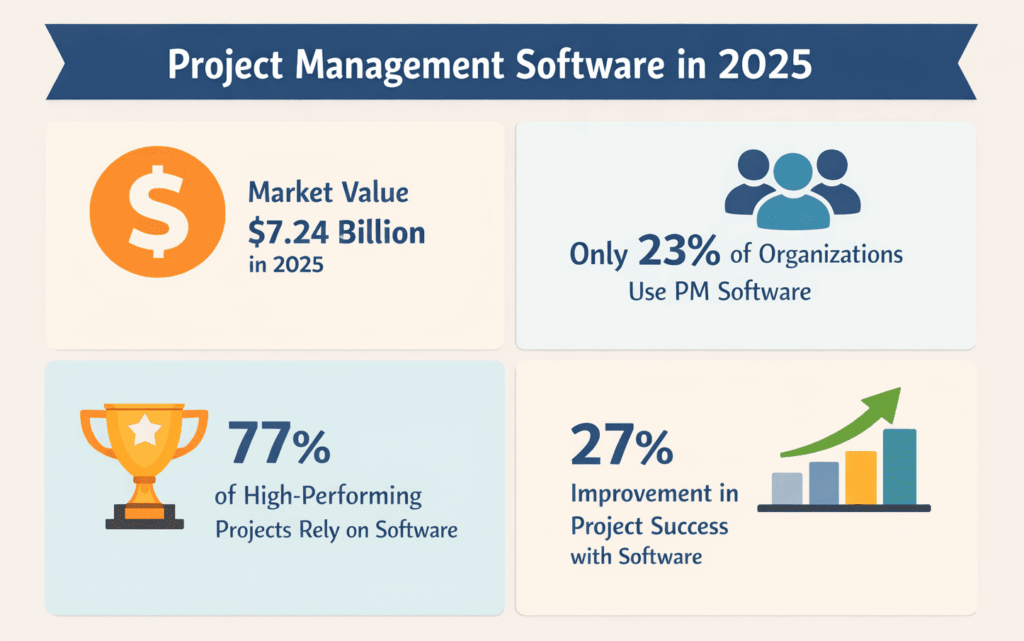
The visual above summarizes these trends. It shows that although the market for project management tools is expanding rapidly, adoption remains low, creating an opportunity for skilled PMPs to stand out. By combining the 80/20 mindset with modern tools, you can boost productivity, streamline workflows, and deliver results that stakeholders notice.
How the 80/20 Rule Aligns with the PMBOK Guide and PMP Exam
The Pareto Principle directly supports several PMP knowledge areas and can help you answer situational questions on the PMP exam. Here’s where it fits:
- Quality Management: Pareto diagrams are explicitly mentioned as a key quality tool for identifying the vital few sources of defects.
- Stakeholder Engagement: 20% of stakeholders often exert 80% of influence on project outcomes.
- Schedule Management: Focusing on the 20% of activities on the critical path that determine 80% of the project duration.
- Risk Management: A small number of risks typically account for most potential impact.
PMP Exam Tip: When faced with questions about prioritizing issues, allocating resources, or addressing defects, consider whether the 80/20 rule could guide your answer. Look for keywords like “greatest impact,” “most significant,” or “limited resources.”
Steps to Apply the 80/20 Rule in Projects
The 80/20 rule is more than a neat observation—it’s a practical method. You can follow the steps below to apply this rule:
- Clarify Your Project Goals: Document the outcomes your team must achieve and the measures of success. Understanding the end state guides your prioritization.
- List all Tasks and Categorize them: Separate tasks into two groups: high-value, low-effort, and low-value, high-effort. High-value tasks directly support your goals, while low-value tasks provide only marginal benefits.
- Allocate Most Resources to the Vital Few: Dedicate your time, budget, and energy to the high-value tasks. Don’t neglect other work entirely, but ensure your best people handle the items that make a difference.
- Review and Adjust Regularly: Projects evolve. Check in periodically to see whether your initial high-value tasks are still the most impactful. If priorities shift, update your focus accordingly.
These actions help you direct attention where it is most effective and avoid spreading your team too thin. A focused approach also reduces stress and increases motivation because everyone knows why their efforts matter.
Using Pareto Diagrams to Identify Issues
In addition to ranking tasks, you can use Pareto Diagrams to address problems. A Pareto diagram is a bar chart that displays the frequency of issues from largest to smallest. By plotting defects, delays, or complaints, you can quickly see which problems are causing most of the trouble.

For example, if several customer issues account for most complaints, addressing those issues first will have the greatest impact. Pareto diagrams support data-driven decisions and align well with quality management practices described in the Project Management Body of Knowledge (PMBOK) Guide.
Pros and Cons of the 80/20 Rule
Like any tool, the 80/20 rule has benefits and limitations.
Pros
- Clarity on Priorities: It highlights which tasks deliver the most value, guiding you to use resources wisely.
- Efficient Use of Time: By focusing on a few critical tasks, one reduces wasted effort and improves productivity.
- Improved Decision-Making: Data-driven prioritization builds confidence and supports transparent communication with stakeholders.
Cons
- Risk of Oversimplification: Complex projects may not fit neatly into a 20/80 split; some tasks are interdependent and cannot be ignored.
- Potential Neglect of Necessary Tasks: Low-value tasks might still be essential to compliance or safety and must not be overlooked.
- Static Thinking: If you treat the 20 percent as fixed, you might miss changes in scope or market conditions.
Understanding these tradeoffs allows you to use the 80/20 rule thoughtfully rather than rigidly.
Real-World Examples of the 80-20 Rule
Airline Routes: One international carrier analyzed its route network and found that 20 percent of destinations generated 80 percent of its revenue. By focusing marketing and service improvements on those profitable routes, the airline increased customer satisfaction and profitability while maintaining coverage elsewhere.
Retail Marketing: A clothing retailer examined purchase data and discovered that a small segment of loyal customers accounted for most sales. The company tailored promotions to those customers and expanded its loyalty program, boosting repeat purchases.
Software Development: A technology firm used bug-tracking data to determine that a handful of modules caused the most critical errors. By assigning senior developers to fix those modules first, the team resolved most crashes early in the release cycle.
Social Media Campaigns: A marketing team reviewed analytics and noticed that a small percentage of posts generated most engagement. They analyzed the themes and timing of those posts and used the insights to create similar content, resulting in greater reach and conversions.
These examples show that the 80/20 rule isn’t about doing less. It’s about doing what matters most and using evidence to guide your decisions.
FAQs
Q1. What is the 80/20 rule in simple terms?
It’s the idea that a small portion of causes leads to a large portion of results. In projects, a few tasks have a major impact on outcomes.
Q2. How can I identify the most important tasks?
List all tasks and assess their impact on your goals. Use data, team feedback, and your professional judgment to decide which tasks create the most value.
Q3. Does focusing on 20 percent mean ignoring everything else?
No. Low-priority tasks still need attention, but shouldn’t consume most resources. Balance your effort so that essential but low-impact work doesn’t slow your progress.
Q4. Is the 80/20 ratio always exact?
No. The numbers are guidelines rather than requirements. Some projects may see a 70/30 or 90/10 split. The key is to recognize that impact is unevenly distributed.
Summary
The 80/20 rule offers a simple lens for tackling complex projects. By identifying and acting on the tasks that drive the majority of outcomes, you can deliver more value with the same—or even fewer—resources. Remember that the rule is a guide, not a rigid formula. Combine it with data analysis, frequent reviews, and professional judgment to stay adaptable.
Further Reading:

I am Mohammad Fahad Usmani, B.E. PMP, PMI-RMP. I have been blogging on project management topics since 2011. To date, thousands of professionals have passed the PMP exam using my resources.