Preparing for the PMI-RMP exam can feel confusing, especially when you search for the exact PMI-RMP passing score. Many professionals want to know how many questions they must answer correctly to pass.
The truth is simple: PMI does not publish a fixed passing score for the PMI-RMP certification exam. Instead, PMI uses a psychometric scoring system that measures your knowledge, skills, and ability to apply risk management concepts in real project situations. Understanding the PMI-RMP passing score process helps you prepare with confidence and avoid common myths.
This blog post explains the exam format, PMI-RMP exam scoring model, domain distribution, preparation strategies, and expert tips to improve your chances of success. If you want to pass the PMI-RMP exam, this post will help you understand what truly matters.
Key Takeaway
- PMI does not publish an exact PMI-RMP passing score. The exam uses a psychometric scoring model based on performance across all domains.
- The PMI-RMP exam includes 115 questions: 100 scored and 15 unscored pretest questions.
- Candidates have 150 minutes to complete the exam at a Pearson VUE center or through online proctoring.
- The exam focuses on five domains: Risk Strategy & Planning, Risk Identification, Risk Analysis, Risk Response, and Monitor & Close Risks.
- Most successful candidates aim for 70–80% scores on quality mock exams before scheduling the real test.
- Strong preparation, practical understanding of risk management concepts, and consistent practice improve your chances of passing the PMI-RMP exam.
Does PMI Publish a Passing Score for the PMI-RMP Exam?
PMI intentionally does not disclose an exact passing score for any of its certifications. According to the PMI Certification Handbook, all PMI exams, including the PMI-RMP, are evaluated using sound psychometric analysis. The exams are “criterion-based,” meaning they determine whether a candidate meets the standard required for the role rather than whether they answered a certain percentage correctly. Each question contributes to a sample of your overall proficiency. Your raw score is converted into a scaled assessment, and you receive an overall performance rating rather than a numerical percentage. This approach ensures fairness across different versions of the exam.
Why the PMI-RMP Exam Passing Score is Confidential
PMI’s exams are developed through rigorous role delineation studies and are reviewed by psychometricians to maintain validity and reliability. Because the difficulty of exam forms can vary, publishing a single cut score could mislead candidates. By keeping the threshold confidential and using a psychometric model, PMI ensures that every exam form is equally challenging and that the passing standard remains consistent.
Understanding the PMI-RMP Exam Format
Knowing what the exam looks like can help you plan your study schedule and manage your time. The PMI-RMP exam consists of 115 multiple-choice and multiple-response questions. Out of these, 100 are scored, and 15 are unscored “pretest” items used to validate future questions. You have 150 minutes (2½ hours) to complete the exam. The exam is available in English, Arabic and Simplified Chinese and can be taken at Pearson VUE test centers or online.
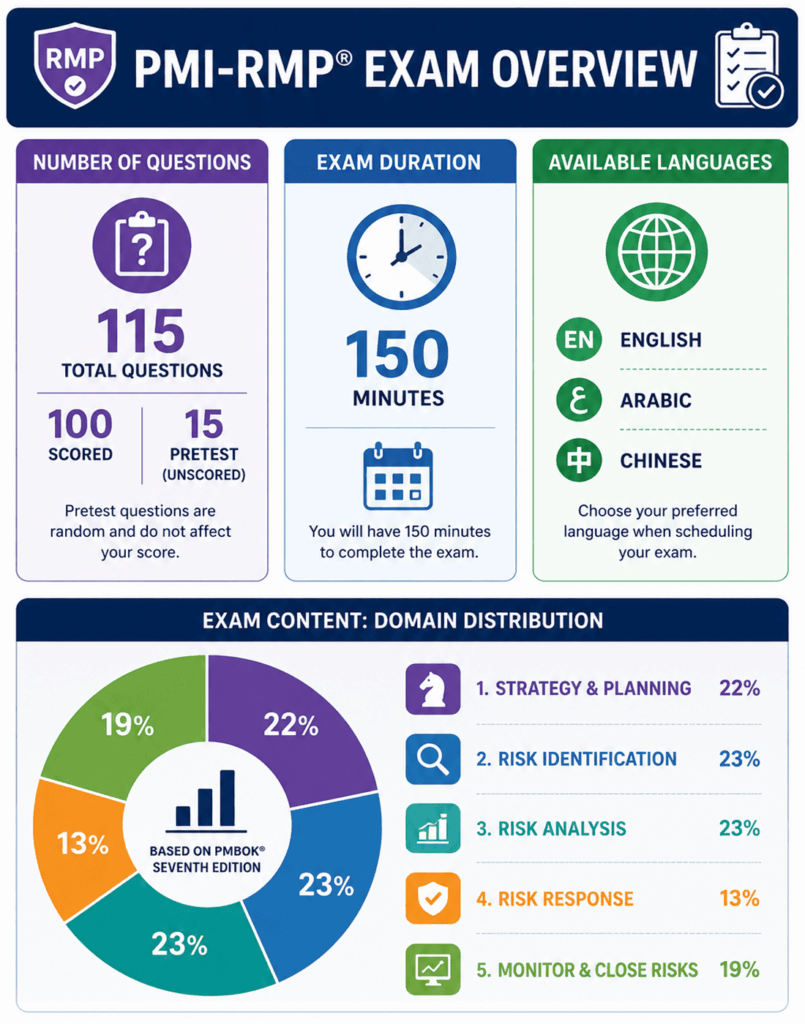
The exam domains and their approximate weightings are defined in the PMI-RMP Exam Content Outline. The current version of the outline distributes the scored questions as follows:
| Domain | Description | Percentage |
| Risk Strategy & Planning | Creating the risk management plan, defining roles and responsibilities, and establishing risk thresholds | 22% |
| Risk Identification | Identifying threats and opportunities using meetings, interviews and document analysis | 23% |
| Risk Analysis | Performing qualitative and quantitative analysis to determine impact, probability, and prioritization | 23% |
| Risk Response | Planning and implementing risk responses, including mitigation, transfer, acceptance or exploitation strategies | 13% |
| Monitor & Close Risks | Tracking risks, evaluating the effectiveness of responses, and closing resolved risks | 19% |
The domains cover predictive, agile and hybrid project environments. Being comfortable with all approaches helps ensure you don’t struggle with scenario-based questions.
How PMI Scores the PMI-RMP Exam
PMI uses a criterion-referenced psychometric model to evaluate your performance. Your raw score is compared against the standard for a competent risk management professional. Pretest questions do not affect your score because they are used to validate future exam items. The scoring model compensates for differences in difficulty across exam forms, so a more challenging set of questions will have a slightly lower passing threshold.
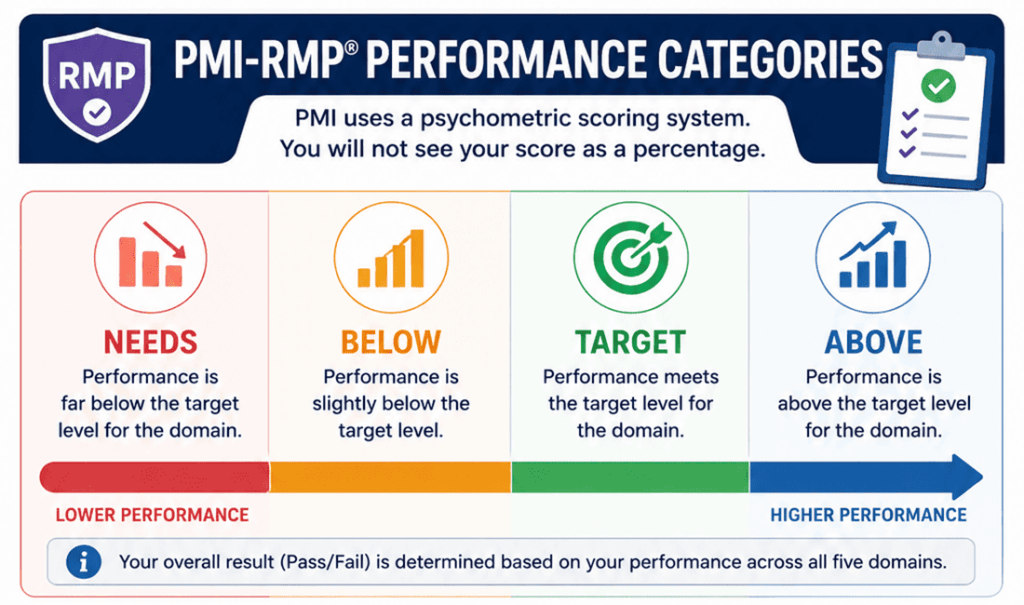
Instead of a numeric grade, you receive a performance rating for each domain and an overall rating. The categories are:
- Needs Improvement – limited ability to apply concepts.
- Below Target – some gaps in knowledge; further study required.
- Target – meets the level expected of a qualified risk manager.
- Above Target – exceeds expectations with strong application skills.
You must achieve at least the Target level overall to pass. If you score Below Target or Needs Improvement, you’ll need to retake the exam. PMI allows up to three attempts within a one-year eligibility period.
What Score Should You Aim for in Practice?
Although PMI does not publish a cutoff percentage, many instructors recommend scoring consistently between 70% and 80% on full-length practice exams before scheduling your test. Achieving higher scores on good-quality mock exams indicates you grasp the underlying concepts and can handle the exam’s scenario-based questions. Consistent performance across different practice tests is more important than a single high score.
Keep in mind that practice exams vary in difficulty. If you’re using easier question sets, aim for the upper end of the range (75–85%). When practicing with more challenging questions, a score of 70% or higher may indicate readiness. Because the real exam questions are scenario-based, it is crucial to focus on how and why the correct answer applies to the situation.
Tips to Maximize Your Chances of Passing the PMI-RMP Exam
- Confirm your eligibility. Check that you meet PMI’s experience and education requirements. You need either three years of risk management experience and 40 hours of education with a secondary diploma, or two years of experience and 30 hours of education with a bachelor’s degree.
- Understand the exam content. Study the official PMI-RMP Exam Content Outline and the PMI Standards for Risk Management. Make sure you know the tasks and enablers for each domain.
- Use reputable study materials. Choose PMI-approved training partners or resources aligned with the current exam outline. Practice questions should include rationales explaining why each answer is correct.
- Practice under real conditions. Take timed practice exams to improve your stamina and time management. Review your incorrect answers to understand gaps in knowledge.
- Apply concepts, not just definitions. The exam tests your ability to apply risk management tools and techniques in real situations. Focus on interpreting scenarios and choosing the best response.
- Manage your time on exam day. With just over one minute per question, pace yourself. Flag difficult questions and return to them later. Don’t spend too much time on any single item.
- Plan for retakes if needed. If you don’t pass on the first attempt, PMI allows up to three attempts within your one-year eligibility period. Use feedback from your score report to focus on weaker domains before retesting.
Common Myths About the PMI-RMP Passing Score
- “There is a fixed percentage, like 60%, to pass.” False. PMI has not published a fixed passing percentage for years. The threshold varies by exam form and is set through psychometric analysis.
- “You need to answer a specific number of questions correctly.” False. Because of pretest questions and scaled scoring, no single raw score guarantees a pass.
- “The exam is graded on a curve against other candidates.” False. PMI uses a criterion-referenced standard, not a norm-referenced curve. Your result depends only on whether you meet the established standard.
- “Once you pass Target in all domains, you automatically pass.” False. While strong performance in each domain helps, PMI evaluates overall competence. Exceptional performance in some areas can offset weaker results in others, but the overall rating must meet the pass threshold.
FAQs
Q1. Does PMI publish the PMI-RMP passing score?
No. PMI uses psychometric analysis and does not release a fixed passing percentage. You pass by meeting the competency standard established for the role.
Q2. What is the format of the PMI-RMP exam?
The exam has 115 questions (100 scored and 15 pretest) and must be completed in 150 minutes. Questions are multiple-choice or multiple-response and cover five domains.
Q3. How many times can I retake the PMI-RMP exam?
If you do not pass on your first attempt, PMI allows you to retake the exam up to two more times within a one-year eligibility period.
Q4. Do pretest questions affect my score?
No. Fifteen pretest questions are included to validate future exam items and do not contribute to your final score.
Summary
There is no magic number for the PMI-RMP passing score, but there is a clear path to success. Understand that PMI relies on psychometric analysis and a criterion-referenced model to evaluate your skills. Focus on mastering the exam content, practicing with realistic scenarios, and applying risk management principles in context. Aim for 70–80% or higher on reputable practice exams to gauge your readiness. With dedication, careful preparation, and a calm approach on test day, you can earn the PMI-RMP credential and demonstrate your expertise in turning project uncertainty into opportunity.
Reference:

I am Mohammad Fahad Usmani, B.E. PMP, PMI-RMP. I have been blogging on project management topics since 2011. To date, thousands of professionals have passed the PMP exam using my resources.