Project managers deal with quality every day. Beyond planning tasks, you must decide how much to invest in preventing mistakes versus fixing them later. This balance is known as the Cost of Quality (COQ) and is a core topic on the PMP exam.
Imagine you are building a new app. Should you train developers and review their work early, or accept the risk of bugs and patch them later? The answer lies in understanding what COQ includes and how it impacts your budget and reputation.
What is the Cost of Quality?
The Cost of Quality (COQ) is the total cost of ensuring that a project meets its quality requirements plus the cost of failures that occur when it does not. In simple terms, it measures all resources expended on preventing, detecting, and correcting defects.
COQ is not limited to the production phase. It spans from project kickoff through delivery and even into customer service.
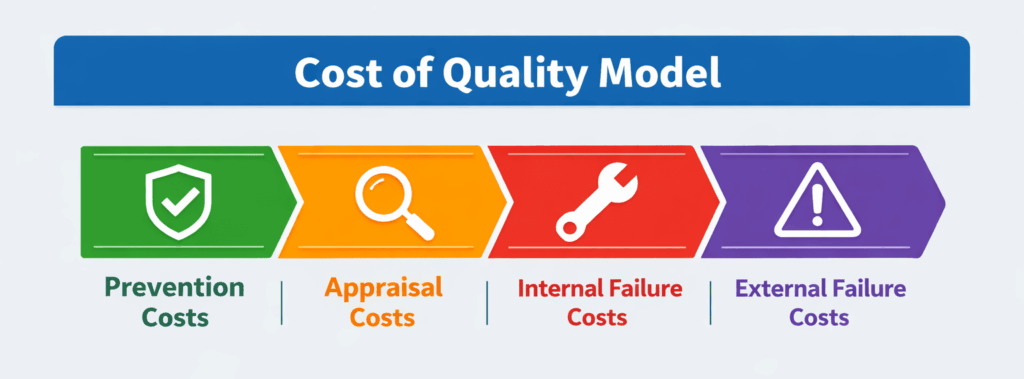
The COQ includes the following:
- Prevention Costs: Money spent to avoid defects from the start. Examples include training the team, purchasing tools, creating precise requirements, and performing quality planning.
- Appraisal Costs: Resources used to inspect and test deliverables for defects. Activities such as code reviews, walkthroughs, audits, and testing fall under this category.
- Internal Failure Costs: Costs incurred when the project team identifies a defect before the product reaches the client. Rework, repairs of defective components, and time spent fixing issues are indicators of internal failures.
- External Failure Costs: Costs incurred when defects reach the customer. This may involve refunds, warranty work, complaints, regulatory penalties, and reputational damage.
These categories form the COQ formula:
COQ = Cost of Conformance (Prevention + Appraisal) + Cost of Non-conformance (Internal + External Failures).
When you invest more in prevention and appraisal, you often incur lower failure costs. The following infographic summarizes these categories:
Why Prevention Pays Off
Quality experts often cite the 1-10-100 rule: it can cost 10 times more to fix a defect during testing than to prevent it, and 100 times more once it reaches the customer. Gartner notes that poor data quality costs the average enterprise $12.9–$15 million annually and that 20–30% of revenue may be lost due to data inefficiencies. These costs include rework, customer refunds, and reputational damage—exactly what COQ seeks to minimize.
The Consortium for Information and Software Quality (CISQ) estimates that poor software quality in the United States costs at least $2.41 trillion in 2022, reflecting the combined impact of cybercrime, technical debt, and operational failures. Such staggering numbers underscore why prevention and appraisal are smart investments.
Think of a time when a small change in your project plan prevented a bigger problem. Maybe you held a requirements workshop and discovered conflicting assumptions early, saving weeks of rework. By allocating time for planning and training, you reduce the chance of costly failures later.
Cost of Conformance Explained
Conformance costs are the price of doing things right. They include both prevention and appraisal. Investing in these areas increases the likelihood of delivering quality on the first attempt. Examples:
- Training and Process Improvement. Sending team members to a PMP boot camp, attending a quality workshop, or adopting Agile practices all count as prevention.
- Tools and Automation. Purchasing an automated testing tool or code analysis platform helps catch defects early and reduces manual effort.
- Quality Planning. Creating a detailed quality management plan, defining acceptance criteria, and establishing review checkpoints prevent misunderstandings.
- Inspections and Reviews. Conducting design reviews, peer code reviews, and inspections helps ensure that deliverables meet standards.
Although these activities require upfront time and money, they are usually far less expensive than the cost of failures. According to the same Gartner report, data teams spend around 50% of their time on remediation, meaning they spend as much time fixing issues as creating value. Shifting even a portion of that effort into prevention frees resources and improves morale.
Cost of Non-Conformance Explained
Non-conformance costs occur when deliverables fail to meet requirements. They are divided into internal and external failure costs.
Internal failures are mistakes caught before your customer sees them. Examples include:
- Discovering a critical bug during system testing and spending days fixing it.
- Reworking a project schedule because stakeholders changed their minds after you failed to involve them earlier.
- Scrapping parts or prototypes that do not meet specifications.
External failures are problems that reach the customer or end user. These are often the most costly and damaging, as they may entail legal penalties, refunds, or loss of future business. Examples include:
- A software release that crashes customers’ systems, requiring emergency patches and customer support.
- A construction project that misses quality standards, leading to safety issues and legal claims.
- Products are recalled for failing to meet safety regulations, harming the brand’s reputation.
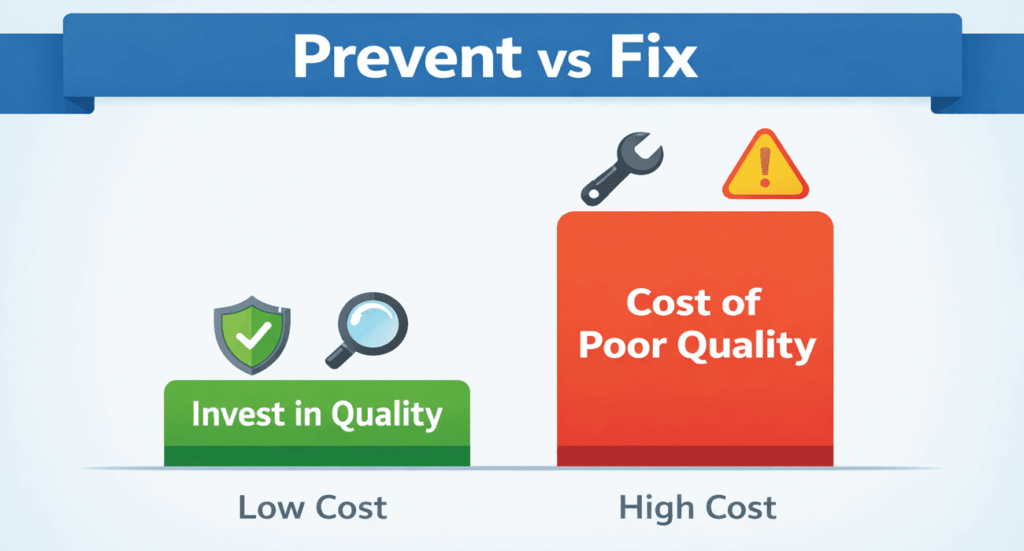
The infographic below illustrates why investing in quality up front leads to lower overall costs:
How to Calculate COQ
Calculating the Cost of Quality is straightforward. Follow these steps:
- Identify Cost Categories: List all prevention and appraisal activities (training, quality planning, testing) and record their cost. Then list the internal and external failure costs (e.g., rework hours, customer support tickets, refunds).
- Assign Monetary Values: Estimate the time spent and multiply it by the labor rates. Include any material costs, equipment purchases, or fees.
- Sum Conformance Costs: Add up all prevention and appraisal expenses. This is your cost of conformance.
- Sum Non-Conformance Costs: Add all internal and external failure costs. This is your cost of non-conformance.
- Add them Together: The total is your COQ. Evaluate whether increasing conformance spending could reduce non-conformance costs.
For example, suppose your team spent $50,000 on training and process improvement (prevention) and $20,000 on testing (appraisal). During the project, you incurred $15,000 in rework (internal failure) and $5,000 in refunds (external failure).
Your COQ is:
COQ = (50,000 + 20,000) + (15,000 + 5,000) = 90,000 USD
If you increased prevention spending by $10,000 for a quality mentor and automated testing tools, you might reduce rework and refunds by $15,000. The total COQ would drop to $85,000, illustrating how prevention pays off.
COQ and the PMP Exam
On the PMP exam, expect questions that test your understanding of the COQ formula and the difference between conformance and non-conformance costs.
Remember:
- Prevention and appraisal are components of the cost of conformance and occur during the planning and execution phases.
- Internal and external failures are part of the cost of non-conformance and can occur during testing, implementation, or after delivery.
- The optimal COQ occurs when the combined cost of conformance and non-conformance is minimized; you do not need to eliminate failures, but you should aim for a balance.
You may also be asked to interpret the impact of poor quality in different project contexts. For instance, a question might present a scenario in which a project manager must choose between additional training (prevention) and skipping it to save time. Understanding the long-term implications helps you select the right answer.
Best Practices for Managing Quality Costs
- Plan Quality Early: Create a quality management plan that sets clear acceptance criteria, roles, and responsibilities. Invest time in defining “done.”
- Empower Your Team: Provide training, mentoring, and the tools they need to build quality into their work. Encourage peer reviews and knowledge sharing.
- Use Data to Make Decisions: Track defects, rework, and customer complaints. Evaluate trends and adjust your budget accordingly.
- Communicate with Stakeholders: Explain the trade-offs between prevention and failure costs. When executives see the numbers, they are more likely to approve investments in quality.
- Continuously Improve: After each project, conduct lessons-learned sessions to capture what worked and what didn’t. Apply those insights to the next project.
FAQs
Q1. What is the difference between quality and grade?
Grade relates to product features, while quality refers to how well the product meets requirements. A high-grade product can still be low quality if it has defects.
Q2. How can I reduce the cost of non-conformance?
Focus on prevention: invest in training, clear requirements, and early testing. These activities reduce the number of defects that reach customers.
Q3. Why is the COQ concept important for the PMP exam?
COQ appears in several exam domains. Knowing the formula and cost categories helps you answer questions about budgeting and quality planning.
Q4. Does the 1-10-100 rule apply to all projects?
It is a general guideline. Actual ratios vary, but the principle holds—defects cost much less to prevent than to fix after delivery.
Summary
Cost of quality helps you control costs while delivering better results. It shows where money is spent to prevent errors and where money is lost fixing them. When you invest early in prevention and checks, it reduces rework, delays, and customer complaints. This leads to smoother projects and stronger stakeholder trust. By understanding cost of quality, you make smarter decisions, protect budgets, and improve outcomes. In the long run, quality planning saves time, money, and effort for every project.
Further Reading:
- Quality Assurance Vs Quality Control
- Quality Control Vs Verify Scope
- Grade Vs Quality
- Control Quality Vs Validate Scope
- What Are the Best Quality KPIs?
References:
- 10 Biggest Product Recalls of All Time
- What is the Cost of Quality?
- Cost of Quality Analysis: Driving Bottom-Line Performance
This topic is important from a PMP exam point of view.

I am Mohammad Fahad Usmani, B.E. PMP, PMI-RMP. I have been blogging on project management topics since 2011. To date, thousands of professionals have passed the PMP exam using my resources.