
Project management skills are in high demand. Organizations in every sector need leaders who can plan, execute, and deliver projects on time and within budget. PMP Vs PRINCE2 is a common debate among professionals who want to stand out. These two certifications validate different approaches to project management, and each one can boost your career in its own way. But how do you decide which is right for you?
In this blog post, we’ll explore their origins, eligibility requirements, exam structures, global recognition, and the factors that matter when choosing between them.
Understanding PMP Certification
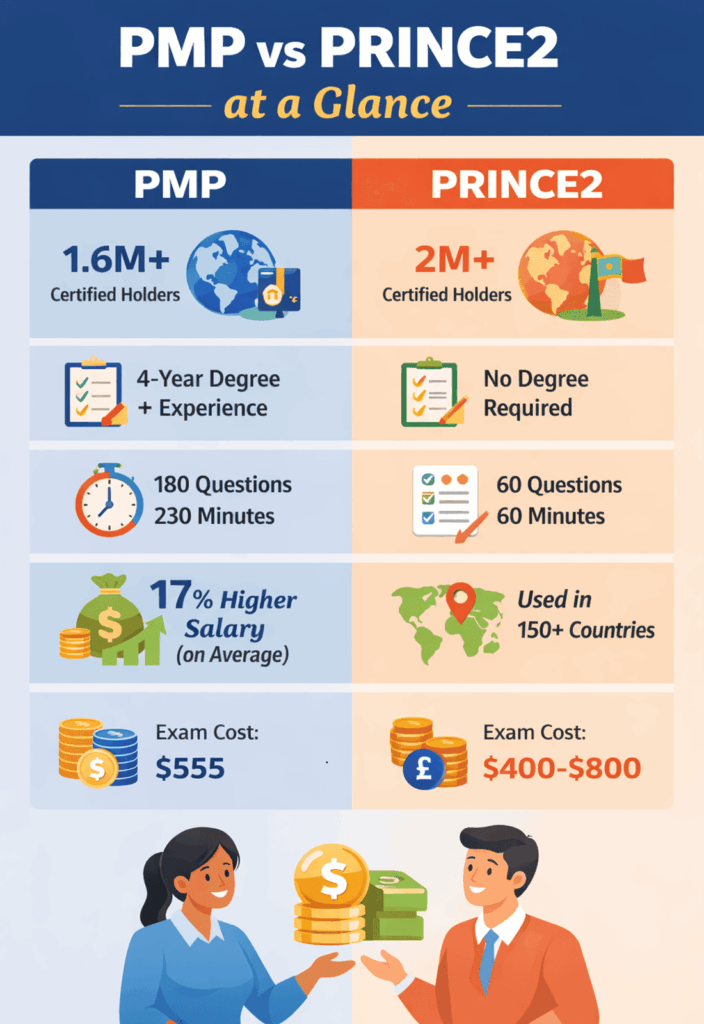
The Project Management Professional (PMP) credential is administered by the U.S.-based Project Management Institute (PMI). Since its launch in 1984, the certification has become a global standard for project managers across industries. According to PMI, there are more than 1.6 million PMP certification holders worldwide. That scale shows how widely the credential is recognized. PMI also reports that PMP-certified professionals earn about 17% higher median salaries across 21 countries compared with their non-certified peers.
Eligibility and prerequisites. To sit for the PMP exam, you need a combination of formal education and project management experience. Applicants with a bachelor’s degree must document at least 36 months of project leadership within the past eight years and complete 35 hours of project management education or hold the CAPM certification. Those with a high school diploma (or global equivalent) need 60 months of project leadership experience and the same educational requirement. These prerequisites ensure that PMP candidates bring real-world experience to the exam.
Exam structure and format. The current PMP exam consists of 180 questions (175 scored, 5 unscored) and lasts 230 minutes with two ten-minute breaks. Questions are a mix of multiple-choice, multiple-response, matching, hotspot, and limited fill-in-the-blank. The exam content outline emphasizes three domains: People (42%), Process (50%), and Business Environment (8%). The test is available in multiple languages and can be taken at a Pearson VUE test center or online.
Why choose PMP? If you aim to work on complex projects in global organizations, especially in North America, the PMP certification carries considerable weight. It demonstrates deep knowledge of PMI’s Project Management Body of Knowledge (PMBOK) and mastery of best practices that apply across industries. Many employers list PMP as a preferred or required qualification. In addition, the ongoing requirement to earn 60 professional development units (PDUs) every three years keeps certificate holders current.
Understanding PRINCE2 Certification
PRINCE2 stands for “Projects IN Controlled Environments.” Developed from UK government methods in the late 1980s, it has evolved into a widely adopted project management approach focusing on processes and governance. PRINCE2 certification is overseen by PeopleCert (formerly Axelos). It comes in two main levels: Foundation and Practitioner. The Foundation level introduces the method’s principles, themes, and processes, while the Practitioner teaches how to apply and tailor them.
More than two million PRINCE2 certifications have been taken worldwide, and the method is used in over 150 countries. These numbers highlight its popularity, especially in Europe, the Middle East, and parts of Asia.
Eligibility and prerequisites. There are no formal prerequisites for the PRINCE2 Foundation exam. Anyone can enroll in an accredited course or self-study. To sit for the Practitioner exam, you must first pass the Foundation level or hold a qualifying project management certification such as PMP. This flexible entry point makes PRINCE2 attractive to professionals who are new to project management or looking for a structured method without extensive experience requirements.
Exam structure and format. The PRINCE2 Foundation exam typically contains 60 multiple-choice questions to be completed in 60 minutes, with a passing mark of 55% (33 correct answers). The Practitioner exam is scenario-based; it contains 68 questions and lasts 150 minutes. Both exams are closed book, though the Practitioner exam allows the use of the official PRINCE2 manual. PeopleCert delivers these exams through accredited training organizations or via online proctoring.
Why choose PRINCE2? PRINCE2 is process-driven. It emphasizes clear roles and responsibilities, robust governance, and a focus on business justification. This makes it well-suited for the public-sector projects, regulated industries, and organizations that prioritize a structured methodology. Its flexibility also allows it to be tailored to project size and complexity. For professionals working in the UK or with clients who follow UK government best practices, PRINCE2 can be an essential credential.
PRINCE2 Vs PMP: Key Comparison
To make an informed choice, it helps to look at the differences side by side. The infographic below summarizes the main contrasts between the two certifications:
Providers and Origins
- PMI (PMP). Founded in 1969 and headquartered in the United States, PMI is a nonprofit membership organization that develops standards and certifies project management professionals. Its flagship credential, PMP, is recognized worldwide. PMI also offers other certifications, such as CAPM, PMI-ACP, and Disciplined Agile.
- PeopleCert (PRINCE2). PRINCE2 is owned and administered by PeopleCert, a global certification company that acquired Axelos in 2021. The methodology itself originated in the UK government. PeopleCert manages exam delivery and updates to the PRINCE2 framework, including the latest version released in 2023.
Eligibility and certification paths
- PMP requires documented project management experience and 35 hours of training. There are multiple paths depending on your education level. The application process involves detailing project roles, durations, and responsibilities. Once certified, you must earn PDUs to maintain the credential.
- PRINCE2 offers an easier entry point. The Foundation exam has no experience requirements. After passing Foundation, you can move to Practitioner. Certification renewal involves earning continuing professional development points every three years.
Exam Structure
- PMP Exam: 180 questions, 230 minutes, multiple question formats, two scheduled breaks. Delivered in many languages and available online or in test centers.
- PRINCE2 Exams: Foundation: 60 questions, 60 minutes, multiple choice; Practitioner: 68 questions, 150 minutes, scenario-based. Exams are closed-book (except for the permitted manual in the Practitioner).
Cost and Time Investment
PMP exam fees range from $555 for non-members to $405 for PMI members. Study time can vary from two to four months, depending on prior experience. PRINCE2 exam fees vary by region and training provider; a package that includes both the Foundation and Practitioner exams typically costs between $400 and $800. Because PRINCE2 has no formal prerequisites, preparation time can be shorter.
Global Popularity and Recognition
- PMP: Over 1.6 million certification holders globally. Widely recognized across industries and especially valued in North America, the Middle East, and India. Employers often list PMP as a required or preferred qualification for project manager roles.
- PRINCE2: More than two million certifications issued and adoption in 150+ countries. Particularly popular in the UK, mainland Europe, and Commonwealth nations. Preferred for government projects and organizations that align with British standards.
Career Prospects and Salary Impact
PMP certification can significantly increase earning potential. PMI’s data show that certified professionals report a 17% higher median salary compared with non-certified peers. PRINCE2 also enhances earning capacity, especially in regions where it is widely recognized. While exact salary figures vary by country and industry, holding either credential signals competence and commitment to the profession.
Geographic demand
PMP is often considered the go-to certification in the United States, Canada, and many parts of Asia. PRINCE2 is favored in the United Kingdom, continental Europe, Australia, and New Zealand. Multinational companies may recognize both, and having both credentials can broaden your opportunities.
Agile and additional certifications
Both PMI and PeopleCert offer agile-focused credentials. PMI’s PMI-ACP and Disciplined Agile certifications validate skills in agile frameworks like Scrum and Kanban. PeopleCert offers PRINCE2 Agile Foundation and PRINCE2 Agile Practitioner that blend the PRINCE2 governance approach with agile principles. Choosing an agile certification depends on your career focus and the methodologies used in your organization.
Deciding Which Certification Is Right for You
Choosing between PMP and PRINCE2 depends on your career goals, experience level, and the environments in which you plan to work. Consider these factors:
- Career objectives. Do you see yourself leading large, cross-functional projects in multinational organizations? PMP may provide broader recognition. Are you primarily working in the UK public sector or industries that require formal governance? Then PRINCE2 could be the better fit.
- Experience level. If you already have substantial project management experience, the PMP’s rigorous eligibility requirements might suit you. If you’re new to the field or want a structured introduction to project management, PRINCE2 Foundation offers an accessible entry point.
- Geographic focus. The region where you live or plan to work matters. Employers in North America often prefer PMP, while those in Europe and the Middle East may lean toward PRINCE2.
- Methodology preference. PMP is grounded in the PMBOK and emphasizes processes and knowledge areas. PRINCE2 emphasizes stages, themes, and governance. Consider which framework aligns better with how your organization manages projects.
- Long-term learning. Both certifications require ongoing professional development. Think about whether you want to pursue additional PMI credentials (like Program Management Professional) or continue within the PRINCE2 family.
The infographic below summarizes these decision factors:
FAQs
Q1. Is the PMP exam harder than PRINCE2?
The PMP exam covers broad concepts and requires documented experience. PRINCE2 Foundation is more straightforward, while Practitioner adds complexity. Your background will influence which feels harder.
Q2. Can I hold both certifications?
Yes. Many project managers earn both to maximize flexibility. Holding both credentials showcases versatility and can open doors globally.
Q3. Do I need a degree to get certified?
PMP requires either a bachelor’s degree plus 36 months of project leadership experience or a high school diploma plus 60 months of experience. PRINCE2 Foundation has no formal educational or experience requirements.
Q4. How long does it take to prepare?
Preparation for the PMP exam usually ranges from two to four months, depending on your schedule and experience. You can prepare for PRINCE2 Foundation in a few weeks, and the Practitioner may require additional study time.
Q5. Which certification is better for Agile projects?
If your work involves agile methods, consider pairing PMP or PRINCE2 with an agile certification. PMI offers PMI-ACP, while PeopleCert offers PRINCE2 Agile. Choose the agile credential that aligns with your organization’s practices.
Summary
PMP and PRINCE2 are both respected project management credentials. PMP shines in global settings and demonstrates mastery of PMI’s extensive body of knowledge. PRINCE2 excels in environments that require formal governance and a process-driven approach. Your decision should reflect your experience, career aspirations, and where you plan to work. Whatever path you choose, investing in your professional development will help you lead projects with confidence and credibility.
Meta: Compare PMP and PRINCE2 certifications, including eligibility, exam formats, global recognition, and salary impact. Learn which project management credential aligns with your goals.
Further Readings:
- What is PRINCE2?
- What is the PMP Certification?
- How to Become a PMP?
- What are the Benefits of PMP Certification?
- What is the PMP Application Process?
References:

I am Mohammad Fahad Usmani, B.E. PMP, PMI-RMP. I have been blogging on project management topics since 2011. To date, thousands of professionals have passed the PMP exam using my resources.


Hi Myself Aditya,
can you please guide me , for which certification should i go .
i have total 9 years of experience as a Qa Lead. i dont want to do automation because i am less interested in scripting and coding .
if i choose PMP certification then it will be helpful to me ?
QA experience is not enough, you must have project management experience in all domains to apply for the PMP exam.
Though, you can go for the CAPM exam.
Many thanks Fahad for your superb notes that clear my many concepts also your latest “PMP questions bank version 3.0” that helps me in passing my PMP exam in first attempt yesterday.
I would like to seek you guidance on what is next after PMP to have further growth in my carrier, as per my limited knowledge i see some options like
1. PRINCE2 CERTIFICATION
2. PMI Risk Management
3 PMI ACP
4. Any other
I am working in embedded systems in Automotive domain.
Could you please guide me , your guidance will be very much valuable for me.
Congratulations Manish on passing the PMP exam.
PRINCE2 is good and similar to the PMP and you can go for it to further enhance your project management skills.
Regarding the other certifications, discuss it with your peers and decide it as per your future career growth planning.
Very brillant explanation!
Thank you Fahad, from France!
You are welcome Brice.
Hello fahad..i am Delhi based engineer having 8+ yrs of exp in IT industry With 3+ years of experience in testing/QA.
Could you please suggest me that i should go for which certification out of these 3— PMP, Prince2 or ITIL.
The PMP is always better but if you are into IT, check with some IT guy who can guide you better.
Thanks fahad!!
You are welcome Sandeep.
AOA:
I am MCS,LLB and now a professional lawyer.My thirst is to pass PMP certification then PMI.I want guidance.
Read following blog post:
https://pmstudycircle.com/2015/08/how-to-become-a-pmp/
Fahad
I recently cleared my PMP in Nov 2016 in first attempt. I want to thank you for clearing some of tricky concepts explained so easily in your blog.
Please keep on the good work.
Thanks PK for your visit and leaving comment.
Hello,
For PRINCE2, should I need 35 PDUs? Do I need to obtain 35 contact hours of training?
Please suggest.
Please read following blog post:
https://pmstudycircle.com/2016/07/prince2/
Hi fahad..im in chennai. Im havng 9yrs exp java side. Im interested todo pmp or prince2. Plz suggest which one i can take it up.
I believe PMP is more valued in India. I suggest you discuss it with your peers and research on various job portals to go ahead with it.
Hi Fahad, thanks for another good post. Being a PMP certified, what advantages are there to prepare for another project management certification exam like Prince2? What is your take on scrum in general and which scrum certification path has or will have more industry recognition (CSM or PSM?)
Regards,
Narendra
PRINCE2 tells you how to run the project, this is something PMBOK lacks.
I don’t have much idea about the scrum certification, contact someone who is into agile project management.
Thank you Fahad.
You are welcome Narendra.
After obtaining my PMP, I am still confused which certificate to hold next: prince2 or CSM.
As you know prince 2 is a uk standard but CSM focus more on agile environment, so what do yu think?
If you are into Agile project management, I suggest you go for PMI-ACP.
Hi Fahad ,
This is the best comparison that i’ve read about PMP and PRINCE2 , now i can make difference between both . So like i am PMP i will go to PRINCE2 in order to see how their methodolgy is .
Regards ,
Morel Cornnery
Hello Morel,
I am glad that you liked my blog post.
Very Nice Comparison between the two ..
Thanks RP Arya for your visit and leaving comment.
I have the PMP certification and will definitely look into PRINCE2, but I’ll keep in mind that I need my PDUs as well before time is tight!
Thanks for the information!
You are welcome Hector.
Very well outlined and explained. This information will definitely help my colleagues who are struggling to decide which certification to pursue.
:)
Hello Fahad,
Thanks a lot for your discussion on the difference between PMP and PRINCE2. To be honest with you, your explanation is the best I have ever read. Well done!
I am now preparing for the CAPM certification exam and I intend going for PRINCE2 after successful completion of the CAPM. I live in Stavanger, the oil capital of Norway, and to develop a new career in the Norwegian oil and gas industry despite the turmoil and downturn in the industry globally.
I wish you good luck.
You can gather PMI-PDUs from PRINCE2 certification training as well. Most of the training providers provide PDUs with PRINCE2 training.
Right.