Agile vs Scrum vs SAFe is a common question for teams trying to improve their delivery. Each approach helps teams move faster, adapt to change, and create better results. But they are not the same.
Agile is a mindset that guides how people think and work. Scrum is a simple framework used by small teams. SAFe helps large organizations scale Agile across many teams. So, which one should you choose? The answer depends on your team size, project complexity, and business goals.
In this blog post, you will learn the key differences and how to pick the right approach for your needs.
Key Takeaway
When comparing Agile, Scrum, and SAFe, you need to remember three key points:
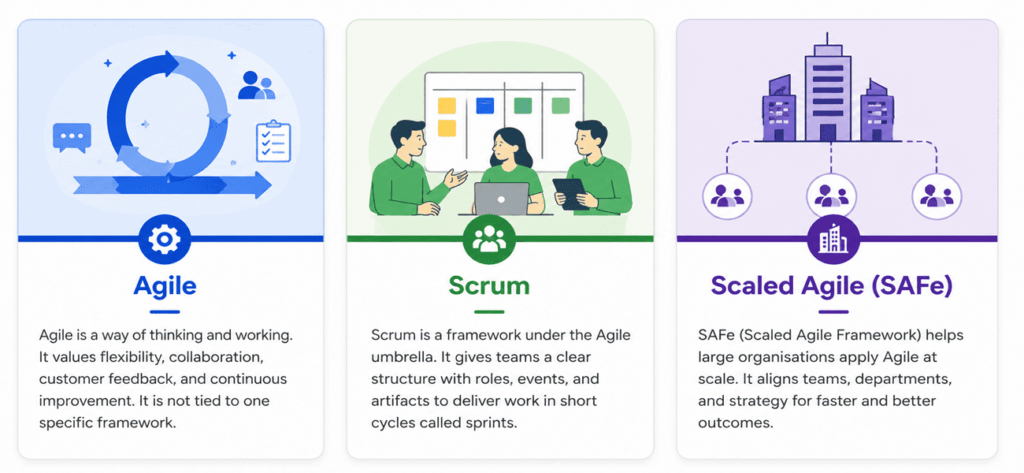
- Agile is a mindset, not a rigid process. It values collaboration, working products, customer feedback, and the ability to change course. Teams adopt Agile values at every level of the organization.
- Scrum is a lightweight framework that applies Agile principles at the team level. It uses short time-boxed cycles called sprints, defined roles, and frequent feedback to deliver small increments of work. Scrum fits well for small, cross-functional teams working on complex products.
- SAFe (Scaled Agile Framework) extends Agile thinking across the entire enterprise. It coordinates multiple Agile teams through a structured set of levels. SAFe is suited for large organizations seeking alignment, faster delivery and better employee engagement.
What is Agile?
Agile is a way of thinking about work, not just a method. It focuses on flexibility, teamwork, and continuous improvement. Instead of planning everything at the start, Agile teams work in small steps and adjust as they go. This helps them respond quickly to change and deliver value faster.
Agile began in 2001 with the Agile Manifesto. It highlights four key ideas: people matter more than processes; working results matter more than documents; customer collaboration matters more than contracts; and adapting to change matters more than strict plans.
In Agile, team members work closely with customers and gather feedback often. They review progress, learn from mistakes, and improve each cycle. This approach reduces risk and improves quality. Agile works well in fast-changing environments where needs evolve over time.
Benefits of an Agile Mindset
Adopting an Agile way of working can produce clear benefits. Teams that embrace iterative delivery catch errors earlier because they inspect their work often. Shared accountability encourages each team member to own their tasks and collaborate openly. Customers stay engaged because they see progress and can offer input along the way.
This flexible approach helps organizations respond to market shifts, new regulations or changing requirements without starting over.
Adoption of Agile
Many organizations recognize these advantages. The 17th State of Agile report surveyed almost 800 respondents and found that about 71% of participants use Agile practices within their software development lifecycle, while 63% rely on Scrum at the team level and 26% use SAFe at the enterprise level.
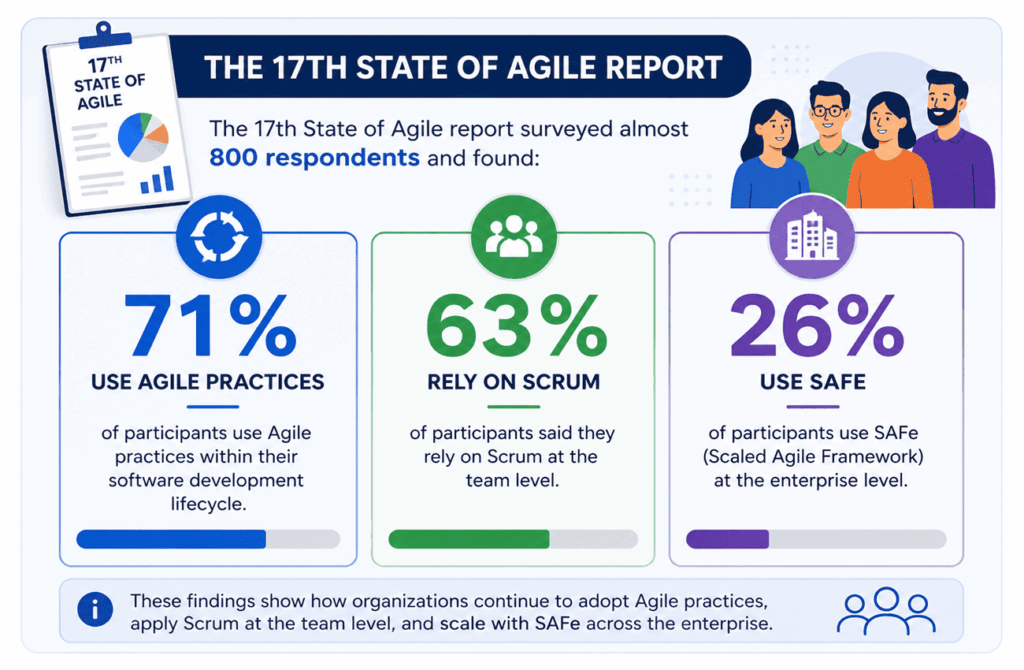
These figures show that Agile is now mainstream, that Scrum remains the most common team-level framework, and that SAFe is gaining ground for large-scale initiatives.
What is Scrum?
Scrum is a simple framework that helps teams deliver work in small, manageable steps. It follows Agile principles and focuses on teamwork, transparency, and continuous improvement. Scrum works best for small, cross-functional teams that need to handle complex tasks.
Work is divided into short cycles called sprints, which usually last one to four weeks. At the start of each sprint, the team plans what they will complete. Every day, they hold a short meeting to discuss progress and challenges. At the end, they review the work and gather feedback.
Scrum defines three key roles: Product Owner, Scrum Master, and Developers. Each role has clear responsibilities, which helps teams stay organized. This structure improves communication and accountability.
By working in short cycles and reviewing often, Scrum helps teams adapt quickly, reduce risks, and deliver better results over time.
Why Scrum Works
Practicing Scrum offers several advantages. According to the Scrum Alliance, Scrum teams experience minimized risk, enhanced ability to manage changing priorities, the ability to uncover bottlenecks, increased stakeholder transparency, and frequent opportunities to inspect and adapt. These benefits flow from the frequent feedback cycles and the emphasis on teamwork.
By delivering working increments often, Scrum teams can detect issues early, refine their process and build products that delight customers. The clear roles and events keep everyone aligned, while the short sprint cadence prevents work from drifting off track.
What is SAFe?
The Scaled Agile Framework (SAFe) is a system for applying Agile and lean practices across an entire enterprise. While Scrum is tailored for small teams, SAFe provides a structure to coordinate multiple teams working on a large product or a portfolio of products.
SAFe rests on three foundations: systems thinking, Agile development, and lean product development. It aligns teams around common goals, synchronizes their cadence, and provides guidance on planning, budgeting and governance.
SAFe offers four configurations to fit different levels of scale:
- Essential SAFe brings together multiple Agile teams within a single value stream. It introduces roles such as the Release Train Engineer and events such as Program Increment Planning.
- Large Solution SAFe extends Essential SAFe for big, complex solutions that require multiple value streams to collaborate.
- Portfolio SAFe adds strategic alignment, lean budgeting and portfolio management to support many solution trains across the organization.
- Full SAFe combines all levels to enable end-to-end value delivery at the largest scale.
Adoption and Benefits
SAFe has become a popular choice for large enterprises that need to coordinate many teams and align work with business strategy. The same State of Agile report cited earlier notes that about one quarter of organizations (26%) use SAFe at the enterprise level. Scaled Agile’s own research shows that 72% of organizations found Scaled Agile learning resources to be very or extremely useful and 68% reported a significant or some increase in employee satisfaction after implementing SAFe.
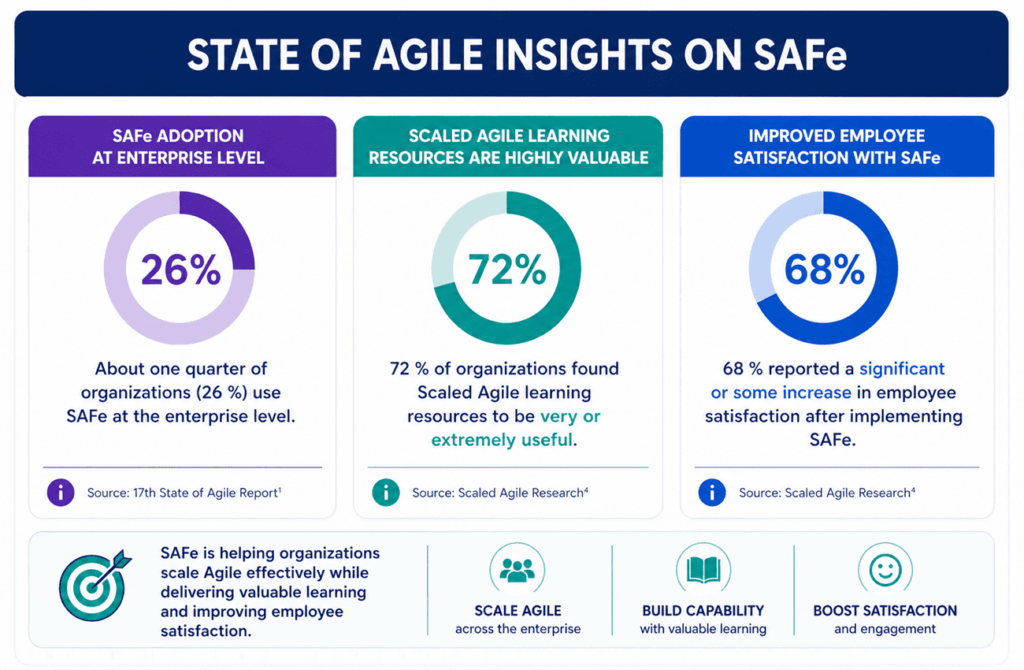
These figures underscore the value of structured guidance and training when scaling Agile.
In practice, SAFe can help companies reduce time to market, improve quality and boost productivity by aligning hundreds of people toward shared objectives. It also encourages autonomy and a sense of purpose at the team level, which can lead to higher morale. Unlike Scrum, SAFe prescribes more roles, events and artifacts, but this added structure supports coordination across divisions and helps maintain alignment.
Agile Vs Scrum Vs SAFe: A Detailed Comparison
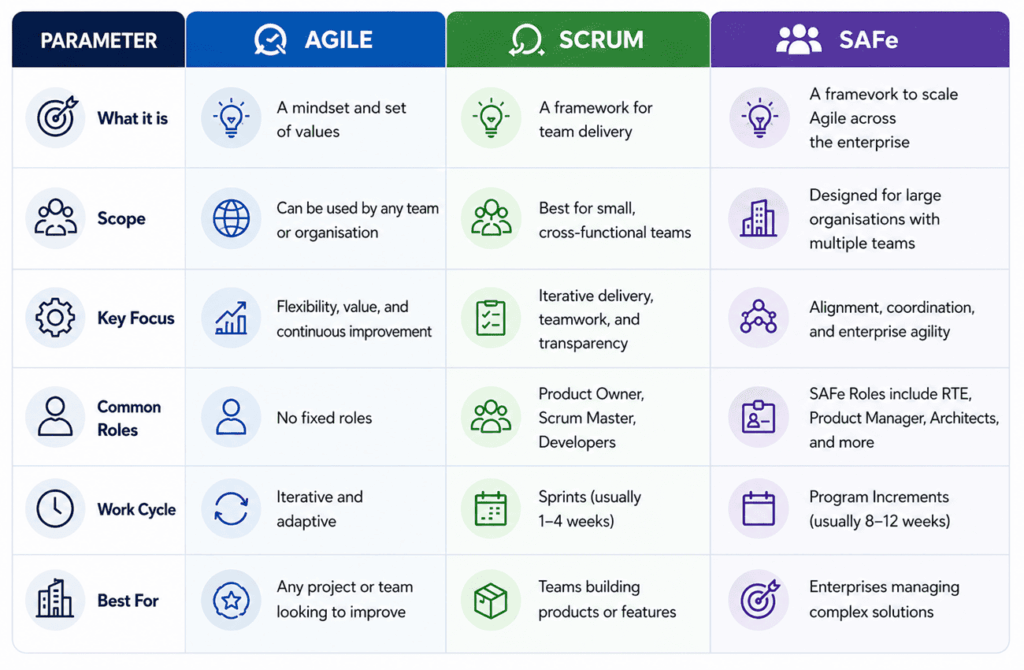
Understanding how Agile, Scrum and SAFe relate to each other can be confusing. Think of Agile as a philosophy, Scrum as one way to practice that philosophy within a single team, and SAFe as a framework for practicing Agile across many teams. The table below summarizes the key differences.
| Attribute | Agile | Scrum | SAFe |
| Scale | Applies to teams, departments or whole organizations; flexible scope | Designed for small, cross-functional teams (usually up to 10 members) | Structured for multiple teams and entire enterprises |
| Focus | Mindset centered on values, principles and adaptability | Framework for delivering working product increments through sprints | System for aligning strategy and execution across portfolios |
| Roles | Depends on chosen method; encourages collaborative leadership | Defines Product Owner, Scrum Master and Developers | Adds roles such as Release Train Engineer, Solution Manager, and Portfolio Manager |
| Processes | Values customer feedback, continuous improvement and adaptability | Uses events like sprint planning, daily scrums, reviews and retrospectives | Incorporates Program Increment planning, system demos and inspect-and-adapt workshops |
| Use cases | Suitable for any domain requiring flexibility and quick feedback | Best for single teams building complex products | Ideal for large organizations needing coordination across many teams |
Below is an infographic that visually compares these approaches. The dark-blue header distinguishes the title, while the light background makes the columns easy to read.
Adoption and Impact Statistics
Statistics help illustrate how widely these frameworks are used and their impact. The bar chart below shows adoption levels for Agile, Scrum and SAFe and highlights how SAFe training and implementation influence employee satisfaction. A contrasting header and vibrant bars make the information clear at a glance.
Choosing the Right Framework
Choosing the right approach depends on your goals, team size, and how your organization works. Agile should guide every choice because it shapes how teams think, collaborate, and adapt. If you have a small team working on one product, Scrum is often a good fit. It provides clear roles, short cycles, and regular feedback, helping teams stay focused and solve problems early.
For larger organizations with many teams and complex work, SAFe can help. It keeps teams aligned and manages dependencies across the business. It adds structure while still following Agile principles. Before using SAFe, check whether your organization is ready, with strong leadership support and training plans in place.
You do not have to choose just one method. Many teams mix Agile, Scrum, SAFe, or even Kanban. The key is to deliver value fast and stay flexible.
FAQs
Q1. Is Scrum the same as Agile?
No. Agile is a set of values and principles, while Scrum is a framework for implementing those principles within a single team. You can be Agile without using Scrum.
Q2. Does SAFe replace Scrum?
SAFe builds on Agile and Scrum to scale coordination across many teams. Teams still use Scrum or another Agile framework within SAFe; SAFe adds roles and events for broader alignment.
Q3. Do I need certification to use Agile, Scrum or SAFe?
Certification is not mandatory, but many professionals pursue it to gain structured knowledge and demonstrate expertise. Courses and credentials can help teams adopt the practices correctly.
Q4. Can Agile and SAFe work together?
Yes. SAFe is designed to scale Agile, so it fully embraces Agile values. It provides guidance on coordinating multiple Agile teams, managing budgets, and aligning work with strategy.
Summary
Agile, Scrum, and SAFe each help teams deliver value faster, but they work at different levels. Agile sets the mindset. Scrum guides small teams with clear roles and short cycles. SAFe connects multiple teams across large organizations. The right choice depends on your size, goals, and complexity. Start simple, learn from feedback, and scale when needed. Focus on collaboration, clarity, and continuous improvement. When teams stay flexible and aligned, they deliver better results and adapt quickly to change.

I am Mohammad Fahad Usmani, B.E. PMP, PMI-RMP. I have been blogging on project management topics since 2011. To date, thousands of professionals have passed the PMP exam using my resources.