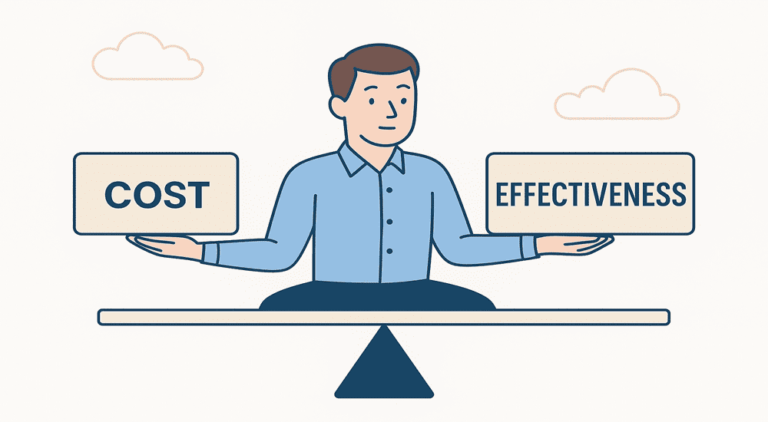
Every organization measures performance, but how you measure it shapes the decisions you make. Managers often track revenue, customer satisfaction, or production speed and refer to them as KPIs. But do a handful of metrics tell the whole story? For three decades, the Balanced Scorecard has provided leaders with a holistic view of the business by examining it from multiple perspectives.
This blog post dives into Balanced Scorecard vs KPI, explains when each approach makes sense, and shows how a thoughtful blend of metrics can guide your strategy.
Understanding the Balanced Scorecard
The Balanced Scorecard (BSC) is a management framework that helps organizations track performance in a clear and structured way. It goes beyond financial results and shows how well a business performs across multiple dimensions. Leaders use it to connect daily work with long-term strategy.
The Balanced Scorecard looks at performance from four perspectives. The financial perspective shows how the organization creates value for its owners and other stakeholders. The customer perspective focuses on customer satisfaction, loyalty, and value delivery. The internal process perspective examines how effectively internal operations are managed and where improvements are needed. The learning and growth perspective measures people, skills, culture, and systems that support future success.
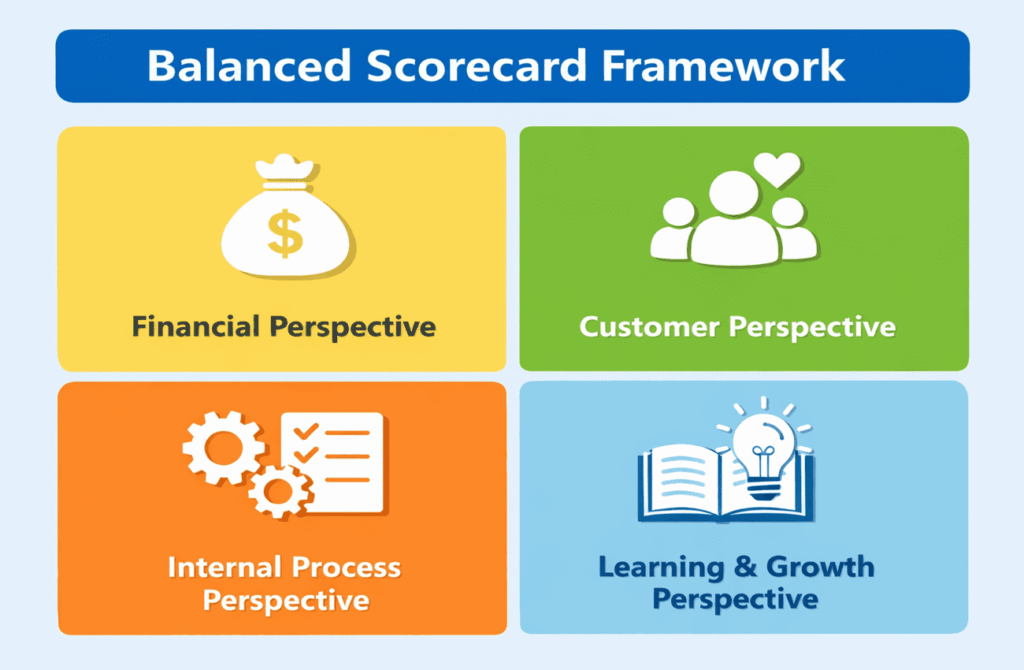
Instead of tracking random numbers, the Balanced Scorecard links goals, measures, targets, and actions. Each metric supports a clear objective. This structure helps teams understand what matters most and why. It also prevents leaders from focusing only on short-term financial results.
Organizations use the Balanced Scorecard to improve alignment, decision-making, and communication. It helps managers see cause-and-effect relationships across the business. When used well, the Balanced Scorecard turns strategy into action and helps teams measure progress in a balanced, meaningful way.
What are Key Performance Indicators?
A Key Performance Indicator (KPI) is a measurable value that shows how well an organization, team, or process is achieving a specific goal. KPIs help leaders track progress and make decisions based on facts, not guesses. Each KPI focuses on one clear outcome, such as sales growth, customer response time, or project completion rate.
Good KPIs are simple, relevant, and easy to understand. They are tied to goals that matter and are reviewed on a regular schedule. For example, a customer support team may track average resolution time, while a finance team may track cost variance. These measures show whether performance is improving or falling behind.
KPIs work best when organizations limit them to a small set of critical measures. Too many KPIs create confusion and reduce focus. When selected carefully, KPIs provide clarity, accountability, and quick insight into performance.
Balanced Scorecard Vs KPIs
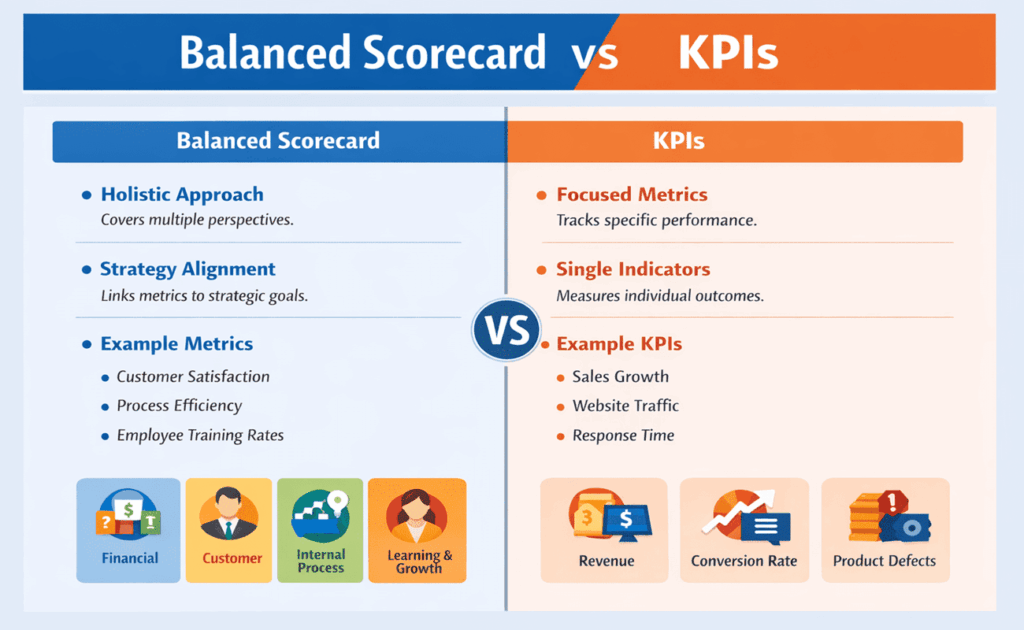
The Balanced Scorecard and KPIs are not competing concepts; KPIs live inside a Balanced Scorecard. The difference lies in scope and purpose. A Balanced Scorecard provides a multi-perspective view of performance and links activities to strategic objectives. KPIs, by contrast, measure specific outcomes. A Balanced Scorecard is “a set of measures that gives top managers a fast but comprehensive view of the business”. The same source lists four perspectives and emphasises that each is informed by strategic goals and KPIs.
A Balanced Scorecard helps organizations connect the dots between projects and programs, the metrics used to track success (KPIs), the strategic objectives the organization aims to achieve, and the mission, vision, and strategy.
In practice:
- Balanced Scorecard – Focuses on the big picture. It aligns goals across finance, customers, processes, and people. It encourages continuous improvement and ensures that metrics support the strategy.
- KPIs – Track discrete elements such as revenue, cost per call, or defect rate. They are useful for monitoring operations or specific projects, but may lack strategic context. When used without a broader framework, KPIs can create “tunnel vision”.
Building a Balanced Scorecard
Implementing a Balanced Scorecard is not as complicated as it sounds, but it requires clear thinking.
You can follow the following steps to build a robust balanced scorecard:
- Clarify your strategy and objectives. Start by defining your mission, vision, and strategic goals. Talk to stakeholders across the organisation to understand priorities.
- Select KPIs for each perspective. From financial, customer, internal, and learning & growth perspectives, select metrics that accurately reflect progress toward your goals. Keep them limited and meaningful. You can use familiar KPIs such as revenue growth, customer satisfaction, process cycle time, and employee training hours.
- Group and weight the metrics. Group KPIs under each perspective and assign weights to show their relative importance. Limit the number of metrics (3–5 per perspective) to maintain focus.
- Set targets and track performance. Establish realistic targets and collect data regularly. Use dashboards or software to visualize results and quickly spot issues.
- Review and refine. A Balanced Scorecard is a living document. Crafting a scorecard is an iterative process of setting objectives, measuring outcomes, learning from results, and adjusting targets. Schedule quarterly reviews and update your KPIs and targets as your strategy evolves.
When to Use a Balanced Scorecard or KPIs
Use a Balanced Scorecard when you need to align diverse teams around a long-term strategy. It is ideal for complex organisations, cross-functional initiatives, government agencies, and non-profits where goals span finance, customers, operations, and learning. Balanced Scorecards complement OKRs and Agile methods by providing a “complete picture” of organizational health. It answers questions such as “Are we investing in sustainable success?” and helps leaders decide what to build now to gain future advantage.
Use KPIs alone when you need to monitor a specific project or function—for example, tracking call-centre average handle time or website traffic. KPIs are ideal for short-term goals, tactical improvements, and individuals or teams focused on a narrow objective. However, even in these cases, linking KPIs back to strategic objectives ensures that efforts contribute to the bigger picture.
Benefits of a Balanced Scorecard
A well-designed Balanced Scorecard yields numerous benefits. A scorecard offers a holistic view, measuring financial, customer, internal processes, and learning & growth perspectives rather than analysing individual KPIs. This holistic view supports several organizational advantages, such as:
- Higher employee engagement. Regular performance reviews and feedback linked to a scorecard improve employee satisfaction and retention.
- Better communication and alignment. Scorecards provide a clear vision and shared understanding of goals, encouraging teams to pull in the same direction.
- Sustained improvement and accountability. A scorecard discourages short-term “metric chasing” and encourages a culture of continuous improvement. With targets weighted across perspectives, improvements in one area should not come at the expense of another.
Challenges and Limitations
No framework is perfect. Balanced Scorecards can be time-consuming to design and maintain, and they may not capture every nuance of your business. Metrics are still abstractions; as the original article notes, they provide only “some kind of abstraction” of performance. If you select poor KPIs or fail to update your scorecard as the strategy evolves, it can quickly become outdated. Complexity can also overwhelm smaller organisations. The key is to start simple, involve key stakeholders, and iterate.
FAQs
Q1. What’s the main difference between a Balanced Scorecard and a KPI?
A Balanced Scorecard is a holistic framework linking strategy to metrics across four perspectives. KPIs are individual measures that track specific outcomes.
Q2. Can I use OKRs with a Balanced Scorecard?
Yes. Use the Balanced Scorecard for long-term strategy and OKRs for short-term execution. Align OKR targets with your scorecard perspectives for best results.
Q3. How often should I review my Balanced Scorecard?
Quarterly reviews with monthly metric check-ins work well. Adjust your scorecard as strategy or market conditions change.
Q4. Is the Balanced Scorecard useful for small businesses?
Yes. Start with a lean version focused on your most critical goals and expand as you grow. Even small teams benefit from linking KPIs to strategy.
Summary
A Balanced Scorecard is more than a collection of metrics; it’s a roadmap that connects your vision to daily actions. It presents financial results alongside customer satisfaction, operational excellence, and learning to give you the full picture. KPIs, on the other hand, are essential instruments for tracking progress but must serve the broader strategy. By combining these tools wisely, you avoid tunnel vision and build a resilient organisation.

I am Mohammad Fahad Usmani, B.E. PMP, PMI-RMP. I have been blogging on project management topics since 2011. To date, thousands of professionals have passed the PMP exam using my resources.