Agile has changed how teams plan and deliver work. But why do so many organizations still choose it today? The answer is simple. The benefits of Agile methodology help teams move faster, adapt quickly, and stay focused on real customer needs. Instead of long plans that often fail, Agile breaks work into small steps. This makes it easier to test ideas, fix problems early, and deliver better results.
Businesses face constant change. Markets shift fast, and customer expectations keep growing. Agile gives teams a way to respond without losing control. It improves teamwork, reduces risk, and keeps projects on track.
So, why use Agile? Because it helps teams deliver value faster while staying flexible and efficient.
Key Takeaway
- Agile helps teams deliver work faster by breaking projects into small, manageable steps.
- The benefits of Agile methodology include better teamwork, faster feedback, and improved results.
- Agile allows teams to adapt quickly when priorities or customer needs change.
- Regular reviews and testing help improve quality and reduce risks early.
- Agile works across many industries, not just software development.
- Strong communication and clear goals make Agile teams more productive and aligned.
What is Agile Methodology?
Agile methodology is a flexible way to manage projects and deliver work in small steps. Teams break large tasks into short cycles called sprints. Each sprint focuses on completing a small part of the project. This allows teams to test ideas early and make quick changes.
Agile values teamwork, customer feedback, and simple processes. Teams meet often, share updates, and solve problems together. Instead of waiting until the end, they deliver results regularly.
This approach helps reduce risk and improve quality. If something goes wrong, teams fix it early. Agile works well in fast-changing environments where needs can shift quickly. It keeps work clear, focused, and aligned with real business goals.
Why Agile Remains Popular
Agile’s popularity isn’t just a legacy of its origins in software. Recent data show that 71% of survey takers use Agile in their software development life cycle, and 42% use a hybrid model that combines Agile with DevOps or other methods. Larger companies are more likely to use a hybrid approach; around 49% of large organizations do so, but even in these cases, Agile remains the core framework. Engineering and R&D teams are the fastest-growing adopters, with usage up 16% since 2022.
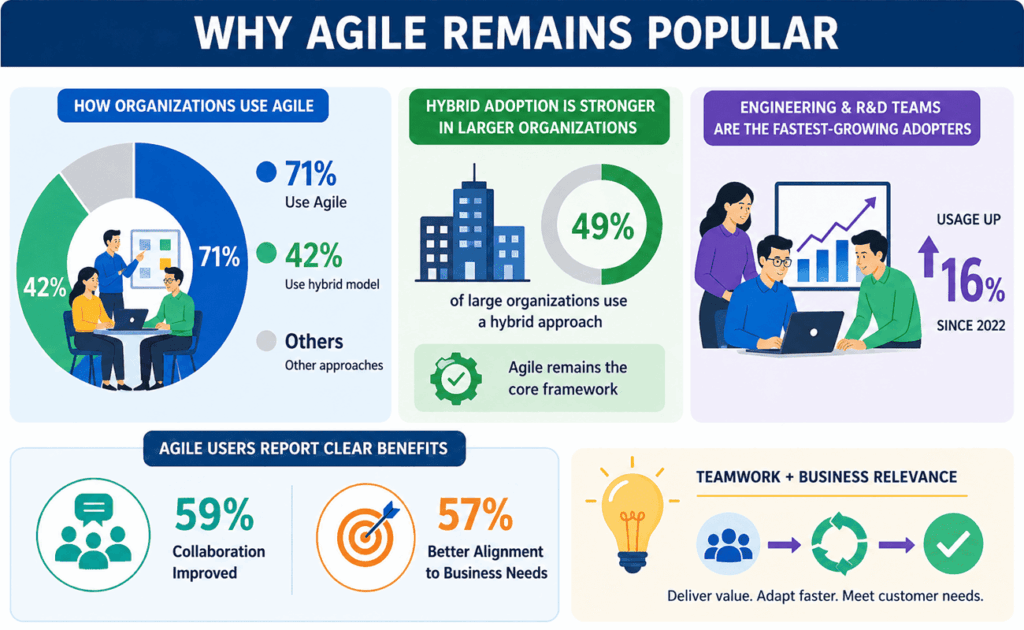
Agile users also report clear benefits. In the same survey, about 59% of respondents said collaboration improved, and 57% noted better alignment to business needs. These two factors, teamwork and business relevance, are at the heart of Agile. When teams work closely with stakeholders and deliver incremental value, they adjust quickly to change and produce products that meet customer needs.
Core Benefits and Advantages of Agile
The following are nine key advantages of using Agile methodologies:
1. Clear Project Goals
Agile begins with a clear vision and a prioritized list of tasks called a backlog. Teams focus on the most valuable work first. This keeps everyone aligned with business goals. Instead of trying to do everything at once, teams work on what matters now. Clear goals reduce confusion and help teams stay on track. When priorities change, the backlog updates quickly, so the team always works on the right tasks.
2. Better Planning and Visibility
Agile uses short cycles and regular planning sessions. Teams break work into small pieces and estimate the effort for each task. Progress becomes easy to track through boards and sprint reviews. Managers and stakeholders can see what is done, what is in progress, and what comes next. This visibility builds trust and improves decision-making. It also helps teams spot delays early and adjust plans before issues grow.
3. Stronger Team Collaboration
Agile encourages open communication and shared responsibility. Daily stand-up meetings help team members share updates and solve problems together. Everyone understands their role and supports others when needed. This builds a strong team culture. Collaboration tools and visual boards make work transparent. When people talk often and work closely, misunderstandings drop. The result is a more connected team that delivers better outcomes.
4. Faster Delivery of Value
Agile focuses on delivering small, usable parts of a product in short time frames. Each sprint produces something valuable that users can see or use. This approach avoids long waiting periods. Businesses start seeing results early instead of at the end of the project. Faster delivery also allows teams to test ideas quickly. If something works well, they build on it. If not, they adjust without wasting time.
5. Early Feedback from Users
Agile invites users and stakeholders to review work often. Feedback comes at the end of each sprint, not just at the final stage. This helps teams understand what users like and what needs to change. Early input prevents costly mistakes later. It also ensures the product matches real needs. When users feel heard, they trust the process more. Continuous feedback leads to better decisions and stronger results.
6. Improved Product Quality
Quality improves because Agile includes testing in every cycle. Teams check their work regularly and fix issues right away. They do not wait until the end to test everything. This reduces defects and keeps the product stable. Code reviews and team discussions also help improve standards. Over time, the product becomes more reliable. A steady focus on quality ensures that each release meets expectations.
7. Higher Flexibility and Adaptability
Agile allows teams to change direction when needed. Business needs can shift, and customer demands can evolve. Agile handles this by updating priorities in each sprint. Teams can add, remove, or adjust tasks without major disruption. This flexibility keeps projects relevant. Instead of following a fixed plan, teams respond to real conditions. This makes Agile ideal for fast-moving industries where change is constant.
8. Reduced Project Risk
Agile reduces risk by delivering work in small steps. Teams review progress often and identify problems early. This prevents large failures at the end of a project. Regular testing and feedback also lowers technical and business risks. If something does not work, teams fix it quickly. Stakeholders stay informed throughout the process. This steady control helps ensure projects stay within scope, time, and budget.
9. Better Customer Satisfaction
Agile keeps customers involved from start to finish. They see progress, share feedback, and influence decisions. This leads to products that closely match their needs. Frequent updates and improvements build confidence and trust. Customers feel valued because their input matters. When the final product meets expectations, satisfaction increases. Agile turns customers into active partners, which leads to stronger relationships and long-term success.
Agile Vs Other Methodologies
Agile isn’t the only project management approach. Understanding how it differs from Waterfall, Lean and PRINCE2 can help you choose the best method or blend of methods for your project.
Agile Vs Waterfall
Waterfall follows a linear sequence: requirements, design, development, testing and deployment. Each stage must be completed before moving to the next. This approach works well for projects with fixed requirements and little uncertainty, such as building a bridge. Agile, by contrast, delivers small increments and accepts changing requirements. If stakeholders aren’t sure what they want or expect frequent changes, Agile offers more flexibility and reduces the risk of building the wrong product.
Agile Vs Lean
Lean focuses on eliminating waste and continuously improving processes. It originated in manufacturing and encourages small, steady changes. Agile and Lean share many values, such as putting customers first and encouraging incremental delivery, but Agile provides a more structured framework with roles (Scrum Master, Product Owner) and ceremonies (daily stand-ups, sprint reviews). Lean can be harder to implement because it’s a culture rather than a prescribed process. Many teams combine Lean’s focus on efficiency with Agile’s structure for project management.
Agile Vs PRINCE2
PRINCE2 (Projects in Controlled Environments) is a process-driven methodology that emphasizes documentation, clear roles, and upfront planning. It works well in regulated industries or environments where governance is critical. Agile values working software over documentation and responds to change more readily. Some organizations use PRINCE2 at the portfolio level to manage governance while allowing teams to work Agile at the delivery level.
FAQs
Q1. What is Agile methodology?
Agile is a project management approach that delivers work in small increments, welcomes feedback and adapts to change. It values collaboration and working software over rigid plans.
Q2. Why is Agile so popular?
Most IT and software teams use Agile because it improves teamwork and aligns projects with business goals. Its flexibility helps teams respond quickly to shifting requirements.
Q3. How does Agile compare with Waterfall?
Waterfall follows a linear sequence and suits projects with stable requirements. Agile delivers features incrementally and adapts to change, making it better for uncertain or evolving projects.
Q4. Can Agile work outside software development?
Yes. Many marketing, HR and finance teams use Agile practices like Kanban boards and short iterations to manage work and improve collaboration.
Q5. What are the common challenges when adopting Agile?
The biggest barriers include resistance to change, insufficient leadership support and legacy systems. Education, executive sponsorship and gradual adoption can help overcome these issues.
Summary
Agile helps teams deliver value faster while staying flexible in a changing world. By focusing on collaboration, customer feedback, and short delivery cycles, organizations improve quality and reduce risk. The benefits of the Agile methodology extend beyond software, helping teams across many fields work better together. When used well, Agile creates clear goals, strong teamwork, and steady results that match real business needs.

I am Mohammad Fahad Usmani, B.E. PMP, PMI-RMP. I have been blogging on project management topics since 2011. To date, thousands of professionals have passed the PMP exam using my resources.