In today’s fast-moving business world, teams need flexible approaches to succeed. The Disciplined Agile Foundations course helps professionals understand how to choose the best way of working instead of following a fixed method.
This Disciplined Agile Foundations course introduces key agile and lean concepts with a focus on real-world applications. It teaches teams how to adapt, collaborate, and deliver value faster. Whether you are new to agile or looking to improve your skills, this course provides practical guidance for building strong, high-performing teams and supporting business agility across projects and organizations.
What is Disciplined Agile?
Disciplined Agile Delivery (DAD) is the software-development portion of the Disciplined Agile toolkit. It helps the project team to make simplified process decisions around incremental and iterative solution delivery. DAD builds on practices from Scrum, agile modeling, and lean software development.
Instead of prescribing a single lifecycle, Disciplined Agile supports multiple lifecycles, such as agile, lean, continuous delivery, exploratory, and large-team versions, because it recognizes that no single approach fits every situation. It is a hybrid toolkit that combines proven strategies from Scrum, XP, SAFe, Agile Modeling, the Unified Process, Kanban, and even Spotify’s development model.
Another key aspect of Disciplined Agile is its people-first philosophy. The framework emphasizes that people and the way they interact are the primary determinants of success. It encourages self-organizing teams with appropriate governance, a complete view of the delivery lifecycle, and context-sensitive advice. By focusing on outcomes rather than rigid procedures, teams can adapt their processes to deliver real business value.
Why Business Agility Matters
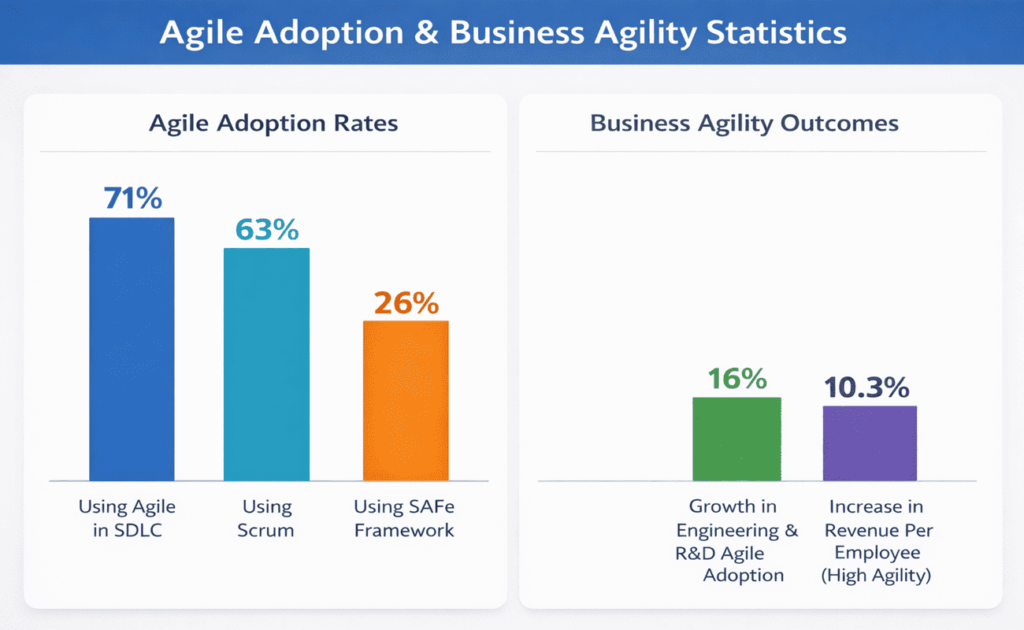
Organizations worldwide are shifting toward agile approaches for good reason. The 17th State of Agile Report found that 71% of survey respondents use agile in their software development lifecycle, and 63% rely on Scrum. Engineering and R&D functions are the fastest-growing adopters of agile, up 16% from 2022. At the enterprise level, the Scaled Agile Framework (SAFe) remains the top choice at 26%, although nearly one-quarter of organizations do not mandate any specific framework.
These numbers show that agile has become mainstream, yet many teams struggle when scaling beyond a single framework. Disciplined Agile addresses this gap by offering tools for context-driven decisions. In addition, the 2025 Business Agility Report shows a clear link between agile maturity and financial performance. Organizations that measurably increased their business agility saw a 10.3% increase in revenue per employee, compared with a 5.1% increase across all organizations.
High-maturity organizations also report higher customer satisfaction, improved operational efficiency, and more predictable financial performance. Put simply, agility isn’t just trendy; it pays off.
Overview of the Disciplined Agile Foundations Course
The Disciplined Agile Foundations Course is an eight-hour training designed for project managers, team leaders, consultants, and anyone who wants to improve team agility. It introduces the key principles of Disciplined Agile and helps learners choose their way of working (WoW).
Below is a visual roadmap summarizing the course modules:

The course begins with an Introduction to Disciplined Agile, covering its history and evolution. Next, it explores Agile & Lean Fundamentals, highlighting iterative delivery, collaboration, value focus, flow, and waste reduction. The third module teaches participants how to Choose Your Way of Working, emphasizing that one size does not fit all. It guides learners in tailoring processes based on team context using the Disciplined Agile toolkit.
The fourth section introduces the DA Process Decision Framework, which helps teams select practices from Scrum, Kanban, DevOps, and other process blades based on goals and risks. Module five focuses on Value Streams & Flow, teaching participants how to optimize workflows to deliver faster and create higher value. The Continuous Improvement segment encourages a culture of learning and experimentation.
Participants then learn about Roles & Responsibilities in Disciplined Agile teams before moving to Practical Application, where real-world examples show how Disciplined Agile works in various contexts. Finally, the course offers Certification Preparation for those pursuing the Disciplined Agile Foundations badge.
Throughout the training, learners practice making trade-off decisions and tailoring their WoW. They explore how to combine agile and lean techniques, adapt processes to team size and industry, and understand the implications of each choice. The self-paced exercises and case studies prepare participants to apply Disciplined Agile principles in real projects.
Key Benefits of the Disciplined Agile Foundations Course
The Disciplined Agile Foundations Course delivers more than theory; it empowers teams to adapt and thrive. Here’s why it stands out:
- Context-Driven Guidance: Rather than prescribing one framework, Disciplined Agile provides guidance for choosing practices that fit your unique situation. This flexibility enables teams to respond quickly when requirements change.
- Improved Collaboration: By focusing on people, roles, and responsibilities, the course teaches how to foster communication and alignment across business, development, and operations. This leads to smoother projects and happier clients.
- End-to-End Lifecycle Coverage: DAD spans the full delivery lifecycle, from inception through release, addressing areas that traditional agile methods often overlook. Participants learn how to integrate modeling, architecture, and governance into agile delivery.
- Multiple Lifecycles and Hybrid Approach: The toolkit supports multiple lifecycles and blends practices from Scrum, XP, SAFe, Kanban, and more. As a result, teams can craft a tailored approach instead of cobbling together frameworks on their own.
- Quantifiable Results: Research supports the value of agility. Seventy-one percent of organizations use agile, and 63% rely on Scrum. Engineering and R&D adoption grew 16% year over year, and high-maturity organizations achieved a 10.3% increase in revenue per employee. These numbers suggest that investing in agile skills pays dividends.
To visualize these benefits, the following bar chart summarizes key adoption and agility statistics:
Who Should Enroll?
The Disciplined Agile Foundations Course is ideal for anyone who wants a holistic view of agile practices. It suits project managers, team leaders, business analysts, and consultants seeking to broaden their toolkits. Individuals new to agile will appreciate the foundational modules, while experienced practitioners will value the hybrid and decision-making guidance.
Because there are no formal prerequisites, the course is open to professionals from software development, operations, marketing, or any department that needs to deliver value quickly. If you’re interested in tailoring your way of working to meet unique challenges, this course is for you.
Experience, Expertise, and Credibility
Disciplined Agile was co-created by Scott Ambler and Mark Lines and later acquired by the Project Management Institute (PMI) in 2019. PMI is a globally recognized authority in project management and agile training. The course content is developed by experts who understand how to blend agile, lean, and DevOps practices. It reflects lessons learned from hundreds of organizations and is continually updated to align with the latest research.
The statistics cited above come from reputable primary sources, including the 17th State of Agile Report and the 2025 Business Agility Report. These reports collect data from thousands of practitioners worldwide, providing reliable evidence for the benefits of agile and business agility. By enrolling in a PMI-authorized course, you gain access to expert knowledge and earn a globally recognized badge.
FAQs
Q1. What is the course duration?
The course takes roughly eight hours of study, making it easy to complete in a single day.
Q2. Do I need prior agile experience?
No. The course starts with basic principles and suits both beginners and experienced practitioners who want to expand their toolkit.
Q3. What certification will I receive?
Upon completing the training and passing the assessment, you earn the Disciplined Agile Foundations badge issued by PMI.
Q4. How does Disciplined Agile differ from Scrum?
Scrum prescribes a single lifecycle. Disciplined Agile offers a hybrid toolkit with multiple lifecycles, allowing teams to tailor practices to context.
Q5. Why should I invest in this course now?
Research shows that agile adoption continues to grow, and organizations with high agility see measurable benefits. Learning Disciplined Agile prepares you to lead agile transformations and improve team performance.
Summary
The Disciplined Agile Foundations course equips professionals with practical skills to choose the best way of working for any project. By combining agile, lean, and hybrid approaches, teams improve collaboration, adaptability, and delivery outcomes. Supported by real-world data and proven frameworks, this course prepares individuals to drive business agility and deliver value faster. Investing in Disciplined Agile training today can strengthen your career and help your organization succeed in a rapidly changing environment.
Reference:

I am Mohammad Fahad Usmani, B.E. PMP, PMI-RMP. I have been blogging on project management topics since 2011. To date, thousands of professionals have passed the PMP exam using my resources.