
The Entry Certificate in Business Analysis (ECBA) is the starting point for professionals seeking to become business analysts. It confirms your understanding of core business analysis principles and gives you tools you can use immediately on the job.
In this blog post, you’ll learn what the ECBA certification is, why it matters, how to prepare for the exam and what to expect, and how earning the ECBA can help your career.
Let’s get started.
Key Takeaways
- What the ECBA is: The ECBA is an entry-level certification offered by the International Institute of Business Analysis (IIBA) that tests your foundational business analysis competencies. It’s recognized worldwide and is designed for people new to the field.
- Exam at a glance: The 75-minute remote-proctored exam has 50 multiple-choice questions. It covers nine domains, such as Understanding Business Analysis (20%) and Mindset for Effective Business Analysis (14%). Each domain carries a specific weight on the exam.
- Cost and preparation: The ECBA package (exam, practice test, and IIBA membership) costs about US$395 or less, depending on your region. Students pay around US$315. After purchasing, you have six months to schedule the exam and 30 days to request a refund.
- Steps to certification: There are six steps: purchase the exam, accept the ethical and exam policies, study using the BABOK Guide and other resources, set up your remote testing space, schedule the exam, and take the test. A clear timeline helps keep you on track.
- Career benefits: ECBA holders often report increased confidence, improved communication skills, and better job prospects.
What is the ECBA Certification
The ECBA certification was created by IIBA for professionals who are new to business analysis. Unlike more advanced designations such as CBAP, the ECBA focuses on foundational skills rather than work experience. It’s ideal for students, recent graduates, career changers, or professionals who want to formalize their skills. There are no formal prerequisites beyond completing 21 hours of professional development training.
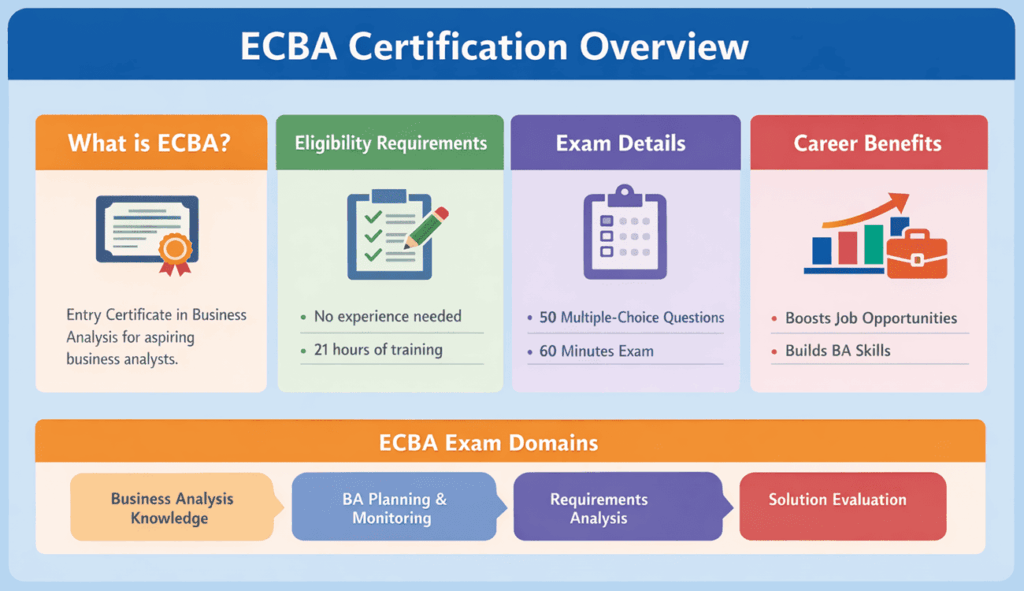
If you’re wondering whether you need programming or project management experience before taking the exam, the answer is no: the ECBA is designed to teach you the basics and build your confidence from the ground up.
Why Earn an ECBA?
Many employers look for candidates who demonstrate a commitment to learning. The ECBA serves as proof that you understand key business analysis principles and can apply them on the job. Earning the certificate can set you apart from other entry-level applicants and show hiring managers that you’re serious about growing in this profession.
Preparing for the ECBA will help you structure your learning and provide a clear roadmap to acquiring job-ready skills. It will also introduce you to a global community of practitioners who may offer you tips and encouragement.
Who Should Consider the ECBA?
The ECBA is meant for beginners. You should consider it if you are:
- A student or recent graduate exploring business analysis.
- A professional in another field who wants to transition into business analysis.
- A junior analyst seeking to validate your knowledge and build credibility.
Because the ECBA doesn’t require work experience, it’s accessible to anyone willing to commit to training and self-study.
ECBA Exam Details
Exam Format and Duration
The ECBA exam is delivered online via remote proctoring, so you can take it from home or any quiet space that meets the technical requirements. You’ll have 75 minutes to answer 50 multiple-choice questions. The questions are mostly situational, meaning they describe a scenario and ask you to choose the best response. This format assesses your ability to apply what you’ve learned, not just memorize facts.
Exam Domains and Weighting
The exam blueprint divides the content into nine domains.
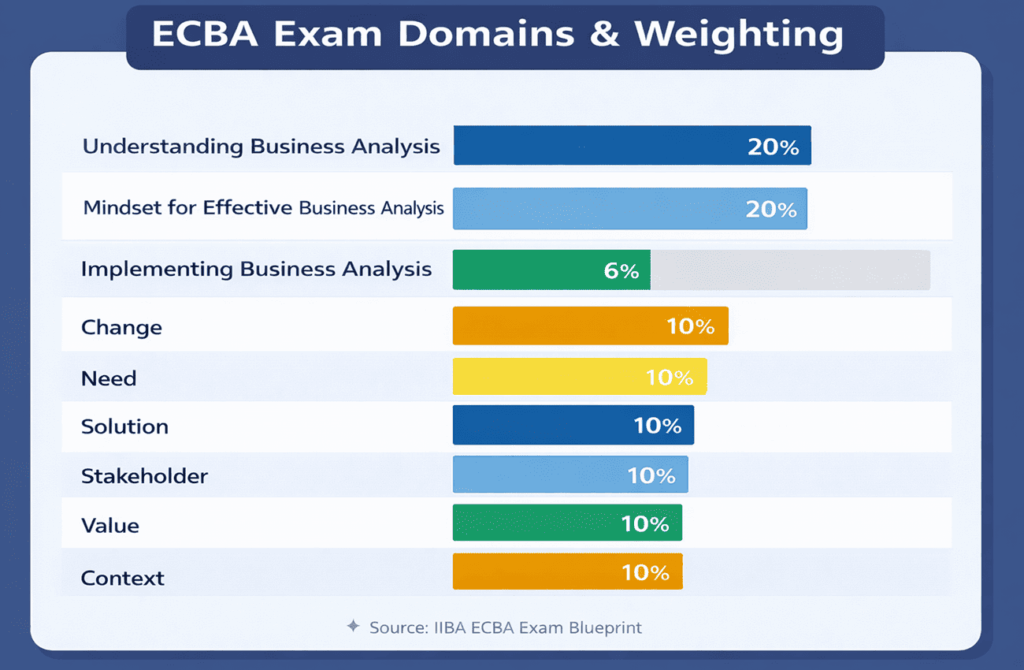
The Understanding Business Analysis domain carries the most weight at 20%, followed by Mindset for Effective Business Analysis at 14%. The remaining seven domains: Implementing Business Analysis, Change, Need, Solution, Stakeholder, Value, and Context, each account for 6–10% of the exam. These percentages reflect the number of questions you can expect in each area. A good study plan allocates time based on this weighting.
How to Earn Your ECBA Certification
Earning the ECBA involves several clear steps. The graphic below summarizes them at a glance. Following a structured process reduces stress and keeps you focused.
Step 1: Purchase the Exam
Create or log in to your IIBA account and purchase the ECBA exam package. This package usually includes an IIBA membership, the ECBA exam, a practice exam, and the learning journey materials. The total cost is typically around US$395 or less, although regional pricing may vary. Students can apply for discounted rates of about US$315. Keep in mind that IIBA often offers promotions or bundles, so check the official site for the latest deals.
Step 2: Agree to the Attestations
As part of the purchase, you must agree to the IIBA Certification and Recertification Terms and Conditions, the Code of Ethical Conduct and Professional Standards, and the Guide to Online Remote-Proctored Exams. Review these documents carefully; they outline expectations for professional behavior and exam security.
Step 3: Study and Prepare
Successful candidates typically spend several weeks to a few months preparing. Begin by studying The Business Analysis Standard and The BABOK Guide; these are the primary reference materials for the exam. IIBA members also have access to a Learning Journey that guides you through the exam blueprint, plus a practice exam that simulates the testing experience. Aim to complete at least 21 hours of professional development activities, which can include online courses or instructor-led training.
Step 4: Set Up Your Remote Exam
The ECBA exam is conducted online. Make sure your computer meets the technical requirements, including a stable internet connection, webcam, microphone, and a room free from distractions. The IIBA Handbook recommends testing your equipment in advance and ensuring that your workspace is clear of prohibited materials. If you need accommodation for a disability, contact IIBA as early as possible.
Step 5: Schedule Your Exam
After preparing, log in to your IIBA profile to schedule the exam through the testing provider. You must schedule and take your exam within 6 months of purchase; otherwise, your eligibility will expire. If you need to reschedule, please do so at least 48 hours before your appointment to avoid forfeiting your fee.
Step 6: Exam Day
On exam day, log in a few minutes early to complete the check-in process. Keep your government-issued ID ready and follow the proctor’s instructions. The test lasts 75 minutes and consists of 50 multiple-choice questions. You’ll receive your score immediately after finishing, and IIBA will email an official confirmation within 48 hours.
Benefits of Earning the ECBA Certification
Gain Confidence and Recognition
One of the most significant benefits reported by ECBA holders is increased confidence. Understanding core concepts makes it easier to communicate with stakeholders and participate in projects. Because the ECBA is globally recognized, it can help you demonstrate your commitment to the profession and differentiate yourself from other candidates. When I earned my ECBA, I noticed how colleagues started seeking my input on requirements gathering and process improvement. It felt good to be regarded as someone with validated skills.
Improve Your Job Prospects
The ECBA signals that you’re job-ready. Employers value certifications because they reduce risk when hiring entry-level talent. In fact, data from the U.S. Bureau of Labor Statistics shows that management analysts, a role closely aligned with business analysis, earned a median salary of US$101,190 in 2024, and employment is projected to grow 9% from 2024 to 2034. While this figure covers analysts at various levels, it illustrates the profession’s earning potential and underscores why investing in your skills can pay off.
Access a Global Community
Becoming an IIBA member introduces you to a worldwide network of professionals. You’ll gain access to webinars, local chapters, and discussion forums where you can ask questions and share experiences. This community aspect is often overlooked, yet it’s one of the most valuable benefits. I found my first mentor through a chapter event, and that connection opened doors to new projects.
How to Prepare Effectively
Studying for the ECBA isn’t just about memorizing terms; it’s about understanding how to apply business analysis techniques in real situations. Here are some practical study tips:
- Read the core guides: Start with The Business Analysis Standard to learn foundational concepts, then move to the BABOK Guide, which covers techniques, tasks, and underlying competencies. Read actively by summarizing each chapter in your own words.
- Use practice questions: Take the official practice exam to become familiar with the question style and pacing. Analyze your answers and identify areas that need more review.
- Join study groups: Connect with peers through IIBA chapters or online forums. Discussing concepts and practicing mock scenarios with others deepens understanding and keeps you motivated.
- Create a study schedule: Plan your study sessions around the exam blueprint. Allocate more time to the domains with higher percentages and revisit challenging topics regularly.
- Apply concepts at work: If you’re already in a related role, try using what you’ve learned on a real project. This hands-on practice reinforces the concepts and builds confidence.
Career Prospects and Salary Insights
Business analysts play a critical role in helping organizations improve processes, identify opportunities, and deliver value. While salaries vary by region and industry, the U.S. Bureau of Labor Statistics notes that the median annual wage for management analysts was US$101,190 in May 2024. The job outlook is strong as well: employment is projected to grow 9% from 2024 to 2034, which is much faster than the average for all occupations. These figures illustrate the value of building a career in business analysis and highlight the potential return on investment of certifications like the ECBA.
FAQs
Q1. What is the ECBA certification?
The ECBA (Entry Certificate in Business Analysis) is an entry-level certification from IIBA that validates foundational knowledge and skills in business analysis for people new to the field.
Q2. How long is the ECBA exam?
You have 75 minutes to complete 50 multiple-choice questions. The exam is delivered via online remote proctoring, so you need a stable internet connection and a quiet room.
Q3. How much does it cost to take the ECBA?
The ECBA exam package, including IIBA membership, the exam, practice questions, and learning materials, costs around US$395 or less. Student discounts bring the price down to roughly US$315.
Q4. Do I need work experience before taking the ECBA?
No work experience is required. The ECBA is designed for beginners, although you must complete at least 21 hours of professional development training through courses or self-study.
Q5. What happens if I fail the exam?
You can retake the ECBA exam by purchasing an exam rewrite. Keep in mind that rewriting fees are not included in the original exam package and must be paid separately.
Summary
The ECBA certification is a strong starting point for anyone entering the field of business analysis. It builds core knowledge, boosts confidence, and demonstrates to employers that you are job-ready. The exam is simple to plan if you follow a clear study path and understand the domains. With growing demand for analysts, this certification can open new career doors. If you want to stand out early in your career, the ECBA is a smart, practical step.
References:

I am Mohammad Fahad Usmani, B.E. PMP, PMI-RMP. I have been blogging on project management topics since 2011. To date, thousands of professionals have passed the PMP exam using my resources.