Estimate to Complete (ETC) is a cost forecasting metric in earned value management. It shows how much more money you will need to finish the remaining project work. It does not include money you have already spent. That is what makes it useful when you want to check future cost needs and avoid budget surprises.
You have three common ETC methods: bottom-up estimation, ETC based on EAC minus AC, and ETC based on BAC minus EV. The right method depends on your project condition, current performance, and whether the original estimate still makes sense.
Estimate to Complete (ETC) Calculator
Use the ETC calculators below to find the estimate to complete for your project.
1) Bottom-Up ETC Calculator
Use this method when the original estimate is no longer reliable. In this case, you re-estimate the remaining work packages and sum them. This method is more detailed and often more accurate when project assumptions have changed.
Bottom-Up ETC Calculator
Enter the re-estimated cost of the remaining work packages.
2) ETC Calculator Using EAC and AC
Use this method when you already know the Estimate at Completion (EAC). The ETC is the forecast total cost minus the actual cost incurred to date.
ETC Calculator Using EAC and AC
Use the formula: ETC = EAC – AC
3) ETC Calculator Using BAC and EV
This is the quick approximation method.
ETC Calculator Using BAC and EV
Use the formula: ETC = BAC – EV
This approach assumes the remaining work will be completed on budget, so it works best when the project is still on track and current performance is close to plan.
How to Calculate ETC
You can calculate Estimate to Complete in three main ways, depending on your project condition. PM Study Circle lists these methods and explains when each one is best suited.
Step 1: Check Whether the Original Estimate Is Still Valid
Ask a simple question: Can you still trust the original cost estimate? If the scope, assumptions, or work conditions have changed a lot, you should not depend on the old estimate. In that case, the bottom-up method is the better choice.
Step 2: Choose the Right ETC Formula
If the original estimate is no longer reliable, re-estimate the remaining work packages and add them. If the project is performing close to plan and you know the EAC, use ETC = EAC – AC. If you want a quick estimate and the project is largely on track, use ETC = BAC – EV.
Step 3: Enter the Required Inputs
For bottom-up ETC, enter the revised cost of each remaining activity or work package. For the EAC-based method, enter EAC and AC. For the BAC and EV method, enter BAC and EV. These are the same core project cost inputs described in the PM Study Circle article.
Step 4: Calculate the Result
Use the chosen formula or calculator. The output gives the amount of money you still expect to spend to finish the remaining project work. That number helps you plan funding, monitor performance, and speak clearly with stakeholders.
Step 5: Interpret the Result
A high ETC means you still need a large amount of money to complete the project. A lower ETC means the remaining work should need less funding. But context matters. A quick BAC – EV estimate may look neat, yet it can hide real cost problems if the project is already off track. Isn’t that the kind of surprise every project manager wants to avoid?
Estimate to Complete Formula
The following are three common ETC approaches.
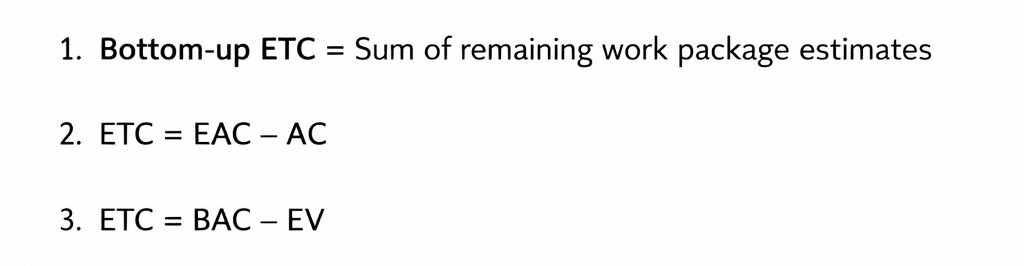
Here:
- ETC = Estimate to Complete
- EAC = Estimate at Completion
- AC = Actual Cost
- BAC = Budget at Completion
- EV = Earned Value
ETC Example
Let’s say your project has the following data:
- Budget at Completion (BAC) = 100,000
- Earned Value (EV) = 40,000
- Actual Cost (AC) = 50,000
If you use the quick formula:
ETC = BAC – EV
ETC = 100,000 – 40,000
ETC = 60,000
This means you still expect to need 60,000 to complete the remaining work. PM Study Circle uses a similar example and notes that this quick method assumes future work will be completed on budget, so you should use a more detailed method if current performance is weak.
Importance of ETC
Estimate to Complete helps you forecast future spending before the project ends. It helps you request extra funds early, adjust plans, and improve cost control. ETC supports other key earned value calculations, such as EAC and VAC, thereby playing an important role in project forecasting. When you track ETC often, you reduce surprises and give stakeholders a clearer picture of project health.
FAQ
Q1. What is the Estimate to Complete in project management?
Estimate to Complete is the expected cost needed to finish all remaining project work. It only covers future spending, not the money already spent.
Q2. What is the ETC formula?
There is no single ETC formula for every case. Common methods include bottom-up estimation,
ETC = EAC – AC, and ETC = BAC – EV.
Q3. When should I use bottom-up ETC?
Use bottom-up ETC when the original estimate is no longer reliable, such as after major scope changes or flawed early assumptions.
Q4. What is the difference between ETC and EAC?
ETC shows the remaining cost to finish the project. EAC shows the total forecasted cost at project completion.
Q5. Is ETC = BAC – EV always accurate?
No. It is a quick approximation. It works best when the project is on track and future work is expected to happen on budget.
Summary
Estimate to Complete is a simple but powerful forecasting tool. It tells you how much more money you need to finish the remaining project work. You can calculate ETC with a bottom-up estimate, by subtracting AC from EAC, or by subtracting EV from BAC. The best method depends on your project status and how reliable the original estimate still is. A good ETC calculator saves time, reduces manual errors, and helps you make better cost decisions.

I am Mohammad Fahad Usmani, B.E. PMP, PMI-RMP. I have been blogging on project management topics since 2011. To date, thousands of professionals have passed the PMP exam using my resources.