You always face constant pressure to balance cost, control, and growth for your business. One major decision is whether to use insourcing or outsourcing. Both models impact operations, efficiency, and long-term strategy in different ways, so choosing wisely is very important.
Insourcing allows you to keep work in-house and maintain control, while outsourcing helps you save costs and access outside expertise.
In this blog post, I will explain what insourcing and outsourcing mean, their advantages, their challenges, and when to use each model.
Let’s get started.
1. What is Insourcing?
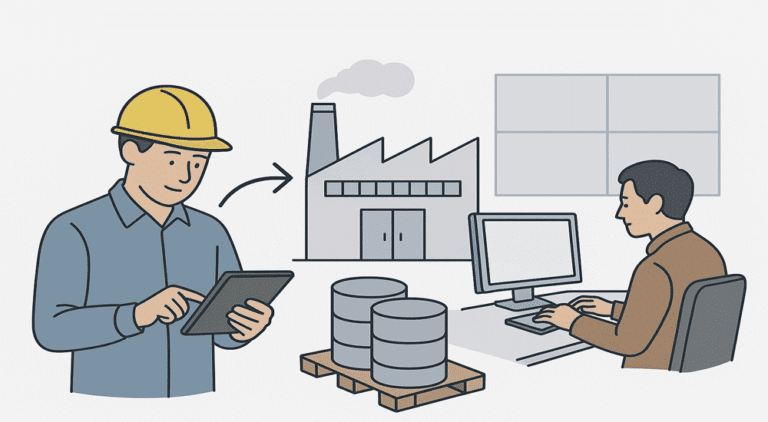
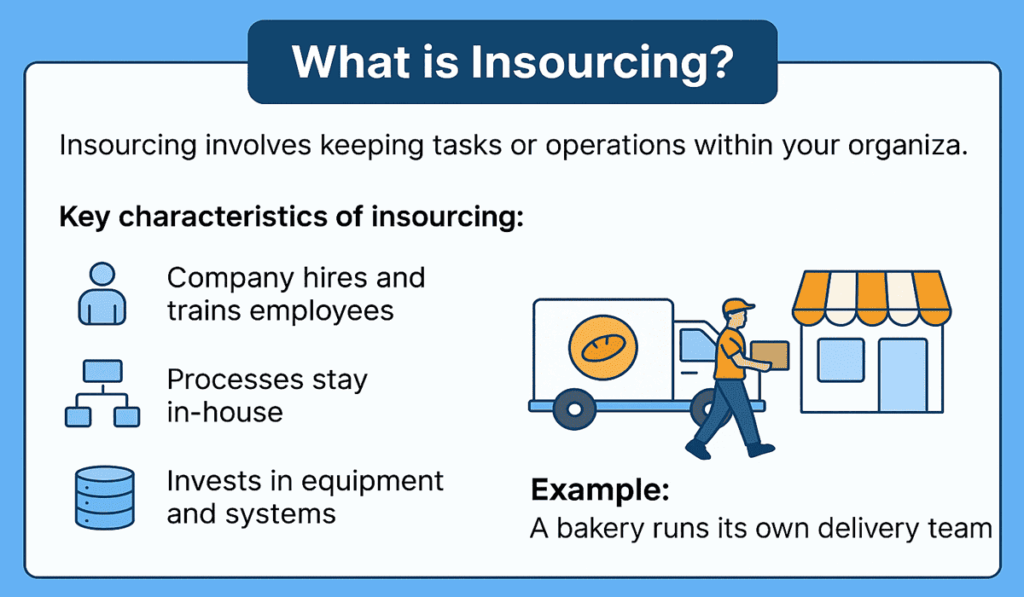
Insourcing refers to retaining tasks, projects, or operations within your organization. Employees, systems, and resources are managed directly by the organization.
Key characteristics of insourcing:
- The company hires and trains its own employees.
- Processes remain within the company.
- The business invests in equipment, infrastructure, and systems.
Example: A bakery decides to run its own delivery team instead of hiring a third-party courier. This gives them direct control, but it also incurs additional costs.
Insourcing is well-suited for businesses that prioritize long-term stability, quality control, and protection of intellectual property.
1.1 Importance of Insourcing
Insourcing is important because it gives you more control over your work. When you use your own employees and resources, you can directly manage quality and efficiency. This helps you maintain high standards and protect sensitive information. Insourcing also strengthens teamwork because employees work together in the same environment.
Communication is easier, and problems can be solved faster. Another benefit is that insourcing builds internal skills and expertise. Over time, your business will develop knowledge that gives you a competitive advantage. It also creates a strong company culture, as employees feel more connected and involved in the industry.
While insourcing may initially incur higher costs, it leads to long-term stability and consistency. If you want to grow steadily, protect your ideas, and build loyal teams, you will find insourcing to be very valuable. It ensures greater trust, control, and ownership of the entire process.
2. What is Outsourcing?
Outsourcing refers to the practice of hiring third-party vendors to perform specific tasks or services on behalf of an organization. The company focuses on its core work while external partners handle specialized areas.
Key characteristics of outsourcing:
- Vendors provide skills or services.
- The business reduces costs by avoiding hiring and infrastructure.
- Outsourcing contracts define roles and expectations.
Example: A startup hires an IT service provider to manage help desk operations. This saves time and money but reduces direct control.

Outsourcing is well-suited for businesses that require cost efficiency, rapid scaling, or specialized expertise not readily available internally.
2.1 Importance of Outsourcing
Outsourcing is important because it helps you save money, focus on your main work, and get access to expert skills. You can outsource tasks like IT support, customer service, or accounting to outside providers who specialize in these areas. This reduces costs since you do not need to hire full-time staff or invest in expensive infrastructure.
Outsourcing also saves time and allows employees to focus on the company’s core goals, such as product development or customer satisfaction. It provides flexibility to handle seasonal demands, scale operations quickly, and remain competitive in rapidly changing markets.
Small businesses benefit from outsourcing because they can access resources that might otherwise be too costly. Large companies also utilize outsourcing to expand globally without establishing new offices. Outsourcing supports growth, efficiency, and innovation by enabling companies to leverage external expertise while focusing on their core competencies.
3. Insourcing Vs Outsourcing: Key Differences
The main differences lie in control, cost, flexibility, and scalability. Insourcing focuses on stability and internal growth, while outsourcing emphasizes speed and cost savings.
The following table shows the key difference between insourcing and outsourcing:
| Parameter | Insourcing | Outsourcing |
| Cost | High upfront costs | Lower initial costs |
| Control | Direct and strong | Limited, depends on vendor |
| Flexibility | Less flexible | Highly flexible |
| Scalability | Slower, limited by resources | Faster, easier to scale |
| Risk Management | Controlled internally | Shared with vendor, sometimes higher |
| Speed | Slower to start | Quick to implement |
| Innovation | Driven internally, slower | Driven by vendors, sometimes faster |
4. Advantages and Challenges of Insourcing
The following are key advantages of insourcing:
- Greater control over operations.
- Easier communication within teams.
- Stronger company culture.
- Better protection of intellectual property.
- Long-term consistency in processes.
Example: A pharmaceutical company chooses insourcing to maintain strict compliance and quality in drug production.
The following are the challenges of insourcing:
- High upfront and ongoing costs.
- Recruitment and training of skilled staff is difficult.
- Limited ability to scale quickly.
- Slower adoption of new technologies compared to external vendors.
Example: A small retailer may struggle with costs when insourcing logistics instead of outsourcing to a delivery company.
5. Advantages and Challenges of Outsourcing
The following are key advantages of outsourcing:
- Saves money on infrastructure and staffing.
- Provides access to global talent pools.
- Offers scalability for seasonal or project-based work.
- Allows focus on core business activities.
Example: An eCommerce brand outsources customer support during holiday seasons to manage high call volumes efficiently.
The following are the challenges of insourcing:
- Quality issues if vendors underperform.
- Possible communication and time zone barriers.
- Dependence on third parties can reduce flexibility.
- Risks of data security breaches.
Example: A company that outsources its IT may experience downtime if the vendor fails to maintain the servers properly.
6. When to Choose Insourcing Vs Outsourcing
Choosing between insourcing and outsourcing depends on cost, control, and goals. Each option suits different business needs and situations.
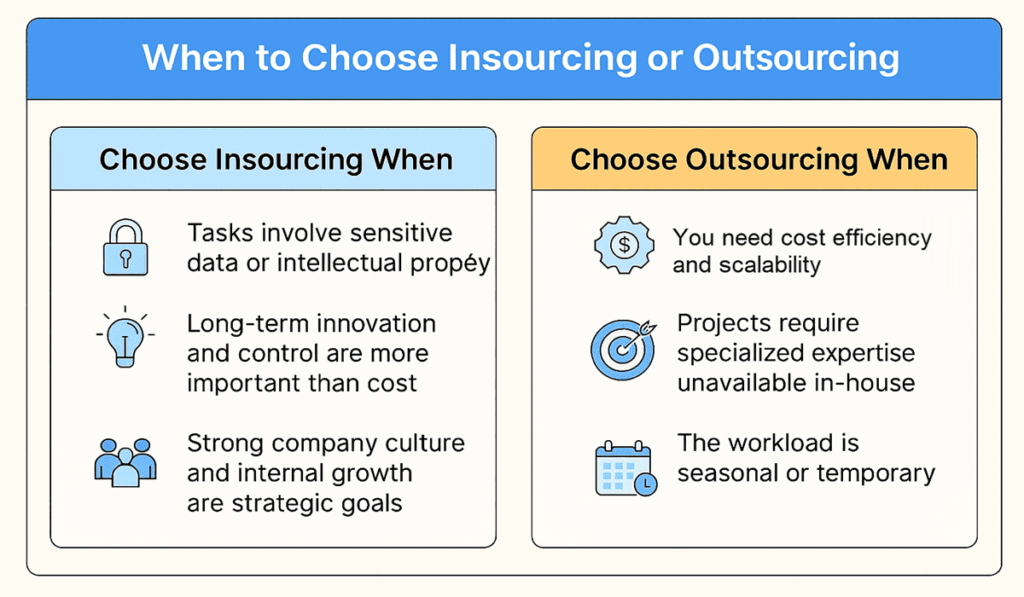
You can choose insourcing or outsourcing as follows:
6.1 Choose Insourcing When
You should consider insourcing when tasks involve sensitive data or intellectual property. Keeping work in-house ensures tighter security, better compliance, and direct oversight of confidential information.
Insourcing also works best when long-term innovation and control matter more than cost. Companies that want to build expertise internally and maintain direct influence over processes benefit from this approach.
If your company values a strong culture and wants internal growth as a strategic goal, insourcing supports it by encouraging collaboration and strengthening employee ownership of results.
6.2 Choose Outsourcing When
Outsourcing is ideal when you need cost efficiency and scalability. By hiring vendors, you reduce overhead costs and scale more quickly without incurring heavy investments in infrastructure.
It also makes sense when projects require specialized expertise that cannot be accessed internally. Outsourcing connects you with skilled professionals at a lower cost and with less effort.
Finally, if your workload is seasonal or temporary, outsourcing gives you flexibility. You can bring in external support when demand is high and scale down when it slows, keeping costs under control.
7. Hybrid Approach: Best of Both Worlds
Many businesses today use a hybrid approach that combines insourcing and outsourcing. This model offers the best of both strategies by balancing cost, speed, and control. Here, you keep essential functions in-house while outsourcing non-core tasks to experts.
For example, a bank may insource its core financial services to protect sensitive data and maintain customer trust. At the same time, it outsources IT support and marketing to specialized vendors. This allows the bank to focus on its strengths while reducing costs and gaining access to expert skills.
The hybrid approach is gaining popularity because it offers flexibility. It allows you to adapt to changing demands without giving up control over critical operations. You can protect your most important processes while still enjoying the scalability and efficiency of outsourcing. By combining both strategies, you can achieve better results, greater agility, and stronger long-term growth.
8. FAQ Section
Q1: What is the main difference between insourcing and outsourcing?
Insourcing utilizes in-house employees and resources, whereas outsourcing employs third-party vendors. The key difference lies in control, cost, and scalability levels.
Q2: Is insourcing more expensive than outsourcing?
Yes, insourcing usually involves higher upfront costs for staffing, infrastructure, and training. Outsourcing often reduces these expenses but sacrifices direct control.
Q3: What industries benefit most from outsourcing?
Industries with high scalability needs, seasonal work, or specialized expertise requirements benefit most, including IT, e-commerce, healthcare, and customer service sectors.
Q4: Can a company use both insourcing and outsourcing?
Yes, many companies use a hybrid model. They keep critical functions in-house while outsourcing tasks like IT support, logistics, or marketing campaigns.
Q5: How do I decide between insourcing and outsourcing?
Evaluate budget, goals, risks, and scalability. If you need control and stability, choose insourcing. If cost efficiency is a concern, outsourcing may be a better option.
9. Conclusion
Insourcing and outsourcing both offer unique strengths and challenges. Insourcing gives more control and long-term stability, while outsourcing provides cost savings and flexibility. The right choice depends on your business goals, budget, and industry needs. You may combine both in a hybrid model for balance.
By studying examples, weighing the pros and cons, and using a decision checklist, you can choose the model that best fits your needs. A smart approach ensures efficiency, growth, and long-term success in a competitive market.
Further Reading:
- What is Insourcing?
- What is Sourcing?
- Sourcing Vs Procurement
- What is the Procurement Process?
- 24 Essential Procurement KPIs You Can Use in Your Organization
Reference:

I am Mohammad Fahad Usmani, B.E. PMP, PMI-RMP. I have been blogging on project management topics since 2011. To date, thousands of professionals have passed the PMP exam using my resources.