Every construction project aims to finish on time and within budget. Yet many projects slip behind schedule, leading to disputes over compensation. When a contractor fails to meet the completion date, the contract may include a liquidated damages clause. This clause establishes a pre-agreed daily or weekly amount that the contractor must pay for late delivery. In contrast, unliquidated damages are not predetermined; a court decides the amount after a breach.
Understanding liquidated and unliquidated damages is essential for project managers, as delay claims can make or break a project’s profitability.
In this blog post, you’ll learn how liquidated and unliquidated damages work in construction contracts, why they matter to project managers, and how to handle them.
Understanding Liquidated Damages (LDs)
Liquidated damages (LADs, or Liquidated and Ascertained Damages, mostly in the UK) are a fixed amount the contractor agrees to pay the client if a project finishes late or otherwise breaches the contract. They serve several purposes:
- Certainty: The parties agree to a fixed upfront amount to avoid costly disputes later. There is no need to prove actual losses because the clause provides a pre-estimate of damage.
- Incentive: A realistic daily rate encourages the contractor to stay on schedule. The penalty must reflect a genuine pre-estimate of loss; otherwise, courts may treat it as a penalty and void it.
- Administrative simplicity: Once triggered, the owner can deduct LDs from progress payments without initiating separate litigation.
Example of Liquidated Damages
Imagine a university awarding a contract to build a new dormitory. The contract states that for every calendar day past the planned completion date, the contractor will pay the university KWD 1,000. This figure reflects the university’s estimated cost of renting temporary accommodation for students.
If the project runs 30 days late, the contractor pays KWD 30,000. The clause provides certainty and recovers estimated losses without incurring the expense of legal proceedings.
Risks of Getting LDs Wrong
Although useful, LD clauses must be carefully drafted. If the amount is excessive or lacks a genuine link to expected losses, a court could deem it a penalty and refuse to enforce it. Parties sometimes insert “NIL” or “n/a” into the liquidated damages rate field, thinking that leaves damages open for later.
In practice, this may mean there is no loss, depriving the owner of either liquidated or unliquidated damages. To avoid ambiguity, contracts should clearly state the rate and circumstances under which LDs apply or explicitly exclude liquidated damages and allow unliquidated damages.
Understanding Unliquidated Damages
Unliquidated damages (sometimes called general damages) are compensation decided by a court or tribunal after a breach. They apply when parties do not set a fixed amount. Unlike liquidated damages, unliquidated damages require the claimant to prove actual loss and that the loss was reasonably foreseeable at the time of contracting.
Example of Unliquidated Damages
Suppose a contractor completes a project eight weeks late, causing the client to postpone the opening of a shopping mall. If the contract does not contain a liquidated damages clause, the client must demonstrate the loss, such as lost rental income, to claim unliquidated damages. The court determines the amount based on evidence of actual losses and factors like foreseeability and causation.
Pros and Cons
- Flexibility: Unliquidated damages allow recovery of losses that could not have been anticipated at the time of contract execution. This is useful in complex projects where potential impacts are hard to estimate.
- Proof burden: The claimant must gather evidence of the loss and show that the breach caused it, which can be costly and time-consuming.
- Uncertainty: Until a court decides, neither party knows the final amount, making budgeting harder.
Comparing Liquidated and Unliquidated Damages
Both mechanisms aim to compensate owners when contractors breach a contract, but they operate differently. Liquidated damages offer certainty and administrative ease but can be struck down as punitive. Unliquidated damages allow recovery for unforeseen losses but require proof and litigation.
The table below highlights key differences:
| Feature | Liquidated Damages | Unliquidated Damages |
| Definition | Pre-agreed sum payable upon delay or breach | Court-assessed compensation based on actual loss |
| Calculation | Daily or weekly rate set in the contract | Determined after breach by evidence |
| Proof of loss | Not required; the clause serves as a pre-estimate | Required; claimant must prove losses and causation |
| Predictability | High; parties know the amount in advance | Low; amount depends on the court’s assessment |
| Flexibility | Limited to the agreed scope | Can cover unforeseen losses |
Visual Overview
The infographic below compares liquidated and unliquidated damages

The Impact of Project Delays on Costs and Schedules
Delays do more than inconvenience stakeholders; they erode profitability and strain relationships.
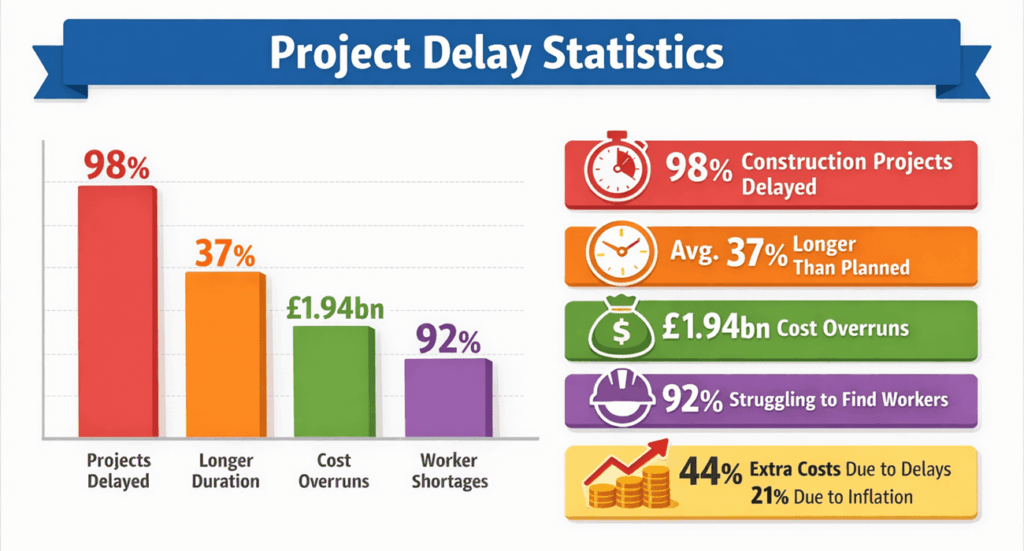
Recent reports underline the scale of the problem:
- Major capital projects in Northern Ireland: An analysis by the Strategic Investment Board (SIB) reported that cost overruns on eleven major capital projects totalled £ 1.94 billion, with an average delay of six years. The report warns that continued performance issues could add another £5 billion to project costs. It also notes that about 44% of additional costs in 2024 were attributable to delays, with 21% due to construction cost inflation.
- North American delays: A 2025 industry report found that 98% of construction projects in North America face delays, and average project durations run 37% longer than originally planned. Large projects typically run 20% behind schedule with budget overruns as high as 80%.
- Workforce shortages: The Associated General Contractors of America (AGC) and NCCER survey released in August 2025 found that 92% of contractors struggle to find qualified workers, and labour shortages have become a leading cause of project delays. Without enough skilled labour, even well-planned projects slip behind schedule and incur additional costs.
These statistics show that delay is not an isolated problem; it is systemic. Escalating costs, scarce labour, and complex processes mean most projects will face time overruns. As a project manager, you need strategies to mitigate delays and negotiate fair damage clauses.
FAQs
Q1. What is the difference between liquidated damages and a penalty clause?
A liquidated damages clause provides a genuine pre-estimate of loss; a penalty clause punishes the contractor. Courts enforce the former but often strike down the latter.
Q2. Can I claim unliquidated damages if the contract has a liquidated damages clause?
Usually no. If the contract contains an applicable liquidated damages clause, the owner cannot disregard it and claim unliquidated damages instead.
Q3. How do I set the right liquidated damages rate?
Base it on a realistic estimate of losses, such as rent, financing costs, or user inconvenience. Document your reasoning and avoid arbitrary figures.
Q4. What happens if I insert ‘NIL’ for liquidated damages?
Writing “NIL” or “n/a” may imply there is no loss, making it hard to claim any damages later. Clearly state whether unliquidated damages apply instead.
Q5. Are damages affected by labour shortages?
Yes. Surveys show that 92% of contractors struggle to find workers, and labour shortages are a leading cause of delays. Without labour, even well-planned projects can slip behind schedule.
Summary
Both liquidated and unliquidated damages play a key role in managing project delay risks. Liquidated damages provide cost certainty and help project managers manage time overruns without protracted disputes. Unliquidated damages offer flexibility when losses cannot be predicted in advance. Choosing the right approach depends on project complexity, risk profile, and stakeholder expectations. Clear contracts, realistic schedules, and proactive monitoring remain essential for reducing delays, avoiding disputes, and protecting project outcomes.

I am Mohammad Fahad Usmani, B.E. PMP, PMI-RMP. I have been blogging on project management topics since 2011. To date, thousands of professionals have passed the PMP exam using my resources.