You may want your team to generate fresh ideas, but you aren’t sure which leadership style encourages innovation. Participative and servant leadership offer two paths. Both invite employees to contribute, but they do so in different ways. Understanding these differences and how psychological empowerment links them to innovative work behaviour (IWB) can help organisations create more supportive cultures.
Innovative work behavior refers to the deliberate actions employees take to develop and implement new ideas to benefit the organization.
This blog post compares participative and servant leadership and explains why empowering employees is critical for innovation.
What is Participative Leadership?
Participative leadership, sometimes called democratic leadership, involves employees in decision-making. Leaders invite team members to share ideas, discuss options, and help determine the best course of action. Research shows that participative leaders encourage creativity by providing space for members to generate and promote new ideas.
Such leaders facilitate collaboration and allow employees to experiment and learn from failure. When employees see their suggestions valued, they gain confidence and take more risks. Participative leadership influences members’ decision-making and builds self-confidence, which in turn encourages innovative work behaviour.
How Participative Leadership Boosts Innovation
- Shared decision-making: Involving team members in decisions gives them a sense of ownership and accountability. This shared ownership encourages them to propose and test new ideas.
- Open communication: Participative leaders listen to different viewpoints and create a safe space for debate. This openness leads to creative problem-solving.
- Support for experimentation: By encouraging experimentation and learning from failure, participative leaders reduce the fear of making mistakes. Employees become more willing to suggest novel approaches.
Of course, participative leadership is not a quick fix. It requires time and a culture that values dialogue. In fast-paced environments, it may slow down decision-making. Yet when leaders invest in participation, they often see higher morale and more innovative ideas.
What is Servant Leadership?
Servant leadership flips the conventional view of the leader’s role. Instead of exercising power from the top, servant leaders prioritise the needs and growth of their team. They act as mentors, offering guidance, listening to concerns, and removing obstacles. Servant leaders focus on empowering members through support and trust. They create environments where employees feel valued, trusted, and free to take risks.
Recent research supports this view. A study of 375 employees in three Iraqi telecommunications companies found that servant leadership positively relates to employee performance, and organisational trust transmits this effect. In other words, when employees trust their leader, they perform better. Servant leaders build trust by listening, encouraging autonomy, and prioritising development.
How Servant Leadership Encourages Innovation
- Empowerment and trust: Servant leaders empower employees by delegating authority and trusting them to make decisions. This trust increases their willingness to explore new ideas.
- Mentorship: As mentors and servant leaders, they help employees develop skills and overcome challenges. Supportive mentorship boosts confidence and innovative thinking.
- Ethical focus: Servant leaders model ethical behaviour and put the team’s interests above their own. This fosters a sense of community and shared purpose.
Psychological Empowerment: The Bridge to Innovation
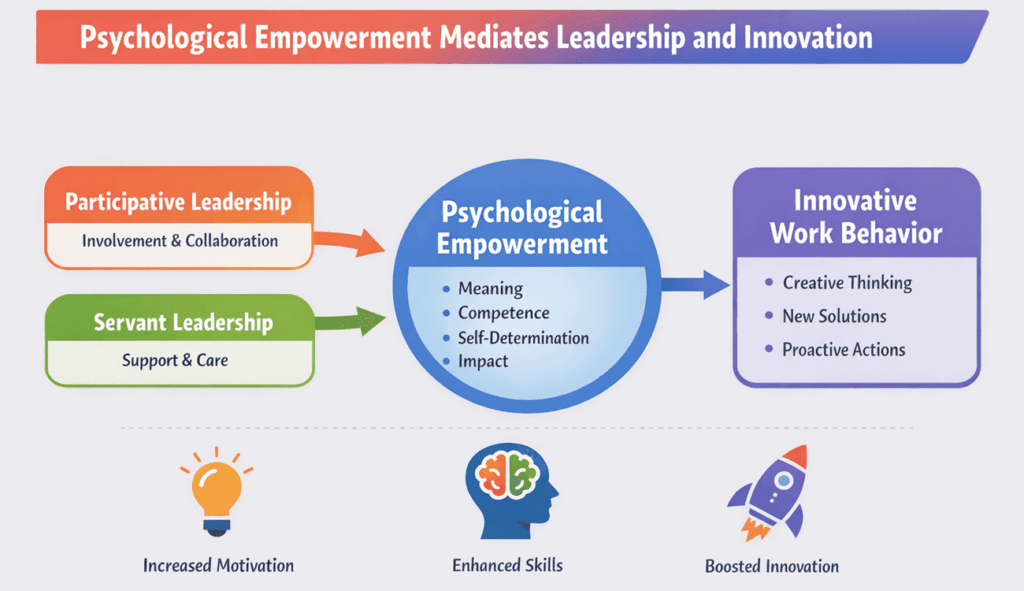
Psychological empowerment refers to a person’s perception of meaning, competence, autonomy, and impact in their work. Psychological empowerment strengthens the relationship between servant leadership and innovative work behaviour. When employees feel empowered, they believe their work matters and that they have control over how it is done. This sense of ownership fuels creativity and persistence.
Components of Psychological Empowerment
- Meaning: Employees understand and care about how their tasks contribute to organisational goals.
- Competence: They feel capable of performing their work well and continuously improving.
- Autonomy: They have the freedom to decide how to approach tasks.
- Impact: They believe their actions influence outcomes and are recognised by the organisation.
Participants in the original study reported higher innovative behaviour when they experienced these four elements. Servant leaders often enhance psychological empowerment by providing meaningful work, opportunities for skill development, autonomy, and recognition.
Key Differences Between Participative and Servant Leadership
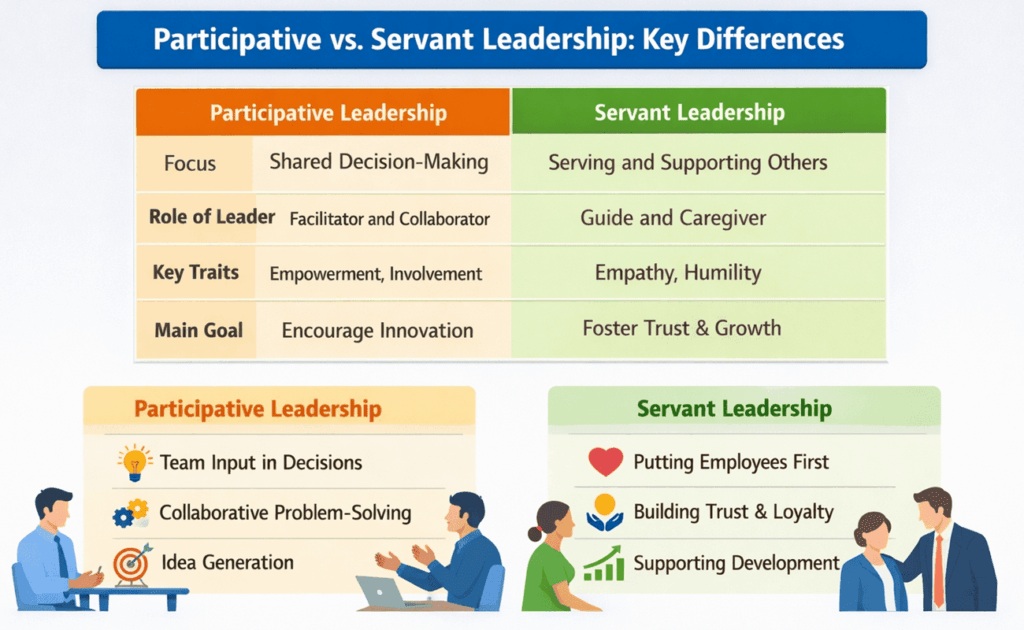
Participative leaders share power and encourage team involvement in decisions. Servant leaders focus on serving their team by mentoring and supporting them. Both styles value employee input, but their emphasis differs: participative leadership centres on collaboration in decision-making, whereas servant leadership prioritises individual growth and well-being.
Integrating the Styles: A Balanced Approach
Are participative and servant leadership mutually exclusive? Not at all. Many effective leaders blend these styles. For example, a manager might invite team members to brainstorm solutions (participative) and then coach individuals as they implement their ideas (servant). By combining shared decision-making with personal support, leaders create a culture where employees feel both heard and valued. This integrated approach strengthens psychological empowerment and stimulates innovation.
An integrated model can be visualised by the following diagram:
Practical Steps to Empower and Innovate
Leaders can adopt several practices to encourage innovation:
- Encourage open dialogue. Hold regular meetings where employees share ideas without fear of criticism. Rotate the meeting chair so everyone has a voice.
- Provide autonomy. Assign projects with clear goals but allow team members to choose methods. Autonomy signals trust and boosts psychological empowerment.
- Offer mentorship. Pair seasoned employees with newer ones to exchange knowledge. Mentorship develops competence and fosters servant-like support.
- Align goals. A workplace trends report shows that employees are 3.2-times more likely to be engaged when their performance goals align with organizational goals. Set mutually agreed-upon goals to increase engagement and innovation.
- Feedback culture. Less than half of employees feel their feedback is taken seriously. Implement regular feedback loops and visibly act on suggestions.
FAQs
Q1. What is the main difference between participative and servant leadership?
Participative leadership focuses on involving employees in decision-making, while servant leadership emphasises supporting and developing employees. Both encourage innovation, but through different mechanisms.
Q2. How does psychological empowerment affect innovation?
When employees perceive meaning, competence, autonomy, and impact in their roles, they are more likely to generate and implement new ideas.
Q3. Can a leader use both styles?
Yes. Effective leaders often blend participative and servant approaches, involving employees in decisions and mentoring them through challenges. This combination enhances trust and creativity.
Q4. Are there risks to participative leadership?
Excessive consultation can slow decisions. Leaders need to balance inclusiveness with timely action.
Q5. Why is trust important?
Trust mediates the link between servant leadership and performance. Employees perform better when they trust their leaders.
Summary
Participative and servant leadership both support innovation, but in different ways. Participative leaders involve employees in decisions and encourage them to share ideas. Servant leaders focus on supporting, mentoring, and empowering their teams. Both styles help employees feel valued and confident in their work. When employees feel trusted and empowered, they are more willing to create and apply new ideas. Organizations that combine participation with strong support often build engaged teams, stronger collaboration, and a culture that encourages continuous innovation.

I am Mohammad Fahad Usmani, B.E. PMP, PMI-RMP. I have been blogging on project management topics since 2011. To date, thousands of professionals have passed the PMP exam using my resources.