Project management is about turning ideas into results. When you earn the Project Management Professional (PMP) certification, you show employers that you can lead teams, manage risk, and deliver on time. Many professionals in Washington, DC are exploring this credential.
In this blog post, you will learn what the PMP certification is, why it matters, and how to meet the 35-hour education requirement. You will also find tips on choosing a course, an overview of job prospects and salary information, and answers to common questions.
By the end, you will know how to start your PMP journey and which training program can help you achieve your goals.
Let’s get started.
Why Pursue the PMP Certification?
The PMP certification is recognized worldwide. It demonstrates that you have mastered a broad set of skills in planning, executing, and closing projects. Employers value this credential because certified professionals have proven that they can manage budgets, schedules, and teams across industries.
The certification also leads to higher pay. According to the Project Management Institute (PMI), professionals in the United States who hold the PMP credential earn a median salary of $135,000, while non-certified peers earn about $109,157. That is a nearly 24 percent difference. Earning the certification can provide both short-term and long-term gains: PMI’s 2025 salary survey found that people with more than ten years of experience as a certified PMP reported a median salary of $173,000, compared with $123,000 for those certified for less than five years.
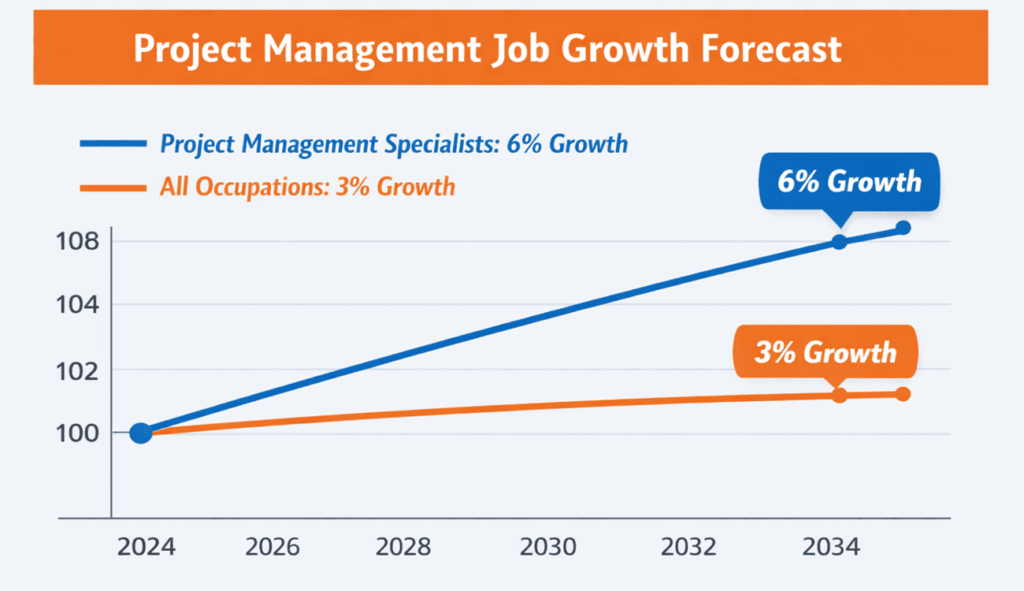
The appeal of the PMP goes beyond salary. Employers across health care, government, technology, and construction need project leaders who understand agile and predictive methods. The demand for project management specialists is growing; the U.S. Bureau of Labor Statistics (BLS) projects that employment in this field will rise 6 percent between 2024 and 2034. That is faster than the average for all occupations, translating into roughly 78,200 new openings each year.
As organizations adapt to technology shifts and tackle complex initiatives, they need people who can keep projects on track. The PMP credential positions you to take advantage of those opportunities.
Understanding the PMP Exam and Education Requirements
To apply for the PMP exam, you need experience in project work and at least 35 hours of formal project management education. The exam itself tests your knowledge of business environments, people skills, and process management. It consists of 180 questions covering traditional, agile, and hybrid approaches. You have 230 minutes to complete the test, which includes both multiple-choice and multiple-response questions.
Meeting the 35-hour education requirement is a common hurdle. Some people attend intensive boot camps held over four days in a classroom. Others prefer weekend sessions or evening classes. Many busy professionals opt for an online program that allows them to learn at their own pace while juggling work and family commitments. The key is to choose a course that is comprehensive, up to date, and taught by experienced instructors.
Job Outlook and Salaries for Project Managers
Washington, DC, is home to federal agencies, technology firms, and nonprofits that rely on skilled project leaders. While local salaries vary, national data offer a useful benchmark. The BLS reports that the median annual wage for project management specialists was $100,750 in May 2024. That is more than double the national median for all occupations, which stood at $49,500. Pay can climb even higher in sectors like finance and insurance, where the median reaches $111,350.
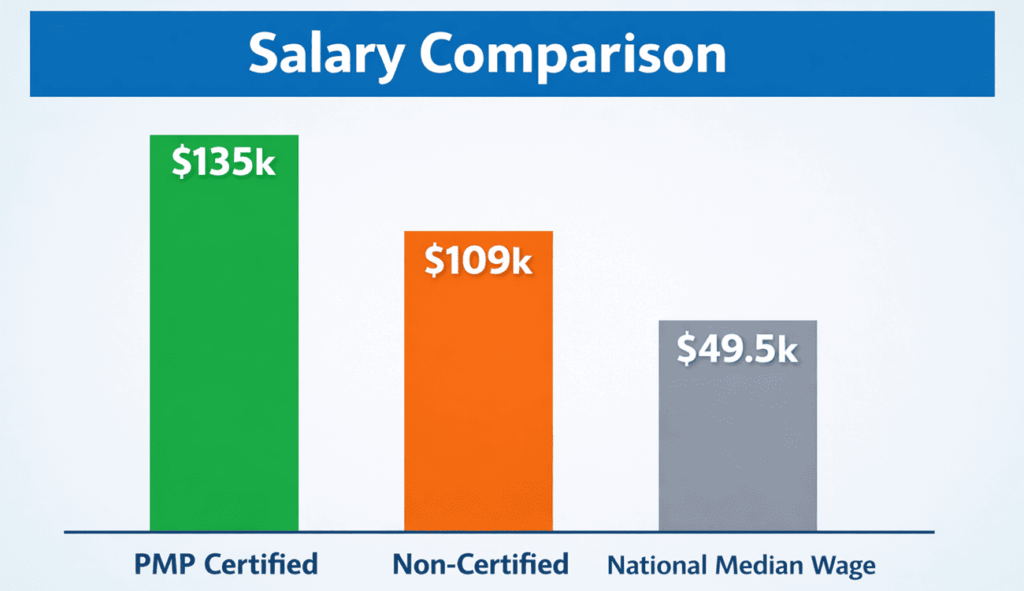
When you pair these wages with the higher earnings that come from holding the PMP certification, the financial case for becoming a credentialed project manager is compelling.
The growth outlook is equally encouraging. As the BLS notes, employment of project management specialists is expected to expand by 6 percent from 2024 to 2034. At the same time, PMI’s research warns that the world may need up to 30 million more project professionals by 2035. These numbers highlight a widening talent gap.
Organizations in Washington, DC, and beyond will be looking for certified professionals to fill critical roles in healthcare, information technology, renewable energy, and government contracting. Preparing now positions you to take advantage of those openings.
Choosing the Right PMP Certification Training Program in Washington DC
Not all training programs are created equal. Some providers focus on fulfilling the minimum requirements without offering enough practice or support. Others offer only video lectures with no interaction. When searching for a course, consider the following:
- Comprehensive content: Look for lessons that cover all process groups and agile methods included in the latest PMP exam content outline. A well-structured course should explain the underlying concepts, not just provide memorisation tricks.
- Practice opportunities: High-quality practice questions and mock exams are essential. They help you identify areas where you need more study and build your test-taking stamina.
- Instructor support: Being able to ask questions and get feedback can make a big difference. Experienced instructors can clarify confusing topics and share practical tips.
- Flexibility: Busy professionals often need a self-paced option that fits around work and family. A course with downloadable materials and mobile access lets you study when it suits you.
Spotlight on a 35-Contact-Hours PMP Training Program
One training program that meets these criteria is the 35-Contact-Hours PMP Training Program offered by PM Sprout. This online course is designed to align with the 2026 exam content outline and combines video lessons, text explanations, and interactive practice tools. Here are some reasons students have found it helpful:
- Video Sessions: The program includes clear and concise video modules that walk through the principles of project management. They cover predictive, agile, and hybrid methodologies.
- Formula Guide: Many exam questions involve calculations. The course provides a detailed formula guide with over 85 examples to make math questions less intimidating.
- True/False Statements and Flashcards: These tools help reinforce key concepts and definitions. They are especially useful for learners who prefer quick review sessions.
- Practice Questions and Mock Test: You will have access to 360 practice questions and a full-length mock exam aligned with the seventh edition of the PMBOK Guide. This practice helps you gauge your readiness and improves confidence.
- Instructor Support and Forum: The course creator is an experienced project manager who engages with students through discussion forums and email. You can ask questions and get personalized feedback.
Because the program is online, you can study from anywhere. This is ideal for professionals in the DC area who may travel frequently or work irregular hours. The course remains accessible for a full year, so you can revisit lessons and practice whenever you need.
Preparing for PMP Success in Washington, DC
Living in the nation’s capital offers unique advantages and challenges. Many organisations in and around Washington, DC require security clearance, which can add to your timeline for starting a new role. Having the PMP certification already on your résumé can set you apart when applying for positions with government contractors or federal agencies. Additionally, the region hosts various PMI chapter events and networking opportunities. Attending local meetups can help you build relationships, find study partners, and learn from certified professionals.
If you prefer in-person learning, Washington offers multiple classroom options. These often run as four-day intensive boot camps or weekend sessions. Before enrolling, ask about the class size, instructor credentials, and post-course support. Make sure the course includes the 35 contact hours certificate you need for your exam application. However, for many busy professionals, an online course like PM Sprout’s provides greater flexibility without sacrificing quality.
Study Tips for Passing the PMP Exam
Passing the PMP exam requires dedication and a structured approach. Here are strategies that successful candidates use:
- Create a study plan: Estimate how much time you can commit each week and map out your study schedule. Break topics into manageable segments and set milestones.
- Focus on understanding, not memorisation: The exam tests your ability to apply concepts. Use practice questions to check your understanding and avoid rote learning.
- Use multiple learning methods: Combine reading, video lessons, flashcards, and practice tests. Switching methods helps reinforce information and keeps you engaged.
- Join a study group or forum: Talking through concepts with others can reveal gaps in your knowledge. Online forums linked to courses like PM Sprout’s can connect you with peers.
- Take a full-length mock exam: Simulate test day by taking a timed mock exam in one sitting. Review your results to identify weak areas and refine your strategy.
FAQs
Q1. What are the eligibility requirements for the PMP certification?
You need either a four-year degree plus 36 months of project leadership experience, or a secondary degree plus 60 months of experience. In both cases, you must complete 35 hours of project management education.
Q2. Has the PMP exam changed for 2026?
Yes. The exam content outline was updated in late 2025 to reflect new trends in agile methods and hybrid approaches. The PM Sprout training program is aligned with this 2026 exam outline.
Q3. How long should I study for the PMP exam?
Most candidates spend three to four months preparing. The exact time depends on your experience level and how many hours per week you can dedicate to studying.
Q4. Do I need to take an in-person course to earn my 35 contact hours?
No. Online courses that meet PMI’s quality standards, such as the PM Sprout program, satisfy the 35-hour requirement. You can complete the training at your own pace.
Q5. Can I retake the PMP exam if I fail?
Yes. PMI allows you up to three attempts within one year of your application approval. Each attempt requires an exam fee, so thorough preparation is crucial.
Summary
Earning your PMP certification in Washington, DC can transform your career. The credential proves your leadership skills, strengthens your resume, and increases your earning potential. With strong job growth and rising demand for certified professionals, now is a smart time to act. Choose a flexible 35-contact-hour training program that fits your schedule and prepares you for the 2026 exam. Stay focused, follow a clear study plan, and take the next confident step toward PMP success.
To meet the 35-hour education requirement and prepare effectively, choose a training program that offers comprehensive content, practice questions, and support. The PM Sprout 35 Contact Hours PMP Training Program delivers these elements through flexible online learning, making it a valuable option for busy professionals. With careful planning and the right resources, you can pass the exam and advance your career as a certified project manager.

I am Mohammad Fahad Usmani, B.E. PMP, PMI-RMP. I have been blogging on project management topics since 2011. To date, thousands of professionals have passed the PMP exam using my resources.