Matrix organizations have become common in today’s global business world. In this setup, team members work across departments, and employees often report to more than one leader. For a project manager in a matrix organization, this creates both opportunities and challenges.
You must balance priorities, coordinate shared resources, and communicate with multiple stakeholders. While this model improves collaboration and flexibility, it can also lead to conflicts and unclear authority. Understanding how to navigate this environment is essential to deliver successful projects and build strong, aligned teams.
Key Takeaways
- Dual reporting is the norm. In matrix organizations, you answer to a functional manager and a project manager. Clear communication keeps those relationships healthy.
- A matrix blends functional and project teams. This structure allows people from different departments to tackle the same project, making the most of shared skills and knowledge.
- Flexibility comes with trade-offs. Shared resources and cross-functional teams help projects move quickly, but may lead to resource conflicts and ambiguous authority.
- Strong people skills are essential. Successful project managers build trust, negotiate priorities, and maintain open lines of communication.
- Ongoing learning pays dividends. Continual development of leadership, emotional intelligence, and organizational skills helps you thrive in this dynamic environment.
Matrix Vs Functional Organizational Structure
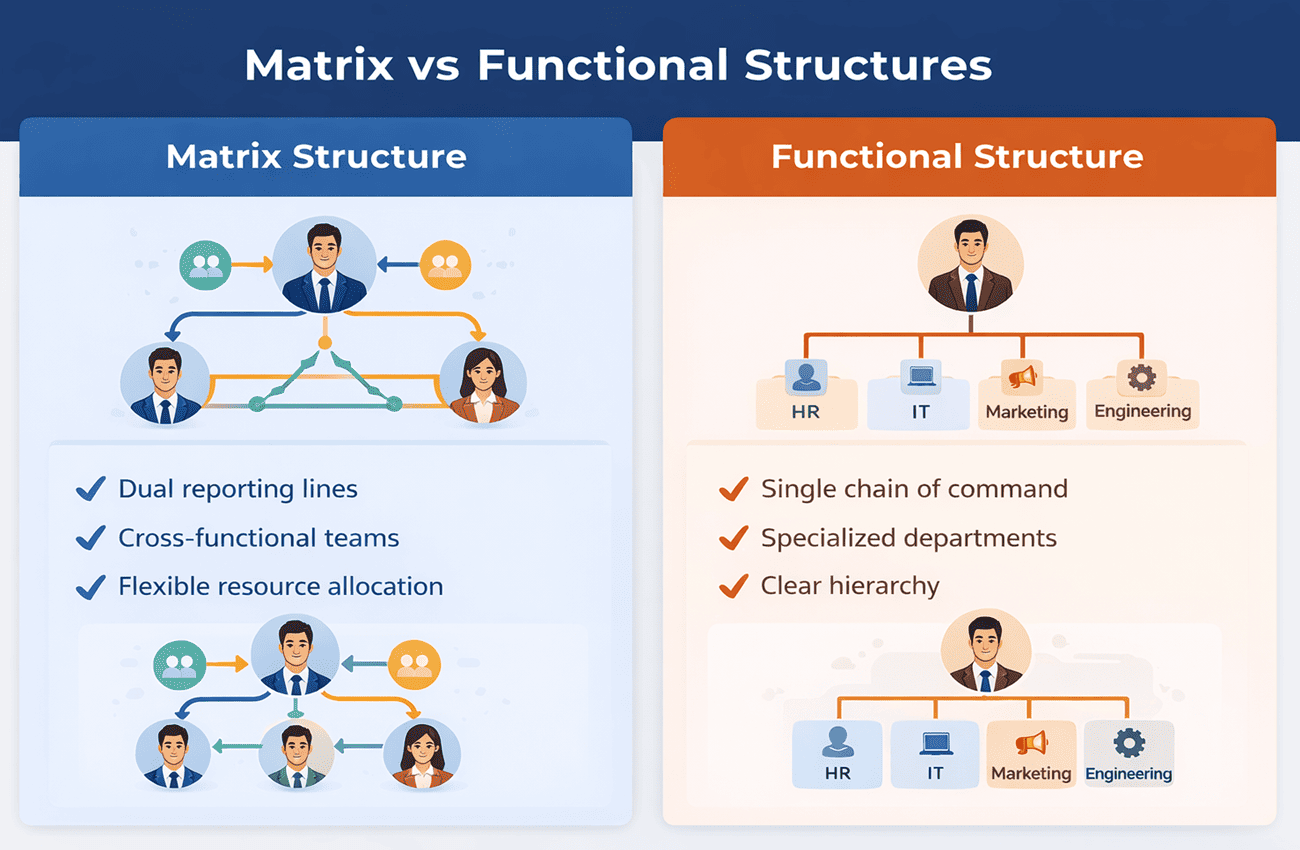
A traditional functional organization resembles a pyramid. Employees belong to departments like finance or marketing and report to a single chain of command. This approach makes roles clear and preserves specialization. In contrast, a matrix organization overlays a project structure on top of the functional hierarchy.
Employees continue to report to their department heads but also receive direction from project managers, who form cross-functional teams. This dual system allows companies to combine resources from different areas without reorganizing the entire business.
Why does this matter for project managers? In a matrix structure, you must align objectives across two chains of command. You need to understand how functional priorities affect your project and vice versa. This juggling act can be stressful, but it also gives you access to talent beyond a single department, which is invaluable for complex projects.
Types of Matrix Organizations
Not all matrix structures grant the same level of authority to project managers. Experts categorize them as weak, balanced, or strong:
- Weak matrix: Functional managers hold most of the power. Project managers act as coordinators and have little control over staffing or decisions.
- Balanced matrix: Functional and project managers share authority. They collaborate on resourcing, performance analysis, and prioritization.
- Strong matrix: Project managers have greater authority. They assign resources, manage budgets, and make key decisions while functional managers focus on skill development.
Understanding which model your organization follows will shape how you plan work, allocate resources, and communicate with leaders. In weaker matrices, negotiate with department heads early so you know when people are available. In stronger matrices, build a shared vision across departments to align priorities. Balanced matrices demand robust communication and conflict-resolution skills.
Benefits of Matrix Organizations
Why embrace a matrix at all? Research shows several advantages:
- Shared knowledge and skills. Bringing people from different departments together allows them to exchange expertise. Employees move between projects, which promotes continuous skill development and aligns people across the company.
- Better decisions through collaboration. Cross-functional teams encourage open communication. Leaders receive perspectives from both project and functional viewpoints, resulting in more informed choices.
- Efficient resource use. Companies can share a pool of resources across multiple projects rather than hiring new staff for every initiative. This flexibility helps manage costs and respond quickly to changing priorities.
- Employee engagement and retention. Participating in diverse projects gives team members more opportunities for growth and feedback. This variety can increase morale and encourage people to stay with the company.
- Flexibility in resource allocation. With access to a shared talent pool, project managers can reassign team members to meet new demands quickly.
Challenges in Matrix Organizations
Every advantage carries a cost. Matrix structures can introduce the following challenges:
- Resource conflicts. Sharing people across projects means that managers may compete for the same skills. Without proper coordination, this leads to delays and frustration.
- Role ambiguity and conflicting priorities. When employees report to two managers, they may receive contradictory directions. Defining clear responsibilities helps reduce confusion.
- Performance evaluation difficulties. Assessing an employee’s contributions can be tricky when they work under multiple leaders.
- Slower decision-making. More stakeholders mean more opinions. Decisions may take longer because managers must consult with one another and reach consensus.
- Administrative overhead. Maintaining two reporting lines requires additional coordination. Meetings, status updates, and shared tools are essential to keep everyone aligned.
Best Practices for Project Managers in a Matrix Environment
Being effective in a matrix is about relationships and communication. Here are practical tips:
Understand each person’s role
Start by learning what each team member does within their functional unit. Knowing their expertise, workload, and reporting lines helps you assign tasks wisely. It also shows respect for their primary responsibilities.
Build trust across departments
You will work closely with functional managers. Schedule regular meetings to discuss priorities, resource needs, and potential conflicts. A strong relationship makes it easier to negotiate for talent and resolve issues before they grow.
Create opportunities for team cohesion
Matrix teams often include people who have never worked together. Encourage informal introductions and team-building activities. Even a short virtual coffee break can help colleagues connect and feel part of a unified project.
Communicate expectations clearly
Explain your project’s goals, timelines, and deliverables. Acknowledge that team members may be juggling multiple assignments. Ask what other commitments they have so you can plan around them. If priorities change, update everyone promptly and seek input.
Coordinate with functional managers
Thank the functional leaders for allowing their staff to work on your project. Keep them informed about progress and recognize their employees’ achievements. When assignments conflict, discuss solutions together rather than making unilateral decisions. Consider using a regular planning cycle for resource allocation; some experts suggest starting with a monthly cadence and adjusting as needed.
Use the right tools
Shared project management software or resource planning tools help track assignments, availability, and progress. These tools create transparency and prevent double-booking. A unified dashboard also streamlines reporting to both functional and project leaders.
Develop soft skills
Successful project managers in matrix environments rely on emotional intelligence. Active listening, empathy, and conflict resolution skills are as important as scheduling or budgeting. Take classes on influencing without authority, communication, or leading dispersed teams to strengthen these abilities.
Training and Skill Development
Continuous learning helps you adapt to the complexities of matrix management. Consider enrolling in courses that broaden your leadership and communication abilities:
- Project Management Fundamentals: Provides a foundation in the processes, tools, and techniques for effective project delivery.
- Project Management in Practice: Focuses on applying principles in real-world situations, including navigating matrix environments.
- Influencing Without Authority: Teaches how to persuade and lead when you don’t have formal power.
- Accelerated Team Building: Offers strategies for creating cohesive teams quickly.
- Emotional Intelligence: Enhances your ability to manage relationships and understand others’ perspectives.
- Leading Dispersed Teams: Covers best practices for remote collaboration and communication.
These courses can help you build the confidence and competence required to thrive in any organizational structure.
FAQs
Q1. What is a matrix organizational structure?
It’s a system in which employees report to both a functional manager and a project manager, forming cross-functional teams for specific projects.
Q2. How is a weak matrix different from a strong matrix?
In a weak matrix, functional managers hold most of the authority. In a strong matrix, project managers have more control over decisions and resource allocation.
Q3. What are the biggest benefits of matrix organizations?
They promote collaboration, allow efficient use of shared resources, and support continuous skill development for employees.
Q4. Why do matrix organizations face resource conflicts?
Because team members work on multiple projects, managers compete for the same people or skills, leading to scheduling conflicts and overlapping assignments.
Q5. How can project managers succeed in a matrix environment?
Build strong relationships with functional managers, communicate clearly, coordinate resource planning cycles, and develop soft skills like emotional intelligence to influence without authority.
Summary
Working as a project manager in a matrix organization requires balance, clarity, and strong communication. While dual reporting and shared resources can create challenges, they also offer opportunities for collaboration and growth. By building trust, aligning priorities, and managing conflicts effectively, project managers can succeed in this dynamic environment. With the right skills and mindset, a matrix structure becomes not just manageable but a powerful way to deliver successful projects and drive organizational value.

I am Mohammad Fahad Usmani, B.E. PMP, PMI-RMP. I have been blogging on project management topics since 2011. To date, thousands of professionals have passed the PMP exam using my resources.