Project quality management plays a critical role in delivering successful projects in every industry. It helps project teams meet customer expectations, reduce costly errors and improve overall project performance. In today’s competitive environment, organizations must focus on quality planning, quality assurance and quality control to stay competitive. Strong quality management practices also improve communication, teamwork and stakeholder trust.
This blog post explains the core principles, processes, tools and real-world examples of project quality management in simple terms. You will also learn how modern technologies, including AI-powered tools, support continuous improvement and help teams identify risks before they become serious problems.
By understanding these concepts, you can deliver consistent, high-quality results while saving time, reducing waste and increasing customer satisfaction.
Let’s get started.
Key Takeaway
- Project quality management combines quality planning, quality control and quality assurance to meet customer needs.
- Focus on customer satisfaction, prevention over inspection and continuous improvement.
- A quality management plan outlines the processes, metrics and responsibilities needed to deliver quality results.
- Quality management applies across industries, from construction to IT and involves tools like network diagrams, affinity diagrams and matrix charts.
Why Quality Management Matters Today
Quality management is important because it helps organizations deliver reliable products and services that meet customer expectations. It reduces errors, prevents costly rework and improves overall efficiency. When teams follow quality management practices, they can identify problems early and solve them before they affect the final deliverable. This saves time, money and resources.
Strong quality management also increases customer satisfaction, builds trust and strengthens a company’s reputation in the market. In project management, it helps teams maintain consistent standards, improve communication and achieve better project outcomes. Quality management supports continuous improvement by encouraging teams to review processes and learn from mistakes.
Organizations that focus on quality are more likely to improve performance, retain customers and achieve long-term success while reducing operational risks and waste.
What Is Project Quality Management?
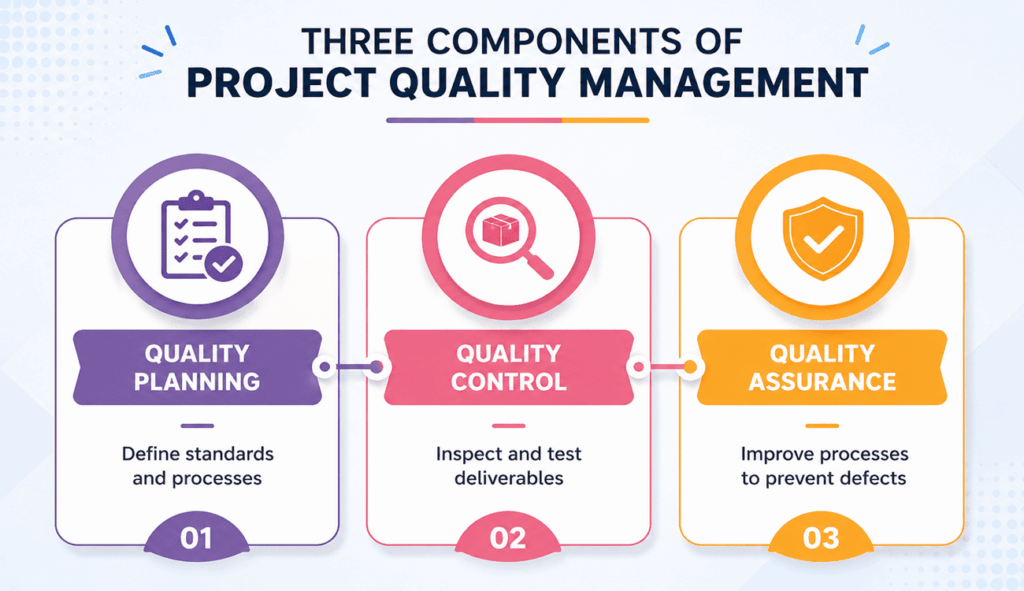
In project management, quality is whatever the customer or stakeholder needs from the deliverables. Project quality management is the process of defining standards for the work and ensuring those standards are met. It blends three disciplines:
- Quality planning – Decide how to meet requirements and document procedures and metrics.
- Quality control – Inspect deliverables, test outputs and report on results.
- Quality assurance – Improve processes, perform audits and ensure procedures support quality.
These activities support each other. Planning sets the direction, control checks the work and assurance improves the system. Together, they help teams deliver consistent outcomes even when projects are complex or distributed.
Customer Satisfaction
Quality begins with customers. A deliverable can meet technical specifications yet still fail if the customer’s experience is poor. Engage stakeholders early, gather feedback often and adjust as needed. Schedule regular check-ins to make sure the work meets expectations.
Prevention Over Inspection
Fixing problems after delivery is expensive. The cost of quality includes both conformance costs (training, documentation, and testing) and non-conformance costs (rework, warranties, and lost business). Invest in prevention, such as clear requirements, training and process checklists to avoid failure costs. In software, for example, catching a bug during planning is far cheaper than fixing it after release.
Continuous Improvement
Teams can always get better. Continuous improvement is a method of making small, incremental changes that reduce waste and increase value. Track lessons learned, adjust processes and celebrate when changes lead to better outcomes.
Creating a Quality Management Plan
You don’t need a lengthy document to manage quality, but you do need a plan. You can follow these steps to develop one:
- Define quality requirements. Meet with stakeholders to clarify what quality means for each deliverable. List measurable criteria and prioritize them.
- Select metrics and standards. Choose simple indicators, such as defect rates, cycle times or customer satisfaction scores. Reference industry standards when they exist (for example, ISO 9001 for manufacturing or IEEE standards for software).
- Assign roles and responsibilities. Decide who performs inspections, who approves results and who resolves issues. Document who owns each step so nothing falls through the cracks.
- Plan quality control activities. Schedule reviews, testing and acceptance criteria. Use checklists and templates to ensure consistency.
- Plan quality assurance activities. Identify process audits, training sessions and continuous improvement meetings. Keep the process lean so it doesn’t become a burden.
- Document and share. Write the plan in clear language, include contact details and store it somewhere accessible. Update it when requirements change.
Industry Examples of Project Quality Management
Quality management applies to nearly every industry. Here are a few examples taken from real-world projects:

- Construction: Infrastructure projects prioritize structural integrity and safety. Teams follow building codes, perform regular inspections and document results to ensure compliance with local regulations.
- Manufacturing: Electronics manufacturers use lean methods and Six Sigma to reduce defects and improve process efficiency. Quality engineers test components and track failure rates to spot trends.
- Professional services: Consulting firms rely on service-level agreements (SLAs) that define deliverables, timelines and expected outcomes. Managers train consultants to meet consistent standards and regularly review client feedback.
- IT projects: Software teams focus on service quality and customer satisfaction. They use quality management systems and SLAs to monitor performance and quickly resolve issues.
Tools and Techniques
Many tools can help manage quality. Here are some common options:
- Network diagrams map out project tasks and dependencies. They show how deliverables relate to one another and help identify risks.
- Affinity diagrams group ideas, requirements or data into categories. They help teams prioritize quality considerations and organize feedback.
- Matrix diagrams establish relationships between deliverables and quality criteria. Use them to ensure each requirement is addressed by specific tasks.
- Process decision program charts highlight what could go wrong and how to mitigate it. They’re helpful for brainstorming potential failure modes and developing countermeasures.
- Interrelationship diagrams illustrate cause-and-effect relationships between factors that influence quality. They assist teams in focusing on root causes rather than symptoms.
A simple spreadsheet or project management tool can also be effective. Choose tools that fit your team’s size, complexity and budget. The goal is to make quality tasks visible and manageable.

Leveraging AI for Quality Management
Artificial intelligence can augment human judgment without replacing it. Many project management tools now include AI assistants that analyze risk factors, predict schedule slips and suggest corrective actions. In 2024, more than half of the project managers surveyed used AI to manage risks.
You might use AI to scan test results, flag anomalies or generate status summaries. Be sure to validate AI recommendations with human expertise and maintain transparency about how algorithms make decisions. Over time, AI can help teams uncover hidden patterns and improve processes.
FAQs
Q1. What is the difference between quality assurance and quality control?
Quality assurance improves the processes used to create deliverables, while quality control checks the deliverables themselves. Both are necessary to achieve consistent outcomes.
Q2. How do I choose quality metrics?
Select metrics that reflect customer requirements and are easy to measure. Use a mix of quantitative indicators, like defect counts or cycle time, and qualitative feedback, such as satisfaction surveys.
Q3. When should I involve stakeholders in quality discussions?
Engage stakeholders early during quality planning and keep them informed through regular reviews. Their feedback helps ensure the deliverable meets their needs.
Q4. Can small teams benefit from quality management?
Yes. Even one-person projects can improve outcomes by setting clear standards, documenting workflows, and reviewing results. Start simple and adapt as the project grows.
Summary
Project quality management helps you deliver consistent, reliable and customer-focused results. By combining quality planning, quality assurance and quality control, organizations can reduce risks, avoid costly rework and improve stakeholder satisfaction. Strong quality practices also support better teamwork, clearer communication and continuous improvement throughout the project life cycle. As projects become more complex, using the right tools, processes and quality standards is more important than ever. Project management teams that prioritize quality build trust, improve performance and achieve long-term project success.

I am Mohammad Fahad Usmani, B.E. PMP, PMI-RMP. I have been blogging on project management topics since 2011. To date, thousands of professionals have passed the PMP exam using my resources.