
Return on Investment, or ROI, shows how much profit or loss you earn compared with the money you invested. It is a simple, percentage-based metric, making it easy to use when comparing projects, campaigns, equipment purchases, or business decisions. ROI is calculated by dividing the net benefit by the initial cost, then multiplying by 100. Because it is simple and fast, many professionals use ROI for quick financial evaluation. One thing to remember is that ROI does not consider the timing of cash flows, unlike NPV.
That is where an ROI calculator helps. You enter the investment cost, the return amount, and the tool gives you the result instantly. This saves time and reduces manual errors.
Return on Investment (ROI) Calculator
Use this ROI calculator to find the return on investment for any project or business decision.
ROI Calculator
How to Calculate ROI
You can follow these steps to calculate Return on Investment:
Step 1: Find the Investment Cost
This is the total amount you spent on the project, asset, campaign, or activity. It includes all direct costs tied to the investment.
Step 2: Find the Return Value
This is the total value you received from the investment. It can be revenue, total proceeds, or final value.
Step 3: Find the Net Benefit
Subtract the investment cost from the return value.
Net Benefit = Return Value – Investment Cost
Step 4: Apply the ROI Formula
Now divide the net benefit by the investment cost.
Step 5: Convert It to a Percentage
Multiply the result by 100 to express ROI as a percentage. This is the standard way ROI is reported.
Return on Investment Formula
The ROI formula is as follows:
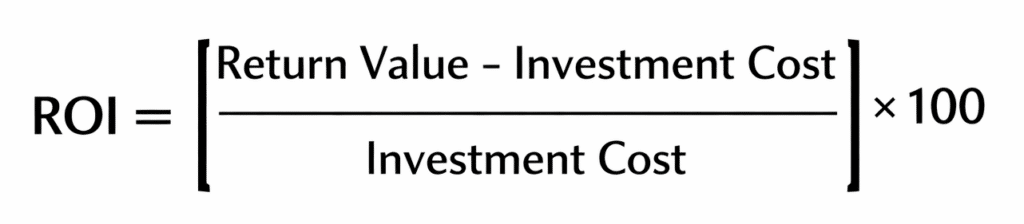
Here:
- ROI = Return on Investment
- Return Value = Total amount received from the investment
- Investment Cost = Total amount spent on the investment
This formula measures the percentage gain or loss relative to the original cost.
ROI Example
Imagine your company invests $10,000 in a marketing campaign. At the end of the campaign, the business earns $12,500 in value.
- Investment Cost = $10,000
- Return Value = $12,500
Step 1: Find Net Benefit
Net Benefit = 12,500 – 10,000 = 2,500
Step 2: Apply the Formula
ROI = (2,500 / 10,000) × 100
ROI = 25%
What does this mean?
An ROI of 25% means the investment earned a 25% return over the original amount spent. If the return value had been lower than the cost, the ROI would have been negative.
Importance of ROI
ROI helps you judge whether an investment is worth the money. It gives a quick percentage that makes comparison easy, even when projects differ in size. Businesses use ROI to review marketing campaigns, software purchases, equipment upgrades, and other decisions. It is also widely used because it is easy to explain to managers and stakeholders.
Still, ROI has limits. It does not account for when the cash comes in, so it may not show the full picture for long-term projects. That is why many professionals review ROI with other tools such as NPV or IRR.
FAQ
Q1. What is Return on Investment?
Return on Investment is a financial metric that measures the profit or loss generated relative to the amount invested. It is usually expressed as a percentage.
Q2. How do you calculate ROI?
You subtract the investment cost from the return value, divide the result by the investment cost, and then multiply by 100.
Q3. What does a negative ROI mean?
A negative ROI means the investment lost money. The return value was less than the cost of the investment.
Q4. Why is ROI important?
ROI helps compare options quickly and shows whether an investment resulted in a gain or a loss. It is simple and easy to understand.
Q5. What is the limitation of ROI?
ROI does not consider the timing of cash flows. Two projects may have similar ROI values but very different time horizons.
Summary
Return on Investment is one of the simplest ways to measure investment performance. It tells you whether your project, purchase, or campaign made money or lost money. Because it uses a percentage, it is easy to compare options and explain results. An ROI calculator makes the process even easier by providing quick, accurate results. Use ROI for a quick financial check, but for larger or longer-term decisions, review it alongside other financial metrics.

I am Mohammad Fahad Usmani, B.E. PMP, PMI-RMP. I have been blogging on project management topics since 2011. To date, thousands of professionals have passed the PMP exam using my resources.