
Estimating activity duration is an important process to know the activity and project duration and develop the project schedule.
This process helps develop project baselines, such as cost baseline and schedule baseline. The schedule baseline is an approved version of the project schedule.
Several tools help determine activity duration. The choice of tool depends on the accuracy you are looking for and the available information.
Each activity has three attributes: resources required, the effort required, and duration. To calculate activity duration estimates, you need to understand these attributes, which
depend on each other. The more resources, the faster an activity can be completed; also, an expert team member will take less time to complete a task than a new team member. Therefore, identify the resources first, then estimate the activity duration.
Estimating Activity Duration
Estimate activity duration process calculates the activity duration using different techniques, depending on the available data and requirements.
This process helps develop the project schedule and determine the project budget.
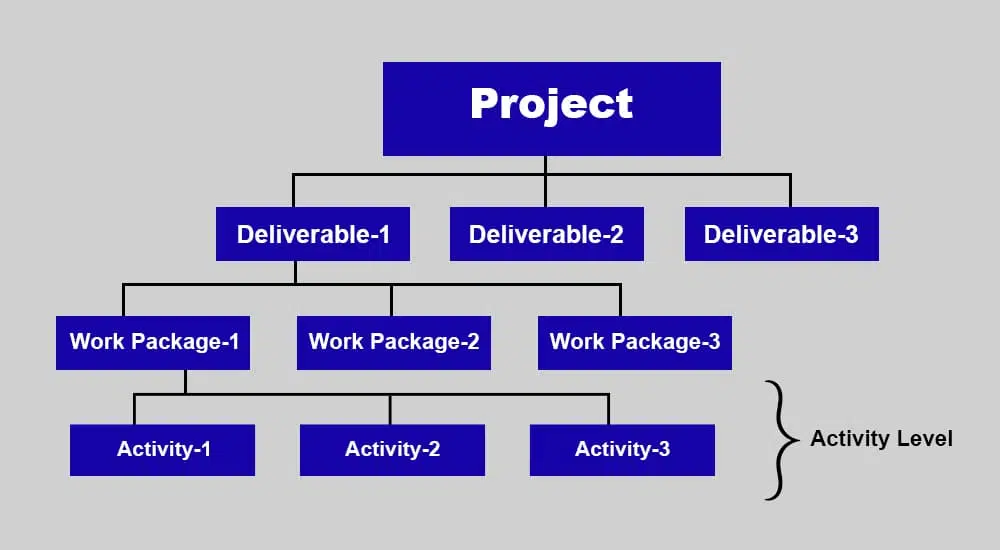
Activity duration estimation is performed on activity level, which comes after the work packages level in a work breakdown structure.
Estimating project duration is not easy, as it is not an algebraic sum of all activities. Some activities can be performed in parallel, so you will consider only one activity or non-overlapping duration.
To find the project duration, you will sequence the activity and find the task dependency. Afterward, you will develop the project network diagram using the Gantt chart, CPM, or PERT method. Then, you can find the duration of your project.
You have four techniques to calculate activity duration in project management:
- Analogous Estimating
- Parametric Estimating
- Three-Points Estimating
- Bottom-up Estimating
Analogous Estimating
You can use this technique for a quick result on an entire project or activity level.
Analogous estimates use comparisons from similar past projects.
For example, to estimate the duration of a project, look into your organizational process assets (OPA) for a similar, completed project and pick the one that resembles yours the most. Using expert judgment, calculate the duration estimate for your current project.
This technique is useful when you have the least project information and management needs quick answers. The accuracy of this estimation depends on the similarities between your project and the project you are comparing it to.
When Should You Use this Technique?
You can use this technique to find activity duration when you need quick results, accuracy is not required, and when you have limited activity details.
Parametric Estimating
The parametric estimating technique uses historical records to compute the duration of an activity. Parametric estimation may seem similar to analogous estimation but has a different approach: using historical statistical data to calculate accurate duration.
For example, if constructing a ten-foot wall took one day, how long would it take to build a hundred-foot wall? Multiply the time taken to build a ten-foot wall by ten.
Or, if one room took three days to paint in an earlier project, how much time would it take to paint twenty rooms on your current project? You will multiply the time taken to paint one room on the old project by twenty to get the duration for your new project.
When Should You Use This Technique?
This technique provides a more accurate duration estimate than the analogous technique. You use this technique when you have completed a recent, similar project.
Three-Point Estimates
Using the three-point estimates technique, you can reduce bias in estimation, which uses a mathematical formula to calculate activity durations.
Triangular and beta distribution formulas are the most popular three-point estimates.
In three-point estimates, we use three parameters:
- Most likely (Tm): This is the activity duration for most cases.
- Optimistic (To): This is the activity duration in the most favorable case.
- Pessimistic (Tp): This is the activity duration in the worst-case scenario.
The triangular estimate formula is:
Te = (To + Tm + Tp) / 3
PERT (Program Evaluation and Review Technique) is the most widely used three-point estimate technique.
It is a weighted average. The PERT estimate formula is:
Te = (To + 4Tm + Tp) / 6
Using a three-point estimate reduces the chance of risks, biased judgment, and uncertainty.
When Should You Use This Technique?
This technique provides a better activity duration estimate than analogous or parametric. It reduces bias, risks, and uncertainties from the duration calculation.
Use this technique when you have three duration estimates for an activity.
Bottom-up Estimating
The bottom-up estimating technique calculates activities’ durations with the highest level of precision and adds them together to get your project duration.
This is the most accurate, time-consuming, and costliest technique. It is also known as a “definitive estimate.”
When Should You Use This Technique?
You can use the activity duration technique when you have all activity details available. This is the most accurate technique and provides reliable results.
However, this is the most time-consuming technique and requires extensive resources.
How to Estimate Activity Duration
The following steps can help you estimate the activity and project duration.
- Select the technique you will use to calculate the activity duration, i.e., analogous, parametric, three points, or bottom-up estimation.
- Study past similar projects to get an idea of estimation and understand the basis of estimation.
- Gather team members who have experience in the estimating process.
- Create the work breakdown structure and organize work packages into activities.
- Estimate the resources and then calculate the duration of each activity.
- To find the project duration, you need to find task dependencies, develop a network diagram and then find the duration.
What is the Basis of Activity Duration Estimates?
The basis of estimates provides assumptions and constraints used in developing the activity duration. It provides what technique is being used, confidence level, etc.
This is a live document; any changes here may cause you to revisit your estimates. For example, if any assumption turns out to be false, your estimate might be affected.
This project document provides transparency and consistency in estimating activity duration or cost.
How to Shorten Activity Duration
You have the following ways to reduce the activity duration:
- Add extra resources
- Assign an expert team member
- Reduce the scope of work
The preferred method is assigning experienced team members to the activity to reduce the duration. If this is not feasible, adding extra resources might help shorten the activity duration.
If these two methods do not work, reducing the scope of work is the last option. Using this option is not in the project manager’s hands, as he/she needs approval from the management or project sponsor.
Please visit my post on schedule compression techniques to learn more about shortening the project duration.
Summary
Estimating activity duration helps develop a project schedule. Accurate activity durations help you create a realistic schedule and avoid surprises. Activity duration is an iterative process, meaning you will repeat this process throughout the project life cycle (as needed).
This is an important topic from a PMP exam point of view. You will see a few questions from this topic in your PMP exam.
Please share your experience with activity duration estimates on your project through the comments section.

I am Mohammad Fahad Usmani, B.E. PMP, PMI-RMP. I have been blogging on project management topics since 2011. To date, thousands of professionals have passed the PMP exam using my resources.