
Today’s topic of discussion is lead vs lag or, more specifically, lead time vs lag time.
Lead and lag have important roles in the schedule network diagram, and a solid grasp of these terms is invaluable if you are into project planning.
Although the concept is relatively simple, a few people still find it difficult to understand.
In this blog post, I will explain lead time and lag time with clear, real-world examples.
Let’s get started.
Lead Vs Lag (Lead Time Vs Lag Time)
Before discussing the lead or lag, let us understand the Finish to Start sequence.
This means when the first activity finishes, a second activity starts. This is a Finish to Start sequence, and it is widely used in a network diagram.
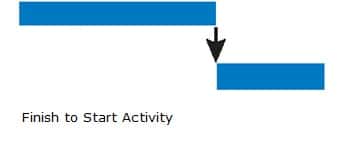
There are many instances when the second activity starts before the first activity is completed, or the second activity will start a few days after completing the first activity.
These two conditions are known as lead and lag and form an integral part of a network diagram. You apply lead and lag after you sequence activities and identify the dependencies.
Lead (or Lead Time)
According to the PMBOK Guide, “Lead time is the amount of time whereby a successor activity can be advanced with respect to a predecessor activity.”
Put simply, it is lead when the first activity is still running when the second activity starts. Lead time is the overlap between the first and second activities.

Example of Lead
Assuming that the time duration for the first activity is 20 days and 15 days for the second activity, the first activity is on its 15th day, and you have started the second activity.
Remember that the first activity still has five days to be finished.
In this case, we would say that the lead time is five days.
Let’s look at a real-world example.
You are constructing a two-floor building. The two activities are in sequence, i.e., electrical work and painting.
However, as you complete the electrical work on the ground floor, you begin painting while the electrical work on the first floor continues.
This is an example of the lead.
We commonly use lead with the finish-to-start relationship. In this project management dependency, the predecessor activity must finish before the successor activity starts.
PS: Often, professionals get confused between lead and fast-tracking. Please note that both are different. Lead is a relationship between activities, and fast-tracking is a schedule compression technique.
When you compress the schedule, several activities that had a finish-to-start relationship will have the lead after applying the fast-tracking.
Lag (or Lag Time)
According to the PMBOK Guide, “A lag time is the amount of time whereby a successor activity is required to be delayed with respect to a predecessor activity.”
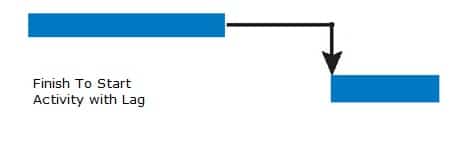
Put simply, lag occurs when the first activity completes, and there is a delay before the second activity starts.
Lag time is the delay between the first and second activities.
Example of Lag
For example, the duration of the first activity is three days and two days for the second activity. After completing the first activity, you wait for one day and then start the second.
Here, we say that the lag time is one day.
Remember that you started a second activity one day after completing the first activity.
Let’s look at a real-world example.
Suppose you have to paint a room. The first activity is applying the primer coating, and then you will do the final painting. However, you must let the primer dry before applying the paint.
Hence, you start your final painting two days after applying the primer. The time given for the coating to dry is called lag time.
Lag can be used with all types of activity dependency.
Difference Between Lead and Lag
- In lead time, you have overlap between the first and the second activity, while in lag, there is a delay between the first and the second activity.
- Lag is a delay and is denoted by the “+” sign in the network diagram, for example, FS+2. Lead is an advancement and is denoted by the “-” sign in the network diagram, for example, FS-2.
Summary
Lead time and lag time have key roles in developing the schedule baseline and can be used in any type of dependency in a network diagram. Lead and lag are very helpful and offer project managers flexibility in schedule development.
This concludes the summary of lead vs lag, and I hope this concept is clear to you.
How do you apply lead time and lag time in your schedule network diagram? Please share your experiences in the comments section.

I am Mohammad Fahad Usmani, B.E. PMP, PMI-RMP. I have been blogging on project management topics since 2011. To date, thousands of professionals have passed the PMP exam using my resources.





Fahad, I suggest that your explanation:
=========
Example of Lead
Assuming that the time duration for the first activity is 20 days and 15 days for the second activity, the first activity is on its 15th day, and you have started the second activity.
========
maybe clearer with the following change:
========
Example of Lead
Assuming that the time duration for the first activity is 20 days and 15 days for the second activity, the first activity is on its 15th day, and still has 5 days to finish, “when” you started the second activity.
========
Hope to have helped.
Best regards,
Paulo Andrade
Thank you for this article. You have helped me learn a lot in a short time. God bless you.