
Every project involves people with different interests. If you want your project to succeed, you need to know who those people are and what they care about. A stakeholder register helps you do just that. According to a global survey, 93% of project professionals say that effective stakeholder management is critical when a project goes off scope or budget.
Put simply, keeping stakeholders engaged can make the difference between a smooth project and a chaotic one. Have you ever started a project only to discover that you don’t know who needs to approve each step? A well-built stakeholder register prevents those surprises.
What is a Stakeholder?
A stakeholder is any person or group with an interest in your work. The ISO 26000 standard defines a stakeholder as “an individual or group that has an interest in any decision or activity of an organization. Stakeholders can be internal or external to your organization, and their influence on your project can range from minor to critical.
For example:
- Internal Stakeholders: team members, department heads, executives.
- External Stakeholders: clients, suppliers, regulators, local communities.
A good register includes people who might be affected by a project outcome, even if they are not directly involved in day-to-day tasks. By documenting their interests, you avoid miscommunication and build trust.
Why You Need a Stakeholder Register
Modern projects move fast and often involve many moving parts. A stakeholder register provides a single source of truth about everyone who matters. It improves transparency, streamlines communication, and supports decision-making. In the latest PMI Pulse of the Profession survey, project professionals identified stakeholder management and engagement as the top skill for addressing budget, schedule, and scope issues.
When you know whom to contact and how to engage them, you can resolve problems before they derail progress.
The benefits of keeping a register include:
- Clear Communication: Knowing preferred communication methods ensures that updates reach the right people at the right time.
- Enhanced Support: Stakeholders who feel heard are more likely to champion your project and allocate resources.
- Risk Reduction: Early identification of influential stakeholders helps project managers anticipate objections and minimize conflict.
- Accountability: A register assigns names to roles, facilitating the tracking of responsibilities and approvals.
The growing scope of project management offices (PMOs) makes this tool even more important. According to Wellingtone’s 2025 State of Project Management report, 72% of respondents believe the scope and responsibilities of their PMO will grow in the future. Greater responsibility entails more people to engage and more reasons to maintain a detailed register.
Components of a Stakeholder Register
Most registers follow a simple structure. The key is to capture enough information to manage relationships without overwhelming readers.
Common data fields include:
- Type: Are they an individual, a group, or an organization?
- Name and Role: Include a title or description of the stakeholder’s position.
- Internal or External: Note whether they are inside or outside the organization.
- Project Role: Describe their influence on scope, budget, or decision-making.
- Preferred Communication: Phone, email, meeting, or other methods.
- Expectations: Summarize each stakeholder’s objectives for the project.
- Influence: Rate how much their opinion can affect the outcome.
- Strategies: Outline how you plan to engage them.
Having all this information in one document makes it easy to sort and filter stakeholders by influence or interest. You can build your register in a spreadsheet or use project management software to keep it up to date.
How to Create a Stakeholder Register
Creating a register is not complicated, but it does require thoughtful research. Follow these five steps to build a useful document:
- Identify Stakeholders: At the start of your project, brainstorm all the individuals and groups that could affect or be affected by your work. Include both obvious stakeholders (team members and sponsors) and less visible ones (regulators and community members). Consult colleagues and review similar projects to ensure no one is overlooked.
- Gather Information: For each stakeholder, collect basic details, including name, role, and contact information. Ask questions about their interests and expectations. ISO’s guidance recommends considering legal obligations and who might be positively or negatively affected by your decisions. Understanding these aspects helps you build a complete picture.
- Categorize Influence and Interest: Rate each stakeholder’s influence (high, medium, low) and interest (e.g., positive, neutral, negative). This allows you to prioritize outreach. A highly influential stakeholder with a negative interest requires more attention than a low-influence supporter.
- Develop a Communication Plan: Decide how and how often you will communicate with each stakeholder. Tailor your approach: high-influence stakeholders may need regular one-on-one meetings, while low-influence stakeholders may only require status updates via email. Keep messages clear and use the preferred channel.
- Review and Update Regularly: A stakeholder register is a living document. As the project evolves, roles change, and new stakeholders appear. Schedule regular reviews to keep the register up to date. Revisiting the register after each major milestone ensures that no one is overlooked.
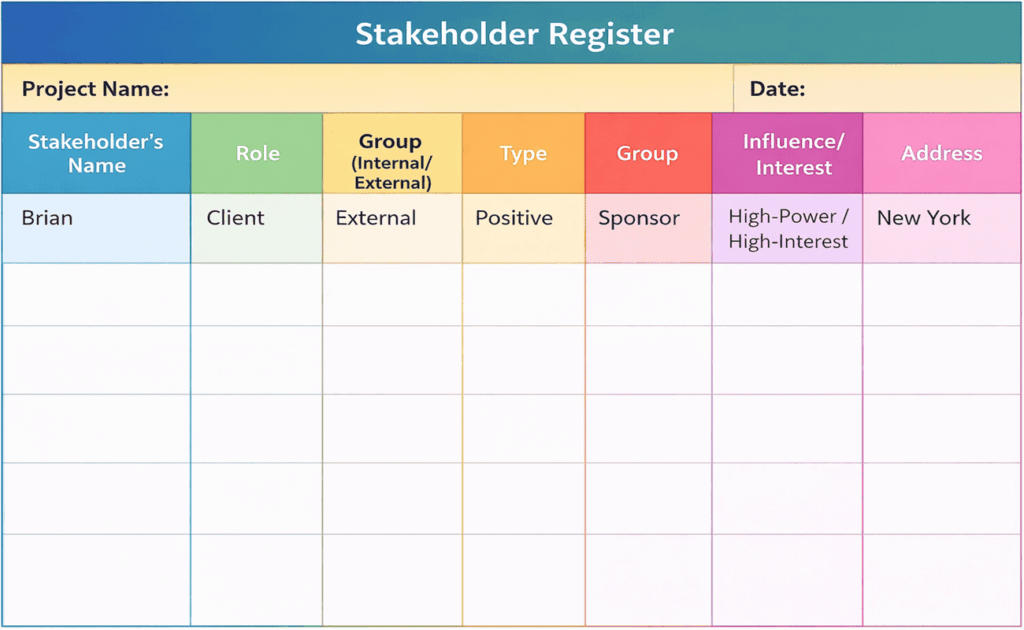
Stakeholder Register Example
You can develop a register as per your requirements.
An example of a stakeholder register is given below for your information.
Stakeholder Register Template
Every organization has a template for the stakeholder register. You don’t need to create it from scratch; simply identify the stakeholders. Once you complete this process, you can update your stakeholder register.
Below are the links for the stakeholder register template in Word and PDF for free:
Click here to download the stakeholder register in Word Format.
Click here to download the stakeholder register in PDF Format
Tips for Managing Your Stakeholder Register
- Be Honest about Influence. Do not downplay a stakeholder’s power. Overlooking an influential opponent can derail your project.
- Keep Sensitive Details Private. Your register should not include confidential information that could harm stakeholders. Store it securely and limit access to authorised team members.
- Involve the Team. Ask your colleagues and senior managers to review the register. They may identify stakeholders you missed.
- Balance Depth with Brevity. Include enough detail to guide communication, but avoid turning the register into a long narrative. Aim for clarity over quantity.
PMP Exam Tips
- The Stakeholder Register is created in Identify Stakeholders (Initiating process group).
- It lists the stakeholders and includes their names, roles, influence, interests, and communication needs.
- Do not confuse it with the Stakeholder Engagement Plan, which explains how you manage them.
- When a new stakeholder is identified, the first document to update is the Stakeholder Register.
- The register is an input to communication and stakeholder management processes; therefore, PMI expects it to remain current throughout the project.
FAQs
Q1. What is a stakeholder register?
It is a document that lists all people, groups, or organizations affected by a project and outlines how to engage them.
Q2. Why is a stakeholder register important?
It keeps communication organized, reduces risk, and improves support by ensuring the right people receive the right information at the right time.
Q3. How often should a register be updated?
Review it after major milestones or when new stakeholders appear. Regular updates keep it relevant.
Q4. Can I use a template?
Yes. Templates help ensure you collect consistent information. Customize the fields to suit your project’s needs.
Q5. Who owns the stakeholder register?
The project manager is responsible, but the team should also contribute. Shared ownership improves accuracy and buy-in.
Summary
A stakeholder register is more than a list—it’s a living tool that drives communication and accountability. By identifying stakeholders early, collecting essential information, categorizing influence, planning communications, and keeping the document up to date, you facilitate smoother projects. Strong stakeholder engagement is critical for addressing budget, schedule, and scope issues. Without a register, you risk missing voices that could make or break your project.
Further Reading:

I am Mohammad Fahad Usmani, B.E. PMP, PMI-RMP. I have been blogging on project management topics since 2011. To date, thousands of professionals have passed the PMP exam using my resources.



Thank you so much for the detail information. when can I add the project manager in the communication channel? N (N-1)/2.
It depends on question. Look at the clue given in the question.
Hi
Have been reading your posts regularly as I prepare for PMP, Can you help me understand why Stakeholder engagement plan is an input to Identify Stakeholder process ? Identify Stakeholder is in Initiating phase, and Plan Stakeholder Engagement is in Planning phase, Also, stakeholder register is an input to Plan Stakeholder Engagement. So ,
Output of Plan Stakeholder Engagement = Input of Identify Stakeholder
Input of Identify Stakeholder= Output of Plan Stakeholder Engagement
Identify stakeholders is a iterative process and performed throughout the project life cycle.
Hi Fahad
Your book sound great in preparing for PMP but I am neither student in the field nor a professional. Will the book
help me to just request for an exam and join the profession?
No, this is an exam preparation book. It will not help you get any request for the exam.
Dear Fahad,
Firstly, let me thank you for all the materials you shared with us – the blogs, the mock questions – all of them make sense a lot to me. I’m a graduate student who is going to take the PMP certification test for the first attempt in one week. For the last week, I would spend the time in testing my knowledge by mock questions.
For now, I have a question about ‘stakeholder expectation’ and ‘requirement’. In the Head First book, the definition is ‘Requirements are what someone needs to get out of your project, while expectations are what they think will actually happen.’
Here is a question about it:
10. Kyle is the project manager of a project that has teams distributed in many different places. One of the stakeholders in his project has asked that all formal communications from the project be shared with all of the teams, regardless of their location. This is an example of:
A. A stakeholder expectation (right answer)
B. A stakeholder goal
C. A stakeholder requirement
D. Decoding communication
While I’m confused that isn’t the ‘communication frequency’ a need for Kyle to get out of the project?
I would be appreciated if you could help me out.
Much appreciate!
Best,
Ruyi
Are you a student and applying for the PMP exam?
Regarding your question, as per my understanding, since the stakeholders has clearly stated it, it is his requirement.
Yes, I am a student right now.
While the answer is ‘expectation’ and it is a question on ‘Head First’ book. I’m really confused.
One more thing is that how can I get notified if I receive your reply? I thought I could get an email. I also sent you an email about this question but you didn’t reply. Which way do you prefer to communicate?
Thanks.
If you are a student, you should prepare for the CAPM certification.
Q- When we create a Requirement doc & Traceability matrix we are using both stakeholder register and Stakeholder mgmt plan as input why ? when Stakeholder Register is already a input while developing Stakeholder mgmt plan? Please advise..thx
This is in the PMBOK Guide itself. Open the PMBOK Guide, and see what input is required.
Just for anyone else using PMBOK 5th Edition, the Stakeholder related information is in Chapter 13:
– 13.1.2. Identify Stakeholders: Tools and Techniques
– 13.1.2.1 Stakeholder Analysis
Thanks.
Wow! This is really great. U ve just opened my understanding for the course. I ve been attending a class for project management without understanding most of the things, such as Stakeholders Register.
God bless you so much for your good work. Keep it up.
Thanks
You are welcome Alwell.
Hi Fahad,
Requirement documentation’s requirements and Stakeholder Register’s stakeholder requirements are same?
1) Refer to the PMBOK Guide page: 117 (point: 5.2.3.1)
2) What do mean by “Stakeholder Register’s stakeholder requirements”?
If you need a change in cost, scope or schedule, you must raise a change request. Otherwise, you may not need to raise a change request.
Dear Fahad,
First, I would like to thank you for what you do. The posts are concise, relevant and spot-on. I have encouraged others to utilize both your blog and your “for purchase” study materials.
I have a general question related to the Stakeholder Register My understanding is that it is a document that falls outside configuration control and is therefore allowed to be (and should be) updated regularly. Straitforward enough. But I have also read that the Communication Plan also resides outside configuration control and can be updated without approval. For instance, the stakeholders have informed the project manager that the communication frequency should be changed. The PM should then update the Commmuncations Management Plan straitaway without introducing a change request. Could you please share which Plans are able to be updated without a change request (i.e. which are not under configuration control?). Thanks and best regards
Wow! So straight to the point and easy to understand! I spent this lil chuck of my time to get something this big. Thank you and keep up!
Thanks Azemazi for your comment.
HOW DO MY FAMILY BECOME REGISTERED STAKE HOLDERS IN OUR AREA
Stakeholder for what?
Thanks for explaining the Stakeholder Assessment and Classification. I usually create the Stakeholder Identification and don’t bother with the other two. This is an issue because you require these in order to develop a Project Communication Management Plan.
Why don’t bother with the other two? This information is required for proper communication management plan.
This is usually how it works in most projects; you’re actually lucky to get a stakeholder register.
:)
Nice article, hope to see more on such topics. Can you please help me by indentifying initial documents which are must to have for project success.
Thanks
Rafat
There is no such fix list of initial documents, which help you complete the project.
Many documents are required to run a project, for examples, project management plans, baselines, logs. registers, etc.
Refer the PMBOK Guide 5th Edition, Page: 291 (Communication Requirements Analysis)
Can you please clarify where the stakeholder communication requirements are contained — the Stakeholder Management Plan, the Stakeholder Register, and/or the Communications Management Plan? I am seeing discrepancies in some of the practice questions. The PMBOK also does not clearly define this. For instance, communication requirements are not explicitly stated as being included in the Stakeholder Register, yet the description for Communication Requirement Analysis states they are included in the Register. Your articles are the best, I’m using them almost every day as I prepare for the exam.
Useful tools for any project management
Thanks Nouhou for your visit and leaving comment.
I like your work it is in details and succinctly explicit and am highly encourage.
Regards,
Dennis Pepple.
Thanks Dennis.
This is very helpful, thank you.
You are welcome Shh.