Projects often require supplies, consumables, or external support to ensure smooth execution. A Request for Quotation (RFQ) is an invaluable tool in such cases. This contract document communicates the buyer’s requirements to sellers, which can help you streamline the procurement process.
Using an RFQ, organizations can efficiently gather competitive offers, compare prices, and assess vendors’ capabilities. This ensures they make well-informed purchasing decisions while keeping costs in check and maintaining project timelines.
In today’s blog post, I will explain the RFQ, its type, and how to create it for your organization.
Let us get started.
What is a Request for Quotation (RFQ)?
A Request for Quotation (RFQ) or Invitation for Bid (IFB) is a procurement document buyers use to communicate specific requirements to sellers. This allows sellers to review the details and submit offers, including pricing and terms. RFQs are ideal when the buyer’s needs are clearly defined, making it easier to compare bids.
The buyer can request price quotes based on various units per item, hour, or meter. This approach streamlines the procurement process, helping organizations obtain competitive pricing and select the most suitable supplier for their well-specified needs.
Types of Request of Quotation (RFQ)

An RFQ can be any of the following types:
1. Open RFQ
In an Open RFQ, sellers can view each other’s bids and adjust their offers until the deadline. This encourages competition, driving prices down for the buyer. However, if not properly monitored, it can also lead to price-fixing among sellers.
2. Sealed RFQ
Commonly used by government agencies and public sector units, a Sealed RFQ allows all sellers to submit bids in sealed envelopes only after the deadline. This ensures transparency but may limit negotiating opportunities for a lower price since all offers are final.
3. Single-Source RFQ
Used for purchasing spare parts or specialized equipment, this RFQ is sent exclusively to a specific manufacturer or an authorized seller in the region. While this guarantees high-quality materials, the lack of competition often results in higher prices.
4. Invited RFQ
In an Invited RFQ, the buyer invites a pre-selected list of bidders to submit quotes. This approach accelerates the procurement process and ensures higher-quality work due to the careful selection of vendors. However, it may limit competitive pricing as it excludes broader participation.
Step-by-Step Process to Create an RFQ
You can follow the following steps to write an RFQ for your requirements:
Step 1. Prepare the RFQ Document
The first step is to gather and document detailed requirements. Ensure that all relevant stakeholders are involved in this process to cover every aspect.
The RFQ should include:
- Material and technical requirements
- Transport and delivery terms
- Inspection and payment conditions
- Compliance with local regulations
- The quote’s validity period
- Who the quote is prepared by (i.e., company details)
- Quantity, unit price, and total cost
- Skills and training competencies required
- Part descriptions and specifications
- Contract terms and conditions
- Expected delivery date
- Bulk order discounts (if applicable)
Step 2. Define the Vendor List (Optional)
If you have a pre-approved list of suppliers, you can specify them to streamline the process and exclude others. This step helps when seeking bids from vendors with a proven track record or specialized capabilities.
Step 3. Issue the RFQ
Once the requirements are finalized and management approval is secured, issue the RFQ with a clear submission deadline. Provide enough time for vendors to prepare bids and set up channels to answer questions. Consider organizing a bidder conference to address common inquiries and clarify details.
Step 4. Accept Bids and Review Offers
After the RFQ submission deadline, open the bids and review them for completeness. Ensure that all submissions meet the specified requirements. The next step is to conduct both commercial and technical evaluations to assess compliance with the project’s needs.
Step 4. Select and Award the Contract
Select the lowest bid that meets the technical and commercial criteria following the evaluations. Conduct multiple rounds to reach the best possible offer if negotiations are allowed. Once finalized, issue a purchase order, which will serve as a legally binding contract between both parties.
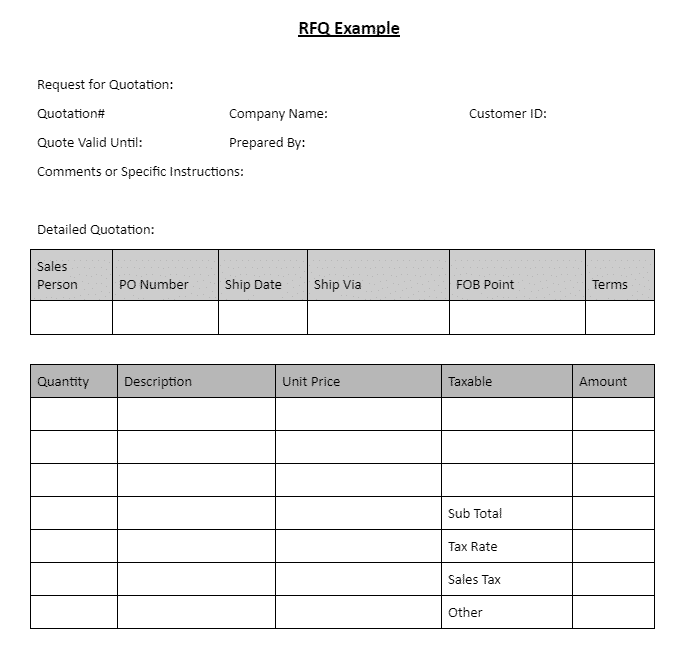
RFQ Example
Below is an example of an RFQ:
RFQ Benefits
- Cost Efficiency: An RFQ invites multiple vendors to submit bids, which can help organizations secure the best possible price, often leading to cost savings.
- Clear Specifications: An RFQ outlines detailed requirements, thus ensuring that vendors understand exactly what is needed, which reduces the risk of misunderstandings or misaligned deliverables.
- Streamlined Procurement Process: The structured nature of an RFQ simplifies the procurement process, which makes it easier to compare offers and choose the most suitable supplier.
- Transparency: The selection process is transparent—particularly in the case of sealed RFQs—which can minimize the risk of favoritism or bias.
- Risk Mitigation: With well-defined terms and conditions, organizations can reduce the risk of delays, poor-quality deliverables, or supplier disputes.
RFQ Limitations
- Limited Flexibility: RFQs work best when requirements are clearly defined. If the project scope is vague or likely to change, then an RFQ may not be the most suitable approach.
- Focus on Price: RFQs prioritize cost; therefore, there is a risk of selecting a low bid that may not necessarily offer the best value in quality, service, or long-term support.
- Time-Consuming: Preparing an RFQ and evaluating multiple bids can be lengthy—especially for complex projects—which can lead to delays.
- Potentially Incomplete Responses: Vendors might misunderstand the requirements or lack sufficient information, thus resulting in incomplete or non-compliant bids, which will add extra effort to the evaluation process.
- Reduced Competition in Single-Source RFQs: In cases where only one vendor is invited (e.g., single-source RFQs), the absence of competition can lead to higher prices and less room for negotiation.
RFQ Vs RFP Vs RFI
An RFQ (Request for Quotation), RFP (Request for Proposal), and RFI (Request for Information) are distinct procurement tools used at different stages of the buying process, each serving a unique purpose.
RFQs are used when the buyer has clearly defined needs and wants to obtain competitive pricing. They focus on price, quantity, and delivery terms for specific products or services. Vendors submit bids based on detailed specifications, making RFQs ideal for straightforward procurements with well-established and quantifiable requirements.
RFP, on the other hand, is used when the buyer needs more than just a price quote and is looking for a solution to a complex problem. It is employed for projects requiring customization, innovation, or specialized services. Vendors are asked to submit detailed proposals in an RFP, including their approach, methodology, and pricing. It allows buyers to evaluate suppliers’ technical capabilities and value-added services.
An RFI is a preliminary step in which the buyer explores the market and gathers information on solutions and suppliers. It’s often used when the buyer needs to understand the options available before drafting an RFQ or RFP. RFIs can help you identify capabilities, gather market insights, and refine project requirements before proceeding to the next procurement stage.
FAQ
Q1. What Does “RFQ” Mean?
An RFQ, or Request for Quotation, is a procurement document that invites vendors to submit bids for providing goods or services at competitive prices. It focuses on obtaining detailed pricing information based on specific buyer requirements.
Q2. What Are RFQ Requirements?
RFQ requirements include clear specifications such as product details, quantities, delivery timelines, payment terms, inspection criteria, and any relevant regulatory compliance. This ensures that vendors can accurately price their bids and meet the buyer’s needs.
Q3. When Should You Use an RFQ?
An RFQ is best used when the buyer has well-defined, fixed requirements for products or services and wants to obtain the best possible price through competitive bidding. It is ideal for straightforward purchases like materials, equipment, or bulk orders.
Q4. What Happens After an RFQ is Issued?
After issuing an RFQ, vendors review the requirements, seek clarifications, and submit their bids by the deadline. The buyer then evaluates these bids, often focusing on the lowest price that meets all technical and contractual conditions before awarding the contract.
Q5. Are RFQs Required for Government Projects?
Yes, in many cases, RFQs are mandatory for government and public sector projects to ensure transparency, fairness, and equal opportunity for all suppliers to participate in the bidding process.
Q6. What Information is Included in an RFQ?
An RFQ typically includes product specifications, quantities, delivery schedules, payment and inspection terms, contract conditions, and submission deadlines. It may also request details like unit prices, bulk discounts, and supplier qualifications.
Conclusion
A Request for Quotation can help buyers obtain the best price for clearly defined products or services. It streamlines the procurement process, thus enabling organizations to purchase materials competitively and efficiently. For government and public-sector entities, RFQs are often mandatory to ensure transparency and provide equal opportunities for all suppliers.
By leveraging RFQs, buyers can secure cost-effective solutions while maintaining compliance with regulations, promoting fairness, and encouraging healthy competition among vendors. This approach benefits organizations and strengthens supplier relationships through clear communication of requirements.
Further Readings:
Reference:

I am Mohammad Fahad Usmani, B.E. PMP, PMI-RMP. I have been blogging on project management topics since 2011. To date, thousands of professionals have passed the PMP exam using my resources.