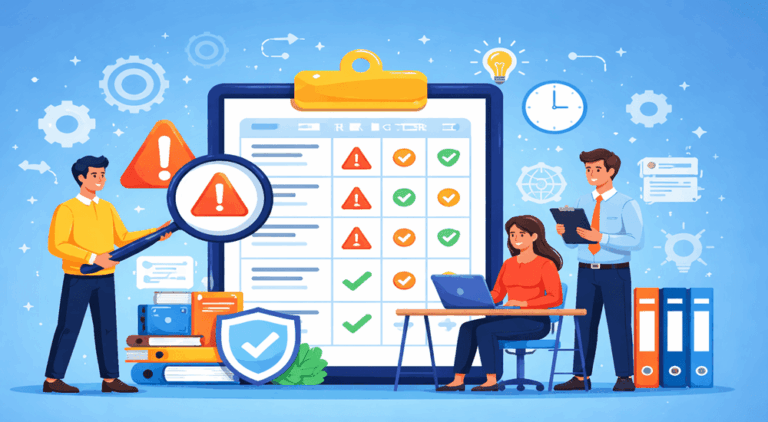
Risk is a part of project management or business operations. The best way to handle it is to identify them before they occur and manage them accordingly.
Risk assessment is a key part of risk management. It helps keep your business or project safe and is a legal requirement in many countries. Risk management is the process of dealing with these risks. It helps manage unplanned events effectively.
Risk assessment means identifying risks at work and taking action to prevent them. It helps employees make better choices, use resources wisely, and find ways to stay safe.
Some risks are negative, like accidents or damage—these are called threats. But some risks can be positive, like chances to grow or improve—these are called opportunities.
In this guide, I will show you five simple steps to assess risks.
However, before that, let us know what risk management is.
What is Risk Management?
Risk management is identifying and managing risks in a business or project. It helps you identify risks early, understand their severity, and decide what to do about them.
Risks include anything that might cause harm, delay, or loss, such as accidents, financial issues, or system failures. Risks can also be positive, such as discounts while making bulk purchases.
The goal is to lower the chance of negative events (and/or impact) and increase the chance of positive events (and/or impact). Risk management has simple steps: first, find the risks; next, study how likely and severe they are; then, decide what to do—avoid, reduce, share, escalate, exploit, or accept the risk, etc.
You must also check for new risks and update your risk management plans. Robust communication and record-keeping are also important. Risk management helps protect people, save money, and keep things running smoothly. It helps you stay safe and succeed at work or in business.
Five Steps to Risk Assessment
The five steps to risk assessment are as follows:
- Risk Identification
- Risk Analysis
- Risk Evaluation
- Risk Treatment
- Risk Communication and Documentation
Step 1: Risk Identification
The first step in managing risks is to identify them. Once you know the risks, you can determine how to handle them. Before you start looking for risks, it is essential to understand what a risk is and the risk tolerance of your stakeholders. This helps you set clear limits and plan to fit your goals.
To find risks, you can analyze lessons learned and reports, walk around the worksite, talk to experts, look at past risks, review old project files and organizational process assets, etc.
People with experience can be a big help. Experts in the field may notice risks you didn’t think about. They also know what works best and what’s changing in the industry.
After finding risks, write them down in a risk register. This register lists all the risks, where they might happen, and what might cause them. You can also sort them by type, which makes it easier to deal with them later.
Step 2: Risk Analysis
After identifying risks, you will analyze them. It helps you see which risks are high priority and which are low priority so you can deal with the important ones first.
To start, think about how likely each risk is to happen. You can look at past events, ask experts, or use data to decide. You might call the chances rare, sometimes, often, or almost certain. Put simply, you will find the probability of the risks occurring.
Next, think about what could happen if the risk does happen. Will it cause injuries, money loss, environmental damage, or hurt your business’s image? You can describe the impact as small, medium, or big, or even put a number on the cost if possible. Put simply, you are finding the impact of risks.
Once you know the chance and the impact, you can determine how serious each risk is. You will find this by multiplying the probability by its impact. You can use a risk matrix chart for this purpose. It helps you quickly see which risks need more attention.
This process helps you better understand risks and make informed choices. It also shows you where to focus your time, money, and effort.
Risk analysis is a continuous process. To stay current, you should revisit and update your risk list and analysis when things change or you get new information.
Step 3: Risk Evaluation
Once you have listed and analyzed your risks, the next step is to decide their severity and what to do about them. This part is called risk evaluation. It helps you determine which risks are okay to accept and which need responses.
You will plan how to respond to each risk. Some risks can be reduced by changing how you work, adding safety steps, giving training, or using insurance to cover losses. If a risk is not too severe and falls within what your business can handle, you can accept it. On the other hand, if the risk is too big, you will need to act immediately.
You will also create a plan to take advantage of positive risks that could benefit you.
Risk evaluation helps you decide which risks matter most and what to do about them. It also lets you focus your time and resources on the high-priority risks. Since things can change, you should regularly review and update your risk management plans.
Step 4: Risk Treatment
After identifying and evaluating risks, the next step is to decide how to manage them. This step is called risk treatment. The goal is to lower the chances of negative events, ensure everyone stays safe, and meet your goals. It also helps you realize opportunities.
Start by making a clear plan for dealing with each risk. Choose the proper steps to control each risk. You must also ensure you have enough resources to implement your plans. This means setting a contingency and management reserve. For example, you might need to budget for training, new equipment, or regular checks to keep things working safely.
Once the plans are in place, you should check if they work. Do inspections, audits, or reviews to catch any risks early. If something isn’t working, update the plans. Implementing effective risk treatments reduces negative risks, realizes opportunities, and helps your team and business run more smoothly.
Keep reviewing and updating your plans to stay relevant.
Step 5: Risk Communication and Documentation
Recording and sharing risk information is key to the risk assessment process. It helps other employees in the organization to learn from your experience and create a positive risk management environment.
You can share this info in meetings, reports, or emails. Ensure the message is easy to understand and fulfills the stakeholders’ requirements.
Keep a detailed record of everything you find in the risk assessment. This includes the risks you identified, how likely and severe they are, how you plan to deal with them, and your actions. Good records help you track progress, follow the rules, and improve over time.
Use a risk register to store and update this information. This working document should be kept current, showing any changes in risk levels or updates to your control measures. Store these records safely, but make sure they’re easy to access when needed.
What is the Importance of Risk Assessment?
Risk management is important because it helps you identify risks before they happen. It also lets you prepare for unplanned events, such as accidents, money loss, delays, or possible discounts. When you know the risks, you can take steps to stop them or reduce their impact.
It also helps you find positive risks that benefit your project or business operations.
This helps protect people, save time, and avoid extra costs. It allows you to make better decisions because you understand what could happen. Effective risk management keeps your work safe and your business strong.
It shows that you care about safety and planning. It also helps you follow laws and meet rules. By managing risks well, you can handle surprises better and stay on track to reach your goals.
In short, risk assessment helps you stay ready, avoid trouble, and do your best work with fewer risks.
Summary
When you follow the five steps of risk assessment, you will have the knowledge and tools to deal with risks smartly and proactively. Adding risk assessment to your decisions helps you improve safety, protect your business, and confidently reach your goals.
It helps you and your team handle uncertainty, work better, and create a safer workplace. Risk assessment is a continuous process; you should repeat it whenever a new risk occurs or when working conditions change.
Further Readings:
- What is Risk Management?
- A Short Guide to Project Risk Management Plan
- Benefits of Risk Management
- 9 Popular Risk Assessment Models in Risk Management
- Qualitative Vs Quantitative Risk Analysis
References:

I am Mohammad Fahad Usmani, B.E. PMP, PMI-RMP. I have been blogging on project management topics since 2011. To date, thousands of professionals have passed the PMP exam using my resources.