Have you ever felt stuck when trying to solve a stubborn problem? Reverse brainstorming helps you break through the block by flipping your thinking. Instead of asking, “How can we solve this?” you ask, “How can we make this worse?” This unusual twist unlocks ideas that might remain hidden in normal discussions. Reverse brainstorming challenges you to explore negative scenarios and then turn those negative ideas into positive solutions.
This method works well when a group is out of fresh ideas or needs to see an issue from a new angle. It encourages psychological safety because there is no “bad” idea; every negative suggestion becomes a way to discover what to avoid and what to fix.
Why Try Reverse Brainstorming?
Reverse brainstorming is more than a quirky game. It has several benefits. By focusing on what could go wrong, you reduce the risk of overlooking harmful assumptions. This perspective can uncover root causes that normal brainstorming misses. It also prevents groupthink by inviting divergent opinions. Finally, it can spark innovation by pushing people beyond safe ideas.
There are drawbacks too. Spending time on negative ideas can be uncomfortable, especially when participants dwell on problems. Facilitators need to manage the tone so the session remains constructive. Reverse brainstorming can also take longer because it involves two phases: first, generating negative ideas, then turning them into positive solutions. With careful planning, though, the benefits outweigh the costs.
Is Remote Work Changing How We Brainstorm?
In a world where remote and hybrid work is common, understanding collaboration dynamics is crucial. According to a 2025 Pew Research Center survey, 75% of remote-capable workers spend at least some time working from home. Many value flexibility; 46% say they would likely leave their jobs if required to return to the office. Organizations are balancing remote and in-office days, and 75% of these workers now face some in-office requirements, up from 63% in 2023.
Remote work can enhance idea sharing. A 2024 Culture Amp study found that 72% of remote workers report acting on promising new or innovative ideas, higher than 68% of office workers and 67% of hybrid workers. However, research in the California Management Review warns that working from home too often can reduce creativity for some groups. These contrasting findings underscore the importance of structured techniques such as reverse brainstorming, which work both in person and online.
Step-by-Step Guide to Reverse Brainstorming
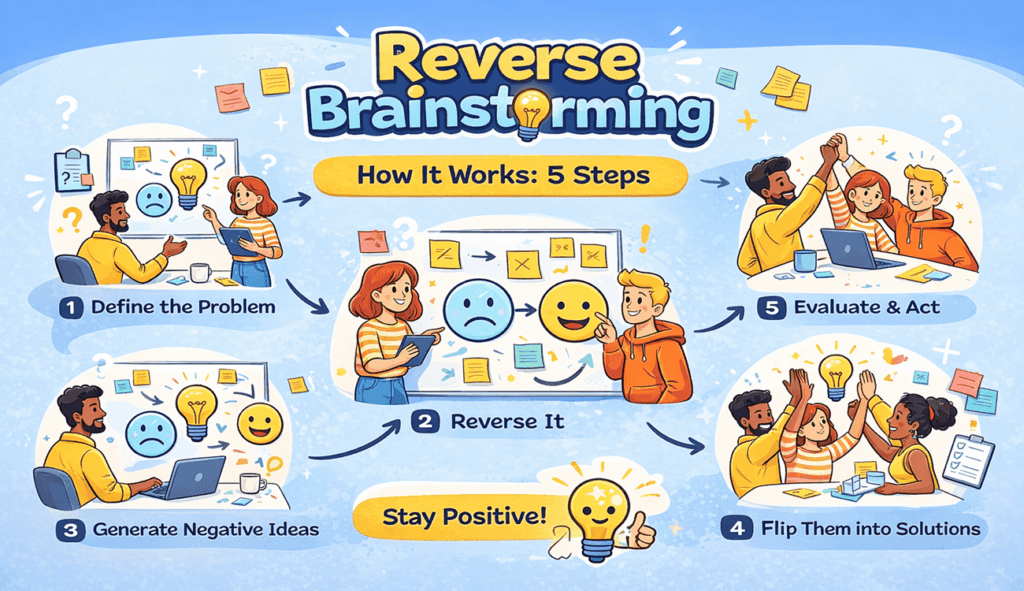
Reverse brainstorming follows a simple sequence. Here is a step-by-step guide that blends research and experience. Use this format for meetings in person or on video calls:
1. Set the Stage
Begin by clarifying the problem. Write it in a clear sentence and share it with the group. For example, “Our website’s traffic is declining.” Encourage participants to keep an open mind.
2. Flip the Question
Turn the problem on its head: “How can we make our website’s traffic worse?” This makes people comfortable suggesting extreme or outrageous ideas because the goal is to identify pitfalls.
3. Generate Negative Ideas
Ask everyone to brainstorm ways to make the situation worse. In a marketing example, suggestions might include hiding the sign-up form, using jargon, or removing calls to action. Have participants write or draw their ideas individually before sharing. Use sticky notes or digital equivalents.
4. Analyze Causes and Patterns
Cluster similar ideas to spot themes. Ask, “What are the causes behind these harmful actions?” For example, hiding a sign-up form indicates an unclear user flow; using jargon shows a lack of audience awareness. This step reveals underlying problems.
5. Flip to Positive Solutions
Finally, reverse each negative idea into a positive action: show sign-up forms clearly, use plain language, and create intuitive navigation. Discuss which solutions are feasible and assign owners. This produces a focused action plan that addresses root causes instead of symptoms.
Pros and Cons of Reverse Brainstorming
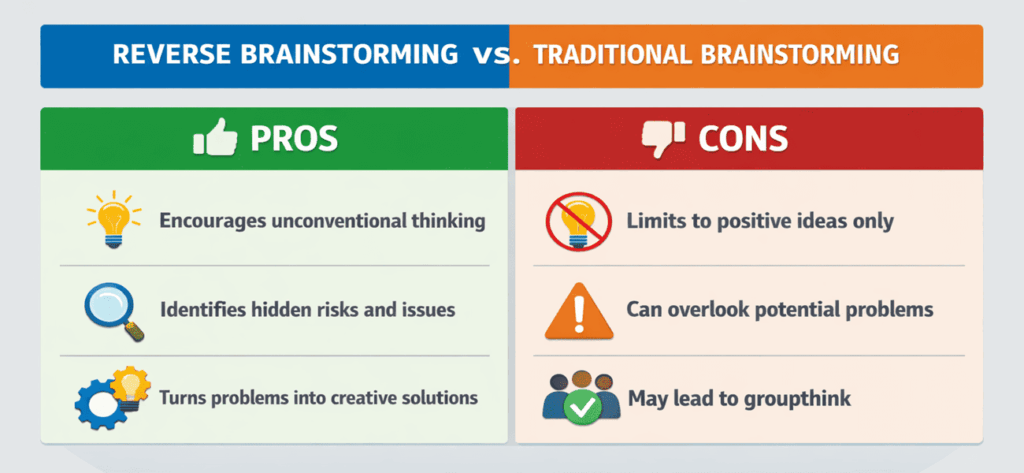
In summary, the advantages include:
- Breaks habits. Reverse brainstorming forces people to step outside regular patterns.
- Focuses on prevention. It helps teams anticipate and avoid potential mistakes.
- Encourages innovation. Considering extremes sparks novel solutions.
- Reduces groupthink. It encourages diverse opinions and prevents premature agreement.
Limitations include:
- Negative tone. Discussing failures may discourage some participants.
- Requires guidance. Skilled facilitators must maintain positivity.
- Takes longer. The two-phase structure demands extra time.
- Risk of bias. Participants may dwell on negative aspects if not redirected.
Examples in Practice
Reverse brainstorming works across many roles. The following examples illustrate how teams can flip problems into solutions. Each category includes negative suggestions (what not to do) followed by positive fixes.
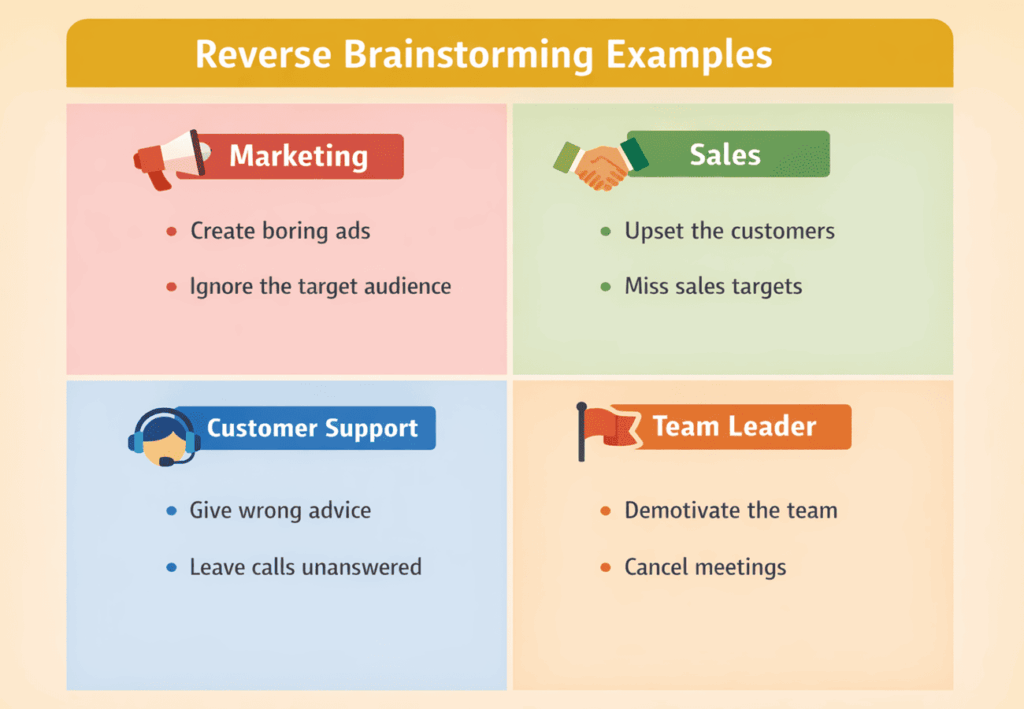
Marketing Team
Negative ideas: Hide the call-to-action button, use complex jargon, load the page with pop-ups.
Positive flips: Make the call-to-action clear, use simple language, and improve user experience by removing intrusive pop-ups.
Sales Team
Negative ideas: Hide contact information, avoid follow-up emails, and use confusing pricing.
Positive flips: Display contact details prominently, send timely follow-ups, and create transparent pricing tables.
Customer Support
Negative ideas: Provide incorrect answers, keep response times slow, ignore urgent cases.
Positive flips: Build a knowledge base to ensure accuracy, set response targets, and prioritize urgent issues.
Team Leadership
Negative ideas: Ignore feedback, discourage collaboration, micromanage.
Positive flips: Actively seek and recognize feedback, promote cross-functional collaboration, and trust team members with autonomy.
Tips for Successful Reverse Brainstorming Sessions
- Create psychological safety. Start with an icebreaker to build trust. Explain that outrageous negative ideas are welcome because they reveal hidden assumptions.
- Set a time limit. Keep the negative idea phase short to prevent discouragement; five to ten minutes works well.
- Use visual collaboration tools. Online whiteboards enable distributed teams to contribute ideas simultaneously.
- Assign roles. A facilitator keeps the group on track, a recorder notes ideas, and participants contribute freely. Rotate roles to build ownership.
- Follow up. After the session, turn ideas into actions. Post the positive solutions where everyone can see them and track progress.
FAQs
Q1. What makes reverse brainstorming different from ordinary brainstorming?
Reverse brainstorming starts by asking how to make a problem worse, then flips those negatives into solutions. It reveals hidden assumptions and encourages preventative thinking.
Q2. Can reverse brainstorming work for small teams?
Yes. Even two or three people can generate and flip negative ideas. The key is to document every suggestion and explain why it would make things worse.
Q3. Is reverse brainstorming suitable for remote teams?
Absolutely. Use digital collaboration platforms and video calls. Remote workers often feel more comfortable sharing ideas online, and studies suggest they are more likely to act on innovative ideas.
Q4. How often should we run reverse brainstorming sessions?
Use this technique when your team feels stuck or needs to anticipate risks. It is not necessary for every meeting, but it can refresh thinking when used occasionally.
Q5. Does focusing on negative ideas demoralize the team?
It can, if not managed properly. Keep the negative phase short and remind participants that the goal is to flip those ideas into constructive actions.
Summary
Reverse brainstorming helps you solve tough problems by flipping their thinking. By asking how to make a situation worse, hidden risks, assumptions, and root causes surface quickly. When you reverse those negative ideas, you unlock clearer, more creative solutions. This method works well for marketing, product, customer experience, and leadership challenges. Used with strong facilitation and a positive close, reverse brainstorming reduces groupthink and sparks action. Try it in your next session and turn obstacles into practical improvements together.

I am Mohammad Fahad Usmani, B.E. PMP, PMI-RMP. I have been blogging on project management topics since 2011. To date, thousands of professionals have passed the PMP exam using my resources.