
The Project Management Institute (PMI) created the PMI Talent Triangle to help project professionals focus on the skills that drive real business value. The three sides of the triangle: Business Acumen, Ways of Working, and Power Skills provide a roadmap for balanced skill development.
Understanding these components of PMI Talent Triangle can mean the difference between just managing a project and delivering strategic results. Have you wondered which skills matter most when you’re pressed to meet goals, budgets and stakeholder expectations?
This blog post breaks down each part of the triangle, explains why they matter today and shows how to earn Professional Development Units (PDUs) that align with each area.
Let’s get started.
Key Takeaways
- The Talent Triangle helps project managers balance three skill areas. Business Acumen, Ways of Working and Power Skills replaced older categories and reflect the skills needed in today’s dynamic environment.
- Recent PMI research underscores the importance of these skills. Only 18 percent of project professionals demonstrate high business acumen, and those individuals outperform their peers in achieving business goals and adhering to schedules and budgets. Nine out of ten managers say power skills help them work smarter, yet organizations invest only about a quarter of their training budget in these skills.
- Hybrid and agile approaches are on the rise. PMI’s 2024 report notes a 57 percent increase in hybrid project approaches and shows that 64 percent of senior leaders believe their teams need new technical skills.
- PDU reporting requires careful allocation. For each learning activity, you must allocate hours to the appropriate triangle component based on the content focus.
Understanding the PMI Talent Triangle
PMI introduced the PMI Talent Triangle concept in 2015 and updated it in 2022 to reflect evolving project management demands.
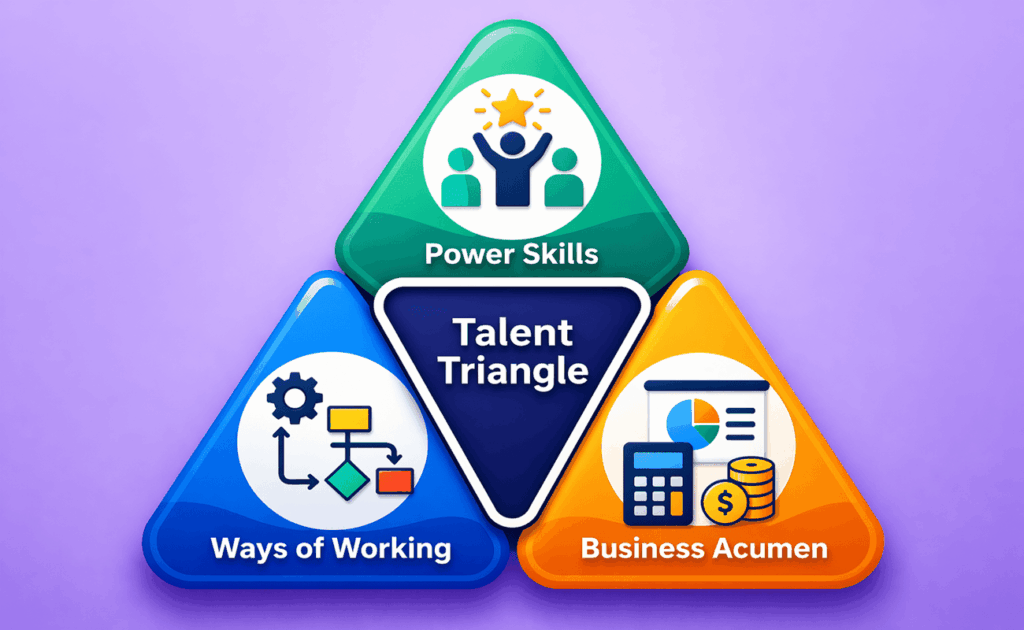
The triangle outlines three competency areas:
- Business Acumen – previously called Strategic and Business Management. It combines knowledge of an organization’s strategy, industry and financial landscape with the ability to make decisions that support long-term goals.
- Ways of Working – formerly Technical Project Management. It emphasizes mastery of predictive, agile and hybrid approaches so project managers can apply the right method for each project.
- Power Skills – once known as Leadership. These interpersonal skills include communication, collaboration and strategic thinking, the skills that help teams deliver results in complex environments.
PMI requires Professional Development Units (PDUs) across these categories to maintain certifications. The following sections explore each side of the triangle in detail.
Business Acumen: Strategic & Big Picture Thinking
Business Acumen means understanding how a project fits into the broader business strategy and using that insight to guide decisions. PMI’s 2025 Pulse of the Profession report shows the value of this skill set: only 18 percent of project professionals demonstrate high business acumen and 66 percent show moderate proficiency. Those with high acumen achieve better outcomes: 83 percent meet business goals, 63 percent adhere to schedules and 73 percent stay on budget, compared to 78, 59 and 68 percent among peers. Furthermore, only eight percent of high-acumen professionals report project failure compared with 11 percent of others.
Why Business Acumen Matters
Project managers often focus on delivery metrics, but understanding the why behind a project drives better decisions. The 2025 report notes that most senior leaders recognize the need for business acumen (54 percent), yet still prioritize technical skills. This gap creates a prime opportunity for professionals who invest in strategic thinking.
What Business Acumen Looks Like
Business Acumen can take many forms:
- Competitive analysis – scanning the market to anticipate changes.
- Legal and regulatory awareness – ensuring compliance with industry rules.
- Organizational strategy – aligning project goals with company vision.
How to Develop Business Acumen
- Learn the language of finance. Review income statements and project budgets to understand how decisions affect profitability.
- Stay informed about industry trends. Read sector-specific reports and attend webinars or training.
- Seek mentorship. Work with leaders who connect day-to-day work to corporate strategy.
Ways of Working: Mastering Predictive, Agile & Hybrid Methods
Ways of Working encompasses the methods and tools you use to deliver projects. PMI’s 2024 report found that hybrid approaches have surged by 57 percent and that 64 percent of senior leaders believe their teams need new technical skills. This shift reflects the reality that no single methodology fits every project.
Why Ways of Working Matter
Project environments vary widely. Hybrid methods blend predictive and agile techniques, giving teams flexibility while maintaining governance. As organizations adopt artificial intelligence and digital tools, project managers must adapt quickly.
Example Skills for Ways of Working
- Agile estimating and planning. Using story points, velocity and backlog grooming to plan iterative work.
- Performance management. Monitoring quality, schedule and budget indicators and adjusting when needed.
- Scope management. Balancing requirements to avoid scope creep.
Developing Your Methods
- Diversify your toolkit. Learn predictive, agile, and hybrid frameworks through courses such as PMI’s Agile Certified Practitioner (PMI-ACP).
- Practice on real projects. Apply new techniques to small initiatives before scaling up.
- Leverage technology. Use modern project management software to track tasks, collaborate and report progress.
Power Skills: Communication & Leadership for Project Success
Power Skills, sometimes called interpersonal or soft skills, are the abilities that enable you to lead teams, manage stakeholders, and think strategically. PMI’s 2023 report illustrates their importance: 92 percent of respondents agree that power skills help them work smarter. Despite this consensus, organizations dedicate only about one-quarter of their training budget to these skills.
Why Power Skills Matter
These abilities differentiate high-performing project managers. They enable you to influence without authority, build trust and guide cross-functional teams. PMI’s report also notes that organizations prioritizing power skills achieve higher maturity in benefits realization and agility.
Core Power Skills
- Communication – delivering clear messages and listening to feedback.
- Collaborative leadership – guiding teams toward shared goals.
- Problem-solving – resolving obstacles through creative thinking.
- Strategic thinking – connecting daily tasks to long-term outcomes.
Growing Your Power Skills
- Practice active listening. Focus on understanding stakeholders’ needs before responding.
- Mentor or coach others. Teaching can sharpen your ability to explain concepts clearly.
- Seek feedback. Ask peers for honest input and act on it to improve interpersonal interactions.
FAQs
Q1. What is the PMI Talent Triangle?
The Talent Triangle is PMI’s framework that outlines three skill areas: Business Acumen, Ways of Working and Power Skills that project managers need to maintain certification and deliver value.
Q2. How do I earn PDUs within the Talent Triangle?
Choose training or professional activities that map to each skill area, then allocate your time accordingly when reporting PDUs. PMI requires a balanced mix.
Q3. Why are power skills important?
They enable you to collaborate, communicate and lead effectively. PMI’s research shows 92 percent of project professionals say power skills help them work smarter.
Q4. How often should I update my skills?
Continuous learning is critical. PMI recommends earning PDUs regularly throughout your certification cycle to stay current with evolving practices.
Q5. Can I use one course to earn PDUs in multiple categories?
Yes. For example, a leadership workshop may include strategy (Business Acumen) and communication (Power Skills). Allocate hours based on how the content is divided.
Summary
The PMI Talent Triangle helps project managers grow in three key areas: business thinking, working methods, and people skills. When you build all three, you make better decisions and deliver stronger results. Recent research shows that professionals who balance these skills perform better in real projects. Keep learning, practice new approaches, and improve how you work with others. This balance will not only help you maintain your certification but also make you a more effective and valuable project leader.

I am Mohammad Fahad Usmani, B.E. PMP, PMI-RMP. I have been blogging on project management topics since 2011. To date, thousands of professionals have passed the PMP exam using my resources.




I have digested some useful information from the article as a PM Practitioner. Thanks for gathering!!!
You are welcome Benon.
I have digested some useful information from the article as a PMI Practitioner. Thanks for gathering!!!
Dear Fahad Bhai
How can i be R.E.P? Please guide me if you can.
And how can i maintain my PMP certification?
Thanks in advance
Please contact PMI to know more about becoming a REP. Regarding maintaining your PMP credentials, you have to earn 60 PDUs in three years and report to PMI.
What is the difference between Project Management Competency Development (PMCD) and the PMI Talent Triangle?
Please refer to the following urls:
https://www.pmi.org/learning/library/project-manager-competency-development-framework-7376
https://www.pmi.org/learning/training-development/talent-triangle
Hi Fahad – Pertaining to this new structure (PMI Triangle) can you please advise any FREE resources to obtain PDUs to maintain PMP certification. Thanks
Are you a PMI member?
Hi Fahad
Is it a must for the project manager to be an expert on the project subject? Or a PMP-holder can manage any kind of project?
Regards
What do you mean by project subject?
Regarding the PMP certification, it equipped you with the best practices in project management which will help you manage any kind of project.
Thank you so much for this well explained post, really loved to study it. There are so much important point in this articles like Technical PM, Leadership & Strategic & business management.
You are welcome Michael.
your 400 question bank was very helpful in clearing my PMP .THANK YOU
You are welcome Mujeeb and congratulations on passing the PMP exam.
Assalam-o-Alaikum
I tried many times to get A2Z of PMP Exam Certification Preparation but errors generated every time. How can I can I get this? Can I get a hard copy?
WaSalaam,
Please check your email.
i m also looking for A2Z of PMP Exam Certification Preparation
Subscribe to my blog through the widget available at top of the right sidebar and get it for free.
1) Do we need to do perform integrated change control process in rebaselining that happens in Execution process.?
2) What are Change control tools used as tools and technique in Perform Integrated change Control?
Please explain with examples
Thanks
1) Yes
2) You can refer to the PMBOK Guide, 5th edition page: 94
How many projects constraints do we have according to PMI?
Thanks
Constraints can be anything for example, any schedule constraint, cost constraints or any risk. There is no fixed list of constraints.
Si bien es correcto el tema tecnico con respectoa los conocimientos para poder realizar y entender el proyecto(s) tambien es incorrecto que algunas empresas en Mexico esten buscando un programador que ademas efectue todo el proceso de PMP.. Por otro lado deberia ser mas exhaustivo y especifico las habilidades que se esperan de un PMP.
Y finalmente los sueldos que pretenden las empresas son bajos para los requerimientos que exigen, y las responsabilidades que indican en sus propuestas de empleo…uno las lee y piensa gua, ¿me fincaran? una responsabilidad por todo lo que exijen?
Hello Jorge,
Can you please translate your comment in English?
What is the PMP passing score?
Thanks
Now nobody knows what is the passing score for the PMP exam. However, I would recommend you to prepare for more than 70% in the real exam.
Helpful Article. Thank You,
You are welcome Wael.
Yes, short and sweet summary.
Thanks Basant.