Project management is booming. Hospitals, banks, and tech firms need people who can guide complex work. The PMP certificate tells employers that you have those skills. But do you qualify for the PMP certification exam?
This blog post answers that question clearly. It gives you practical tips and examples to help you decide whether you are ready. Are you curious to see how your experience stacks up?
Let’s get started/
Why PMP Certification Matters
For many managers, the PMP is more than a badge. It shows you can lead teams, track budgets, and deliver results. A recent PMI salary survey reports that people with a PMP earn about 17 percent more pay. The same survey says they earn around $135,000 in the United States. Nearly 60 percent of respondents got a raise in the last year. Those numbers show clear financial value. Beyond money, the certificate proves that you can handle change. It also shows that you can motivate others. It gives you a common way to work with partners across industries. Do you want to show this level of skill?
Demand is rising as well. PMI’s Global Project Management Talent Gap report says the world will need up to 30 million more project professionals by 2035. The same report says that demand could grow 64 percent in the coming decade. Governments and companies are investing in technology. They are also building new roads. They will look for leaders with proven project skills. A PMP can help you stand out from other candidates. What does this mean for you?
Do You Qualify for the PMP Certification?
PMI changed its rules to make them simpler. The focus is now on education, project leadership, and training. You can qualify in three ways. Each option trades off work history with formal learning.
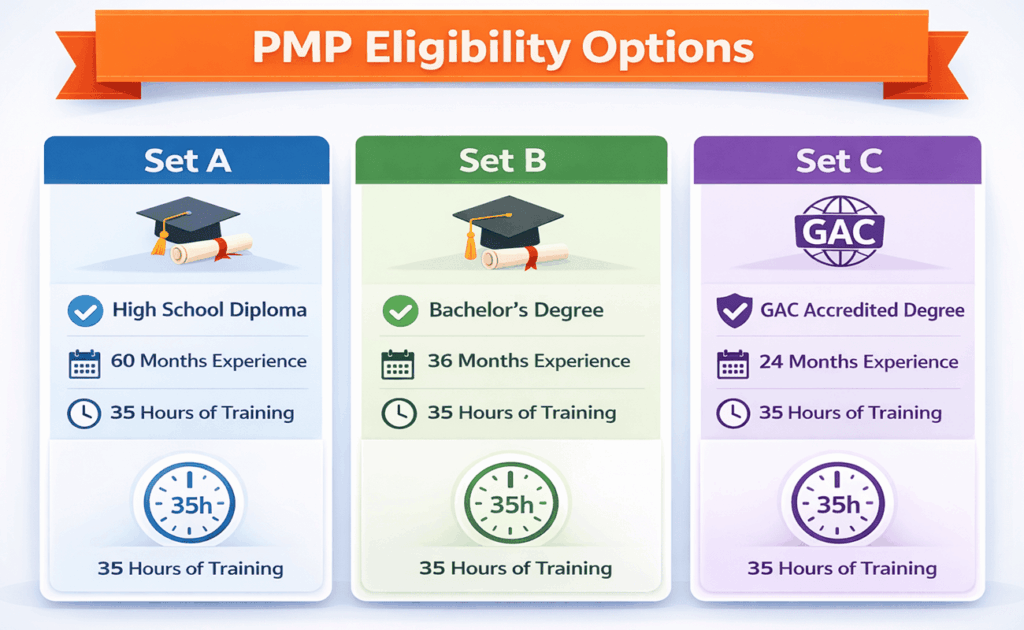
Choose the one that matches your highest level of education.
Path A – High School Diploma or Equivalent
If you hold a high school diploma or a GED, you need at least 60 months (five years) of project leadership experience. Your work must be from the past eight years. You also need 35 hours of project management training. Take a CAPM class or an authorized PMP prep course to satisfy this rule. Focus on projects where you planned, guided, or delivered a new product, service, or process. Routine office tasks don’t count. Does your job include many of these simple tasks?
Path B – Bachelor’s Degree or Higher
If you have a four-year degree, you need only 36 months (three years) of project leadership within the past eight years. You still need 35 hours of formal training. Recent graduates can count internships, capstone projects, or early job roles as long as they involve creating something new. When describing your work, emphasize the decisions you made. Highlight problems you solved and people you managed. Can you think of examples from your own work?
Path C – GAC-Accredited Degree Programs
If you graduated from a program accredited by PMI’s Global Accreditation Center (GAC), the bar is even lower. You need 24 months (2 years) of project leadership experience and 35 hours of training. Many GAC programs already include project management courses. Ask your department to confirm whether your coursework meets the education requirement.
What Counts as Project Leadership Work?
PMI cares about what you did, not your job title. You qualify if you worked to create something new. Launching a marketing campaign counts. Developing a mobile app counts. Building a bridge or installing solar panels counts. Routine tasks like answering support calls don’t. Ask yourself: Did I lead a unique effort with a clear start and finish? If yes, it likely counts. For example, an HR manager planned an employee wellness program. It counted toward her hours because she planned the schedule, managed vendors, and rolled out a new process. These examples show how diverse project work can be.
Non-Overlapping Experience Explained
PMI needs a unique, non-overlapping work history. You cannot count the same months twice, even when you juggle two projects.
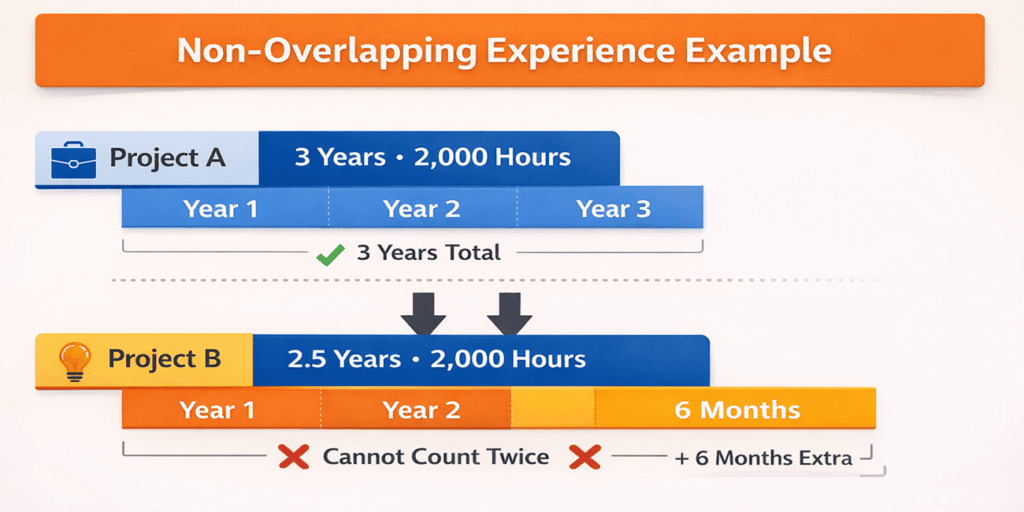
Suppose you spent two years running Projects A and B simultaneously. You may log 5,000 hours, but PMI counts the duration only once. You still need three years of unique leadership to meet Path B. Consider this example. Project A runs for three years (3,000 hours). Project B runs for 2.5 years (2,000 hours) and overlaps with Project A. Only the six extra months after Project A ends extend your total time.
Understanding the Contact Hour Requirement
In addition to project work, PMI requires 35 hours of formal training for each path. This training teaches you the terms, tools, and best practices in the PMBOK Guide. Do you enjoy learning new tools and techniques? You can take exam prep courses, university classes, or even the CAPM certification to meet this rule. Look for providers approved by PMI’s Authorized Training Partner program. At Project Management Academy, our boot camps provide the required hours and prepare you for the test. Your hours never expire. Complete them early.
Demonstrating Work Across the Process Groups
Your project history must cover all five process groups: Initiating, Planning, Executing, Monitoring and Controlling, and Closing. PMI does not set a minimum number of hours for each group. You only need to show that you participated in every group at some point in your career. For instance, when launching a new product, you might lead a kickoff meeting. That is Initiating. You might plan the timeline and budget. That is Planning. You might oversee development. That is Executing. You might track progress. That is Monitoring and Controlling. You might conduct a review after launch. That is Closing. Keep notes on your duties for each project to fill out the application form accurately.
How to Document Your Work History
PMI’s online form asks for each project’s start and end dates. It also asks for your role, your company, and a short description of your tasks. Focus on actions you led. Write plain statements like “Led a team to install a new CRM system.” Write statements like “Managed risk and budget for a hospital project.” Avoid jargon. Stress results. You will need the name and contact details of a supervisor or colleague to verify your story. PMI audits about five percent of applications. If audited, you must send a copy of your degree. You must also send proof of your 35 hours of training and a signed statement of your work. Having these documents ready will save time if you are selected. Do you have these documents ready?
Tips to Strengthen Your PMP Application
Preparing the application can feel daunting. These simple strategies can help you succeed:
- Track your projects early. Keep a simple notebook. Write each project’s dates, goals, and your role. Update it often so you don’t forget details. This helps you recall details when you apply.
- Use PMI’s language. Learn terms from the PMBOK Guide. Use words like scope, risk, schedule, and stakeholder in your descriptions. Doing this shows you understand standard practices. It also makes it easier for PMI reviewers. It helps them follow your story.
- Diversify your experience. Volunteer for different kinds of projects. Lead a software rollout. Then lead a community event. These varied examples help you cover all process groups. Can you think of two projects you have led?
- Ask mentors for feedback. Show your application draft to a PMP holder or instructor. They can spot gaps. They can suggest clearer wording. Why not use their insight?
- Be honest. PMI values integrity. Misrepresenting your work can lead to losing the certificate. It can harm your reputation. Is it worth the risk?
Which tip will you try first?
What if You Do Not Qualify for the PMP Certification Yet?
Maybe you are early in your career or don’t meet the work rule. That is okay. PMI offers the Certified Associate in Project Management (CAPM), an entry-level certificate for newcomers. CAPM requires only 23 hours of training and no project leadership experience. Earning a CAPM shows that you take project management seriously and gives you a foundation for the PMP later. To build hours, look for chances to lead small initiatives at work. Or volunteer in your community. Working with experienced managers can help you gain skills. It also helps you gather the necessary months of project work. Have you considered asking a mentor for help?
FAQs
Q1. How recent must my project work be?
All work used for your application must be from the past 8 years. Projects older than that don’t count.
Q2. Do internal process improvement efforts qualify?
Yes. If you led a structured effort to improve a business process with defined goals and deadlines, it counts as project leadership.
Q3. Can I count part-time projects?
Yes, but you must meet the total months and hours required. Part-time work spread over five years may satisfy the time requirement under Path A.
Q4. What happens if I am selected for an audit?
You must provide copies of your diploma, proof of your 35 hours of training, and a signed verification of your project work. Preparing these documents in advance makes the process smoother.
Taking the Next Step
Once you confirm that you meet the requirements, the next steps are simple. First, complete the PMI application and pay the exam fee. Then study and schedule your test. PMI’s exam outline lists the topics you will see on the exam. Good training courses offer practice tests and review sessions to build confidence. Focus on understanding ideas rather than memorizing facts. If you need help, Project Management Academy offers courses and coaching. We can guide you through every step.
Summary
Earning the PMP certificate can open doors to higher pay and more rewarding roles. The key is to ensure that your education, work history, and training meet PMI’s current rules. Document your projects carefully. Gain experience across all process groups. Prepare for audits. Doing these things sets you up for success. Whether you qualify today or need more hours, the journey will make you a stronger leader. Ready to take the next step?

I am Mohammad Fahad Usmani, B.E. PMP, PMI-RMP. I have been blogging on project management topics since 2011. To date, thousands of professionals have passed the PMP exam using my resources.